
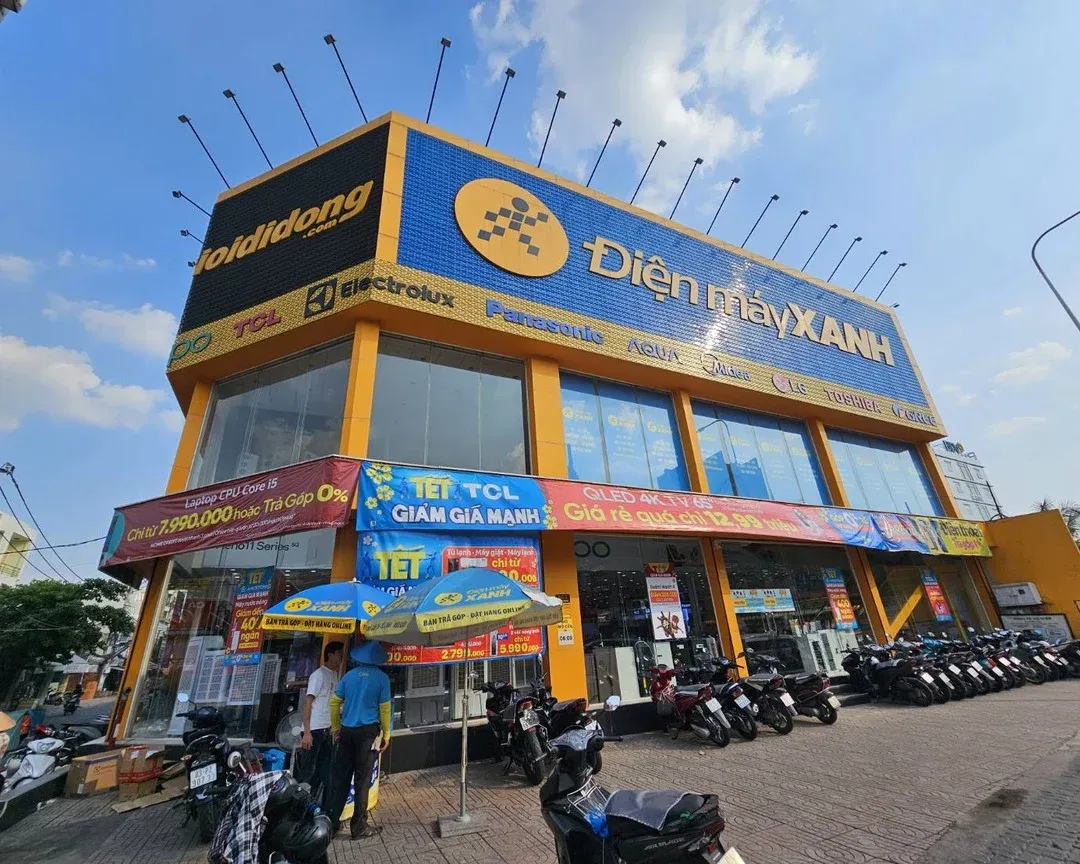

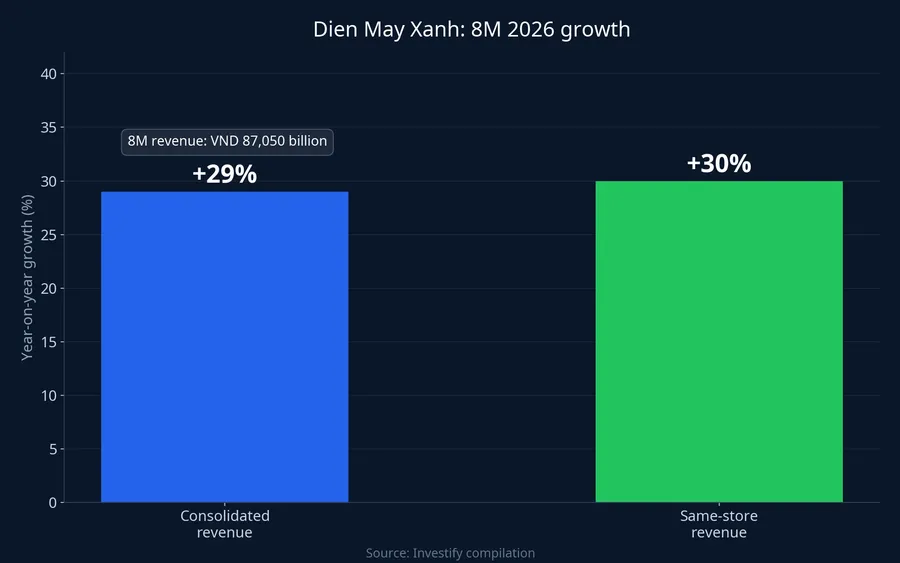
Dien May Xanh's consolidated revenue for the first eight months of 2026 rose 29%, while same-store revenue rose 30%. The two figures are almost identical, and that is the context for the chain's latest news. On the morning of October 5, Mr. Doan Van Hieu Em, Executive Board Member and General Director of Dien May Xanh Investment JSC (HoSE: DMX), wrote on his personal page that the company expects to open no new stores. Instead, the chain will roll out a technology experience concept called House of Future and add an AI and robotics category.Znews
Also on October 5, Dien May Xanh published a filing on Mr. Hieu Em's own trades: he bought another 732,000 DMX shares, completing a plan to buy 1 million shares in total.DNSE This piece covers both items, starting with the question that matters most to shareholders: once a chain stops adding outlets, what measures its growth?
House of Future: named, but not yet quantified
According to Mr. Hieu Em, House of Future is a space showcasing technologies expected to become mainstream within 5 to 10 years, or even later. Visitors can see and try household robots, AI that recognizes family habits, smart bedrooms that track sleep, and health-care devices. He described it as the next step after nearly two decades of selling products for families' current needs.Znews
What has not been disclosed matters just as much. Vietstock notes that the company has not given a business model, product list or official rollout timeline.Vietstock MarketTimes likewise reports that neither the opening date nor the location of House of Future has been set.MarketTimes In other words, AI and robotics is for now a named direction with no revenue figure to measure. Vietstock also suggests that the "no new stores" message implies the category will sit inside existing outlets rather than in a separate network. That detail is worth keeping, because it ties the new category to the chain's bigger problem.
Eight-month numbers: growth came from existing stores
The planned shift is not a sudden turn. Looking at the numbers, the chain has been growing this way since the start of the year. Consolidated revenue for the first eight months of 2026 reached VND 87,050 billion, up 29% year on year. Over the same period, same-store revenue rose 30%.Người Quan Sát With the two growth rates this close, it is reasonable to infer that the added revenue came mainly from stores opened earlier, with new outlets contributing little.
In August alone, revenue came to VND 11,576 billion, up 28% year on year and 14% month on month, the second-highest monthly figure of the year after the Tet month. Cumulative revenue for eight months has reached 71% of the full-year plan.Znews
The network behind these figures is approximately 2,002 Dien May Xanh stores nationwide as of end-August.Người Quan Sát Note that DMX's revenue also includes the Thế Giới Di Động and TopZone chains and EraBlue in Indonesia, so 2,002 covers only the Dien May Xanh-branded network. EraBlue is where the company is still expanding: it has passed 300 stores, and Mr. Hieu Em calls it "the second Dien May Xanh."Znews The "no new stores" message should therefore be read as applying to the domestic network, not the whole ecosystem.
How each store can still sell more
With the store count flat, a retailer's revenue can grow in only three ways: more categories on the same floor space, pricier items for the same footfall, or extra services for customers already at the counter. Dien May Xanh is pursuing all three. AI and robotics is the newest category, with high value per order but still very new to Vietnamese buyers.
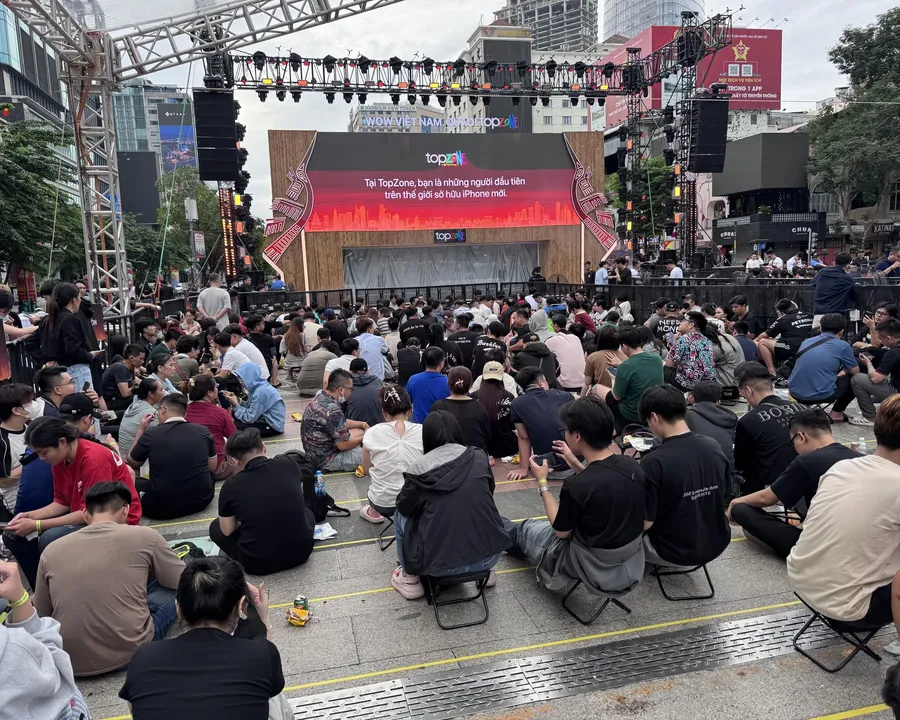
Product cycles are the second route. According to the company, roughly 80,000 iPhone 18 deposits were recorded within 24 hours of its order page opening, more than double the pre-orders for the previous year's model.Znews The iPhone season is a familiar driver of the final quarter.
The third route is in-store financial services. Dien May Xanh has partnered with VietCredit on a domestic credit card, and earlier signed a strategic partnership with digital bank Cake by VPBank for 2027 to 2029, aiming to lift total disbursement to billions of US dollars.Znews That figure needs careful reading: it is disbursement of loans and buy-now-pay-later within the ecosystem, not revenue Dien May Xanh books directly. Its role is to help customers afford pricier items at the counter, including high-ticket goods such as home robots.
The profit target has been raised
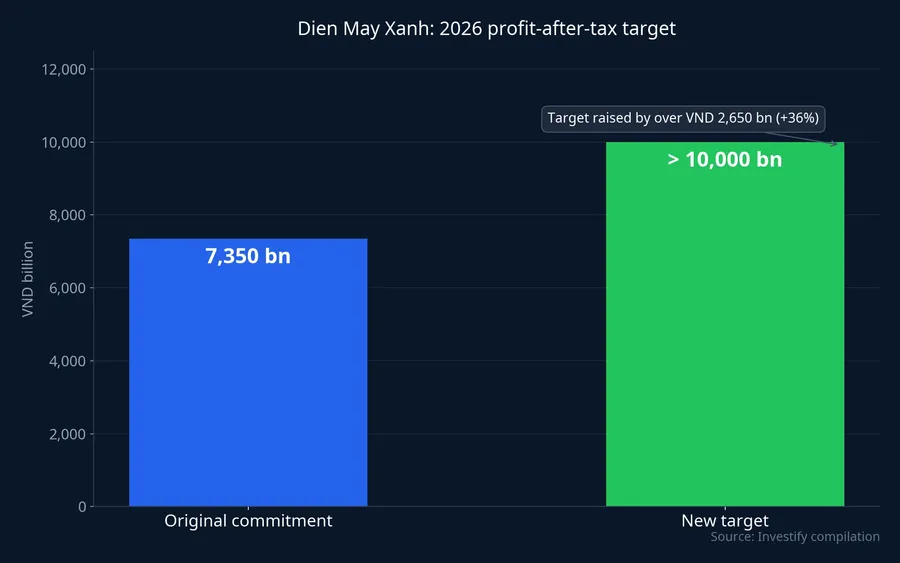
Dien May Xanh's management is aiming for 2026 profit after tax above VND 10,000 billion, well above the original commitment of VND 7,350 billion. The company also says it is confident that third-quarter results will exceed the average of the first two quarters.Znews This is a target stated by management, not a reported result, and Dien May Xanh has not yet published third-quarter profit.
The natural question for the coming report is where the extra profit comes from. For the 30% same-store growth, there are two explanations. One is a favorable product cycle, such as new phone launches lifting demand. The other is that the chain genuinely sells more per customer through categories and bundled services. The available data is not enough to split the contribution. What is certain is that the AI and robotics category was only announced on October 5, so it cannot be in the eight-month figures. If growth rests mainly on the product cycle, it will slow when the cycle fades. If it rests on how the chain sells, it will last longer.
The general director shifts shares from MWG to DMX
According to the trading report published on October 5, Mr. Hieu Em bought 732,000 DMX shares between September 10 and October 2 via order matching. His holding rose from 4.1 million to 4.83 million shares, or from 0.32% to 0.38% of Dien May Xanh's capital. This is the second tranche. In the first, he bought 268,000 shares on August 6, the day DMX listed on HoSE, and the two tranches together make up the 1 million shares in the registered plan.DNSE
In parallel, he sold 1 million MWG shares between September 7 and September 23, cutting his holding from 2.26 million to 1.26 million shares, or from 0.15% to 0.08% of Thế Giới Di Động's capital. Some outlets wrote that he sold all his MWG shares, but the trading report shows he still holds 1.26 million. The stated purpose is to restructure his portfolio toward DMX, with a long-term commitment to the company. Mr. Hieu Em is also an executive board member at MWG.DNSE
This is a fact about ownership, not a price signal. A 0.38% stake is a small slice of DMX's shareholder base. In the October 5 session DMX closed at VND 77,000 per share, for a market capitalization of about VND 97,600 billion. What the trade shows most clearly is that the person running the chain chose to tie his personal assets to Dien May Xanh's own results rather than to the wider group.
Risks and signals to watch
The biggest risk of the new direction is that household AI and robotics is still new to Vietnamese buyers. As Người Quan Sát notes, adoption speed still depends on price, usefulness and accessibility.Người Quan Sát An experience concept can draw customers into stores without necessarily turning into meaningful revenue within the next few quarters, and so far no figure shows how much the category contributes.
The second risk is that the yardstick itself has changed. Once the chain stops adding domestic outlets, every stall in same-store revenue shows up directly in total revenue, with no new stores to offset it.
The thesis here is clear: Dien May Xanh's growth this year has come mainly from its older stores, and the October 5 news only clarifies that direction. From here, the number to follow is same-store revenue rather than new store openings. When the company reports third-quarter results, set same-store revenue growth beside profit progress against the target of over VND 10,000 billion. If both hold pace, the new growth model is working. If same-store revenue slows clearly once the iPhone season passes, most of this year's gain came from the product cycle, and the AI and robotics category has more to prove.
One more date in October: on October 29, Dien May Xanh holds an extraordinary shareholders' meeting for 2026 to approve a cash dividend from 2026 undistributed profit and a private placement of bonds with warrants.DNSE