


On the evening of September 29, PNJ added two proposals to the materials for its extraordinary general meeting, scheduled for October 21. The first asks shareholders to approve a private placement of up to 550 million common shares to professional securities investors.Tin nhanh CK That is more than the roughly 511.7 million PNJ shares currently outstanding.CafeF The second asks to move more than VND 4,602 billion from the development investment fund into undistributed after-tax profit.
The headline number most readers will stop at is 51.8%, the share of the company new investors could hold if every share is sold. That is a ceiling, not a forecast. How much of PNJ its current holders actually keep hinges on a variable nobody knows yet: the offer price. This piece walks through how each proposal works, why price is the swing factor, and why the VND 4,602 billion is not a profit.
The proposals also give the first concrete answer to a question PNJ left open on September 25. At that point the company said it planned to raise up to VND 8,000 billion "through various forms" after revising its 2026 plan to a loss.VietTimes One of those forms now has a name: selling new shares to a hand-picked group of investors.
How a private placement differs from a rights issue
In a rights issue, existing shareholders can buy new shares in proportion to what they already own. Anyone who takes up their full allotment keeps the same percentage of the company. A private placement works differently. The new shares go only to professional investors chosen by the board, and current PNJ holders get no allocation.
If all 550 million shares are sold, PNJ's share count rises to about 1,061.7 million. New investors could then own roughly 51.8% of the company, leaving all existing shareholders combined with about 48.2%.CafeF Put simply, someone holding 1% of PNJ today would end up with about 0.48%, without selling a single share.
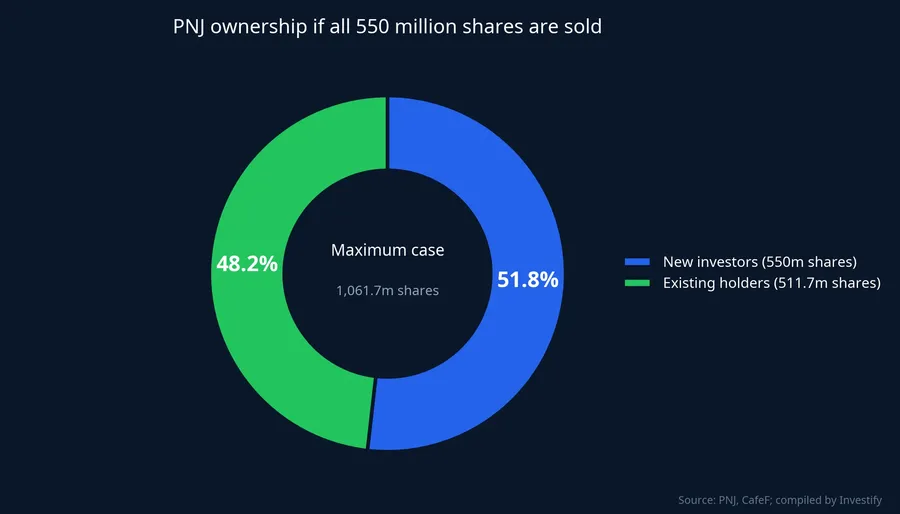
That is why CafeF noted that the deal, if fully placed, could reshape voting power and the composition of the board. For scale, the same report said the family of PNJ's Chairman of the Board holds about 11.36% of the shares in total, before a sale one family member has registered for October.CafeF A group that buys the full 550 million shares would hold several times that.
Buyers in the placement face a transfer restriction of at least one year after the offering closes.Tin nhanh CK Tin nhanh Chứng khoán puts the timeline at Q4 2026 to Q2 2027, while FireAnt lists Q3 2027 as the end date.FireAnt Either way, the offering window runs well into next year.
550 million is a cap; the price decides the real number
The words "up to" carry real weight here. The number of shares actually sold will be set by the board within the range shareholders approve, based on the offer price, capital needs and negotiations with investors.FireAnt The 51.8% is best read as an upper bound.
A quick calculation shows how wide the gap between ceiling and reality could be. Suppose PNJ raised the full VND 8,000 billion through this placement alone:
- At around VND 37,300, the 30-session average close through September 29, PNJ would need about 214 million shares. New investors would then own about 29.5% of the company.
- At around VND 26,300, it would need about 304 million shares, or roughly 37.3% after issuance.
- Only if the offer price fell to around VND 14,500 would VND 8,000 billion require all 550 million shares.
This is an illustration, not PNJ's plan. The proposal does not say the placement must cover the entire VND 8,000 billion, and the company may sell fewer shares or price them differently. What the math does show is an inverse relationship: the lower the offer price, the more ownership existing shareholders give up for the same amount of money raised.
The price floor has two anchors
Under the proposal, the offer price cannot be lower than PNJ's average closing price over the 30 consecutive sessions before the board approves the price.CafeF It also cannot be lower than book value per share in the latest audited or reviewed consolidated financial statements at the time of pricing. No fixed discount rate is specified.CafeF
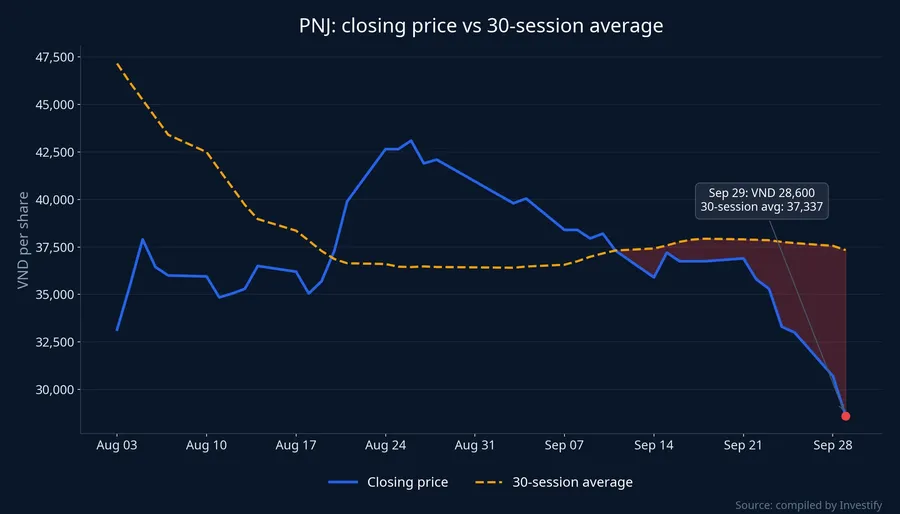
The first anchor is drifting lower. On September 29, PNJ hit its daily limit-down for a second straight session, closing at VND 28,600, its lowest level in about six years.Pháp luật By mid-morning on September 30, the stock was down 6.99% at VND 26,600. The 30-session average still sits above the market price because it includes late-August sessions above VND 40,000. If the price stays low long enough, those older sessions roll out of the window and this anchor falls with them.
The second anchor depends on which financial statements the board uses. According to the reviewed half-year report, PNJ's equity stood at about VND 13,456 billion as of June 30, 2026.VietNamNet Divided by about 511.7 million shares, that gives a book value of roughly VND 26,300 per share.
That figure predates the loss in the revised plan, which targets an after-tax loss of VND 6,271 billion for 2026.VietTimes If that loss shows up in the audited 2026 accounts, equity would fall to about VND 7,185 billion, pulling book value down to around VND 14,000 per share. Audited annual reports usually come out in the first quarter of the following year, squarely inside the offering window.
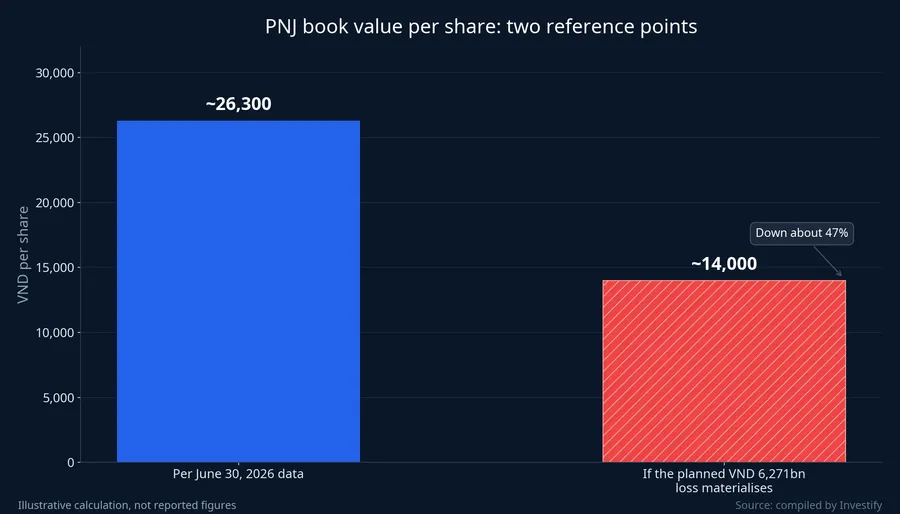
To be clear, this calculation is based on the planned loss. Press coverage has pointed out that a projected accounting loss does not mean all of that money is lost at once, and the actual figure may differ.VietNamNet The mechanism, though, is clear. The floor is the higher of the two anchors, and both tend to move down if current conditions persist.
The VND 4,602 billion is a reshuffle within equity
Headlines about "reversing more than VND 4,600 billion into profit" can easily suggest PNJ just booked a gain. It did not.
The development investment fund is a line item within equity, built up from prior years' profits that shareholders voted to set aside. Undistributed after-tax profit sits in equity too. Moving money between them is like shifting cash from one compartment of a wallet to another: no new revenue, and nothing passes through the income statement. PNJ itself said the transfer does not change total equity, so book value per share is unchanged as well.Tin nhanh CK
The stated rationale is a single line: to increase flexibility in managing and using equity.VietTimes Lining up the numbers suggests where that flexibility might matter. As of June 30, 2026, consolidated undistributed after-tax profit was about VND 2,944 billion. Subtract a VND 6,271 billion loss and the line turns negative by about VND 3,327 billion, meaning the company would carry accumulated losses on its books. Add the VND 4,602 billion-plus from the fund and it stays positive at around VND 1,275 billion.
That arithmetic is only one reading. PNJ has not said the proposal is meant to avoid accumulated losses, and other explanations are plausible: preserving the ability to pay dividends once the business recovers, or tidying up equity accounts before bringing in new shareholders. Some outlets cite the fund balance from the parent-company statements and others from the consolidated ones, so the figures above are estimates. What is certain is that this proposal does not put a single extra dong into PNJ.
Where the money would go
Under the plan, 60% of the proceeds would fund the business plan tied to the revised buy-back policy for previously sold goods and the volume of merchandise PNJ expects to repurchase. The remaining 40% is split evenly between working capital and working capital or repaying short-term debt.Tin nhanh CK
Disbursement is planned from 2027 through Q2 2028, and in the meantime PNJ may park the cash in term deposits at credit institutions. In other words, most of the new shareholders' money would flow into the very thing generating the loss: the obligation to buy back goods already sold to customers.
The milestones that will set the final ownership split
Nobody knows yet who the investors are, what the offer price will be or how many shares will actually be sold. The answers will arrive in this order:
- October 21: The extraordinary general meeting votes on both proposals. If they fail, the fundraising plan goes back to the drawing board.
- Filing with the State Securities Commission: the offering can only begin once the filing is confirmed as complete.FireAnt
- Board resolution on price and investor list: this document will reveal the offer price, which financial statements the book-value anchor comes from, and who the new shareholders are.
- Offering results report: the number of shares actually sold is what determines how much of PNJ existing holders retain.
The numbers point to a clear conclusion. Dilution is not locked in at 51.8%. It gets locked in at the third milestone, when the offer price is revealed. A price near the 30-session average means fewer shares for the same amount of money. A price that falls back to the book value of a balance sheet already carrying the loss would make the 550 million cap far less hypothetical.