


Your phone rings and a broker is on the line. They are offering a batch of corporate bonds that pays more than a bank deposit, runs for a few years, and comes with the familiar reassurance: "it's secured, nothing to worry about." If that call sounds familiar, one extra step now stands between you and the transfer. From Thursday, October 1, individual buyers must sign a statement confirming they have read the offering documents, understand the risks and accept responsibility for their own decision.
This post is not about whether you should buy corporate bonds. The aim is narrower: to help you answer three questions for yourself. Are you allowed to buy? Does the bond you are being offered meet the new rules? And what does your brokerage owe you?

Where the new rule comes from
The change sits in Circular 138/2026/TT-BTC, issued by the Minister of Finance to guide Decree 200/2026/ND-CP on the offering and trading of privately placed corporate bonds. The circular takes effect on October 1, 2026, replacing Circulars 30/2023/TT-BTC and 76/2024/TT-BTC.Báo Chính phủ Decree 200 itself has been in force since June 5, 2026, superseding Decrees 153/2020, 65/2022 and 08/2023.Thời báo Tài chính
Think of it this way: the decree sets the rules of the game, and the circular spells out each step, from opening an account to placing the order and settling the trade.
Why the sales calls keep coming
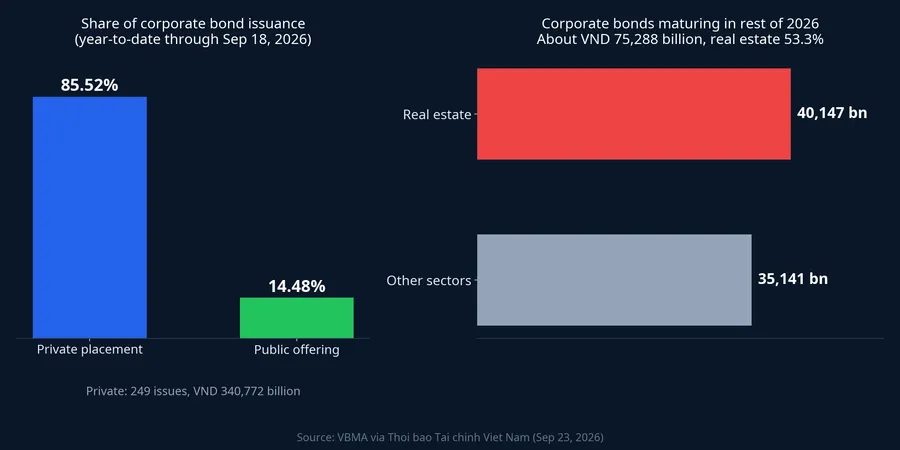
Private placements remain the main way Vietnamese companies raise bond money. According to the Vietnam Bond Market Association (VBMA), there were 249 private issues worth VND 340,772 billion from the start of the year to September 18, or 85.52% of all corporate bond issuance.Thời báo Tài chính Banks accounted for 51.1% of issuance by value and real estate for 40%.CafeF
The coupons are tempting too. Corporate bonds yield about 9.5% a year on average, and real estate issuers pay about 10.5%.VnEconomy Put simply, the extra yield over a savings account is compensation for two risks: that the issuer cannot repay, and that you cannot easily sell before maturity.
Repayment pressure is also bunching up toward year-end. About VND 75,288 billion of corporate bonds mature over the rest of 2026, of which real estate accounts for VND 40,147 billion, or 53.3%.Thời báo Tài chính Anyone who lived through 2022 knows why those numbers should be read alongside the terms of each individual bond, not just its coupon.
Are you eligible to buy
Private placement bonds are not open to every retail investor. An individual buyer must be a professional securities investor. If you do not meet that bar, you are not eligible, whatever the seller tells you.
The test most individuals run into is portfolio size. Under Article 9(2)(b) of Decree 200, the listed and registered securities you hold must be worth at least VND 2 billion, measured as the daily average market value over at least 180 consecutive days. Margin borrowing and securities tied up in repurchase agreements do not count.Tạp chí Luật sư Việt Nam
In practice, borrowing to push your account above VND 2 billion for a few weeks does not qualify you. The portfolio has to hold that level on its own for roughly half a year.
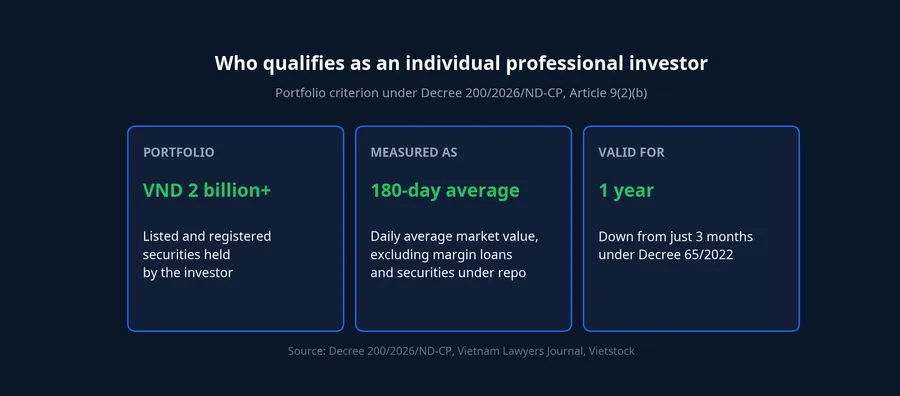
Once confirmed, professional status is valid for one year.Tạp chí Luật sư Việt Nam Under the old Decree 65/2022, the confirmation lasted only three months.Vietstock So the paperwork for buyers got lighter, while the requirements on the bonds themselves got tighter.
From October 1, under Circular 138, whoever is responsible for vetting investors must confirm that you qualify before the order is entered into the system. Before buying, you must sign a statement that you have accessed the information, understand the risks and take responsibility for the decision. The requirement applies both when buying at issuance and when buying from another holder.Tạp chí Luật sư Việt Nam
The decree also states plainly that the State does not guarantee that issuers will pay principal and interest in full and on time. Your signature is therefore not a formality. It is an acknowledgment that the risk is yours.
Is this a bond individuals are allowed to buy
This is the biggest change. Decree 65/2022 let qualified individuals buy any private placement bond; Decree 200 narrows that.Vietstock For most offerings, individuals may only buy when the bond meets two conditions at once. First, it has a credit rating. Second, it is backed by collateral or a payment guarantee from a credit institution sufficient to repay the entire principal.Thị trường Tài chính Tiền tệ
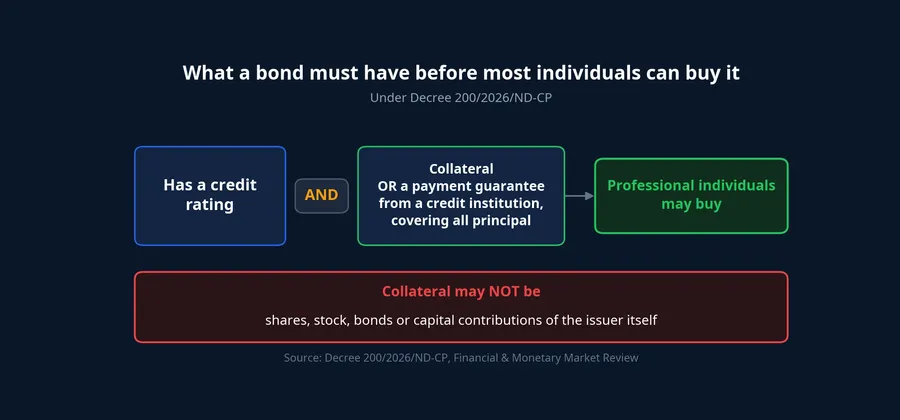
The collateral is restricted as well. It cannot be shares, stock, bonds or capital contributions of the issuer itself. Ms. Hoàng Việt Phương, CEO of S&I Ratings (S&I Credit Rating JSC), explained that when a company runs into trouble, its own share price usually falls in step with it, often faster than its ability to repay shrinks.Thời báo Tài chính It is a bit like insuring a house against fire with a policy written on the same house. That kind of collateral stops working exactly when you need it.
There is a narrow exception for certain bonds issued by public companies, securities firms and fund managers. Press summaries of this group do not fully agree, so if you are offered bonds from these issuers, ask the brokerage to point to the exact clause of Decree 200 that applies.
If you are buying from an existing holder, note one more thing. According to Ms. Phương, Decree 200 includes a transition clause allowing bonds issued earlier with the old types of collateral to keep them until maturity. An older bond may therefore still be secured by the issuer's own shares.
What shape is the issuer in
Decree 200 also tightens requirements on issuers. Total liabilities, including the planned bond issue, may not exceed five times equity, based on audited annual financial statements rather than semi-annual or quarterly reports.Thị trường Tài chính Tiền tệ
There are exemptions, though. State-owned enterprises, credit institutions, insurers and companies issuing bonds to fund real estate projects are excluded. For buyers of real estate bonds, the five-times-equity cap is no safety net. The collateral and the credit rating are what deserve a close read.
The purpose of the issue must be specific: an investment project, restructuring the issuer's own debt, or another purpose permitted by sector law. The proceeds must be tracked separately. To change the bond's terms or its stated purpose, the issuer needs approval from holders of at least 65% of the outstanding bonds of that type, and must buy back early the bonds of anyone who objects.Cổng Thông tin Chính phủ In other words, if you do not agree to a longer term or a lower coupon, you have the right to be paid out rather than being dragged along by the majority.
What your brokerage owes you
Circular 138 standardizes how a trade moves. You need a securities trading account with a trading member; if you already have a regular stock account there, it can be used. Trades are negotiated deals on the private placement bond trading system of the Hanoi Stock Exchange (HNX). Brokerages must execute client orders ahead of their own proprietary orders, at the price the client asked for or better.Báo Chính phủ
You must be notified of the result right after execution and receive monthly statements for your cash and bond accounts. The Vietnam Securities Depository and Clearing Corporation (VSDC) settles each trade the same day, delivering bonds and cash simultaneously. If a trade fails to settle because of an error by a trading or depository member, the party at fault is liable for your losses.FireAnt

On disclosure, issuers must send their pre-offering information to HNX at least one business day before the planned offering date, for publication on the corporate bond information portal. While bonds are outstanding, issuers must report every six months and annually, and disclose unusual events within 24 hours.FireAnt That gives you an official place to cross-check, instead of relying on documents sent over a chat app.
Questions to ask before you sign
Based on these rules, when you are offered a private placement bond, you can ask the seller to answer the following in writing:
- Have I been confirmed as a professional investor, and until when is it valid? If your portfolio has not averaged VND 2 billion over 180 days and you are still being pitched, something is wrong from the start.
- Who rated this bond, and what was the rating? Without a rating, individuals cannot buy most offerings.
- What is the collateral, who valued it, and does it cover the full principal? If it is a payment guarantee, which bank is providing it?
- What is the stated purpose of the issue, and what is the debt-to-equity ratio in the audited annual statements?
- Is this bond code listed on the HNX portal, and does the filing match the documents in front of me?
- If I need to sell early, who buys? A promise that "the company will buy it back" should be written into the contract, with conditions and a price.
If you do not qualify as a professional investor, you can still get bond exposure through publicly offered corporate bonds, government bonds or open-ended bond funds. Each carries different yields and levels of safety, but none requires you to shoulder the risk of a single private placement on your own.
The new rules do not make private placement bonds safe. They push the duty to check onto both sides: the brokerage must verify the buyer before entering the order, and the buyer must sign that they understand. That signature only protects you if you have actually read the documents before putting pen to paper.