

If you hold SHS, PVS or CEO, a change is coming to your account even though nothing about the companies themselves is changing. Right now these stocks can rise or fall up to 10% in a single session. Once they move to HoSE, that limit shrinks to 7%. The gap sounds small, but for anyone trading on margin it changes how fast gains and losses build up.
Take SHS. It closed at VND 13,700 on September 25. On HNX, the next session's ceiling is around VND 15,000. If SHS were already on HoSE, the ceiling would be about VND 14,650. This guide covers what actually changes, what doesn't, and what to check before the December 31 deadline.
Why Hanoi-listed stocks have to move
Put simply, Vietnam's stock market is being reorganized so that each exchange has one job. Under Circular 139/2025/TT-BTC, every stock listed on the Hanoi Stock Exchange (HNX) must transfer to the Ho Chi Minh City Stock Exchange (HoSE) no later than December 31, 2026. The deadline was already pushed back a year from the original roadmap because system and staffing limits meant the handover couldn't be finished in 2025.CafeF
Once the move is complete, HoSE will be the only venue for listed stocks, fund certificates and covered warrants. HNX will focus on bonds, derivatives, the UPCoM market and newer segments such as carbon credits.Thời báo Ngân hàng Think of two shops with the same owner consolidating one product line into a single store.
It's a big move. As of September 24, HNX still had 299 listed companies with nearly 19.7 billion shares and a market capitalization of about VND 470,000 billion. Four companies worth more than USD 1 billion each, namely KSF (Sunshine), THD (Thaiholdings), NVB (National Citizen Bank) and KSV (TKV Minerals), together account for about 41% of the exchange's market cap.CafeF Many retail favorites are on the list too, including PVS, SHS, MBS, CEO, HUT and VCS.
As of late September, there is still no official schedule for individual batches or tickers. PVS told its shareholder meeting that it expects to move to HoSE in the fourth quarter if the market reorganization stays on track, and is considering a voluntary transfer if the overall process keeps slipping.CafeF
Narrower price limits: the one certain change
The daily price limit is the band a stock is allowed to move within in one session, measured from its reference price. HNX uses ±10%. HoSE uses ±7%.Thời báo Ngân hàng When your stock moves to HoSE, the band loses 3 percentage points in each direction.
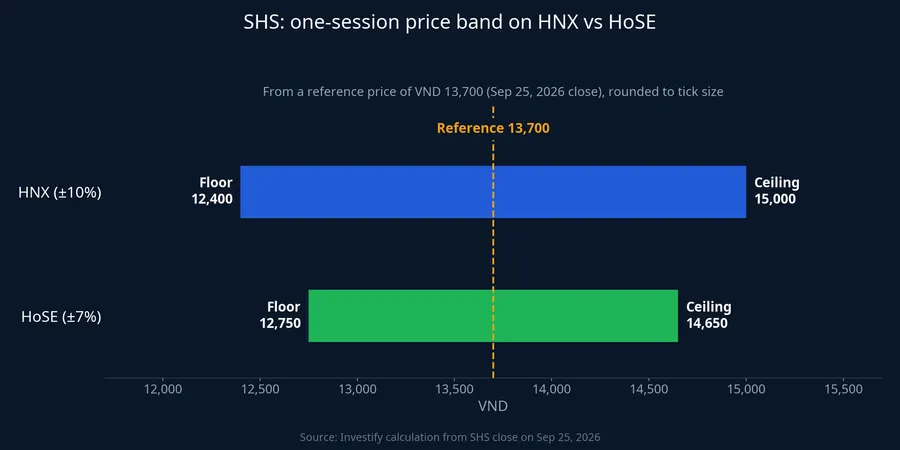
This cuts both ways. The upside is that each limit-down session takes less off the price: three straight limit-down days on HNX would cut the price by about 27%, versus about 19.6% on HoSE. The downside is that when the same piece of news hits, a HoSE stock needs more sessions to reach the level an HNX stock might reach in one. Volatile names will hit their limits more often. When sell orders pile up at the floor for several days in a row, leveraged traders may stay stuck for longer before they can get out.
HSC Securities has laid out a scenario in which HoSE widens its limits at some point.Thời báo Ngân hàng That is one brokerage's forecast, not a regulator's proposal. The 7% rule is the one in force today.
The first session on HoSE is the big unknown
The everyday limit is settled, but nobody yet knows what the first session after the transfer will look like. HoSE currently allows ±20% on the first trading day of a newly listed stock, including stocks that voluntarily move over from HNX. No announcement has been made on the first-day limit for stocks transferring under Circular 139.CafeF
The closest precedent is SHB. The bank's first HoSE session, on October 11, 2021, used its last HNX close as the reference price and a ±7% limit, not ±20%.CafeF If regulators follow that approach, transfer day will look like any other session. If they apply the new-listing rule, that session could swing almost three times as far as a normal day.
The trading day runs differently too
Beyond price limits, the two exchanges open and close the day differently. HNX has no opening auction: orders placed at 9:00 start matching continuously right away.DSC HoSE opens with an auction that pools all orders to set a single opening price. HNX also has a post-close session where you can trade at the closing price. HoSE has none.
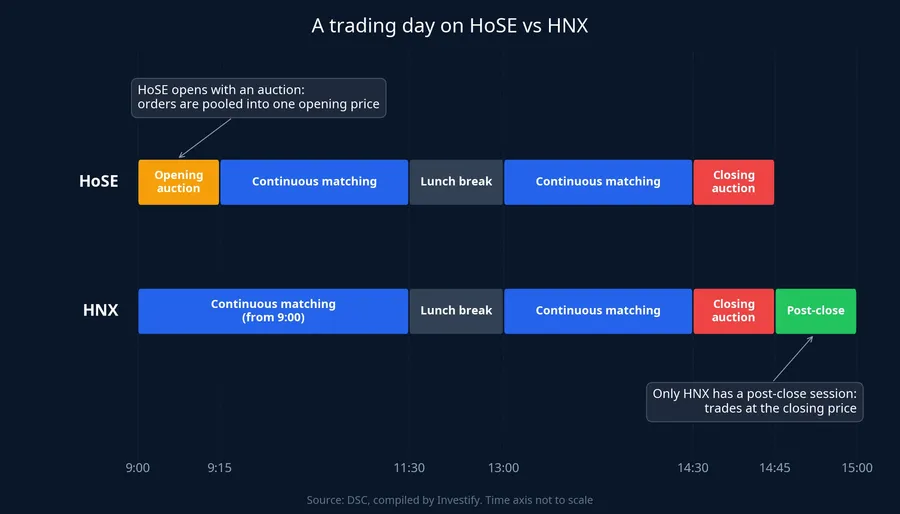
This affects your habits more than your returns. If you're used to placing orders early to catch the opening price, or to using the post-close session to offload leftover shares, you'll need a new routine. Other rules such as tick size and lot size should be checked against the regulations in force on transfer day, since there's no official public comparison yet for transferring stocks.
Will switching exchanges push prices up?
This is the question most investors care about. The idea that stocks moving to HoSE will attract more money does have some basis in liquidity. According to KAFI Securities, average trading value on HNX is only about 5% of HoSE's.Thời báo Ngân hàng
But being easier to trade isn't the same as being worth more. A change of exchange doesn't change a company's revenue, profit or debt. Nor does the data show the market betting on the deadline. The HNX30 index, which tracks the largest Hanoi-listed stocks, closed at 441.41 on September 25. That is down 17.98% from 538.15 at the end of 2025.
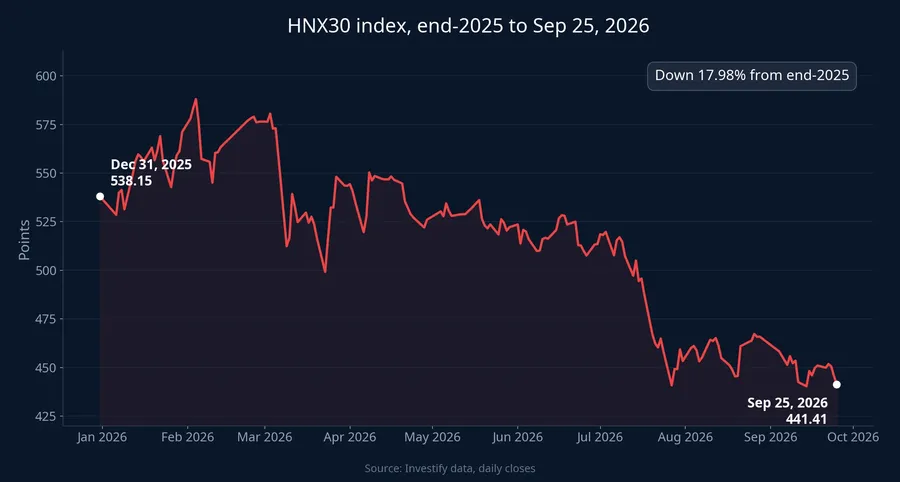
That decline has several causes, including weaker earnings at brokerages and property developers and lower valuations across the market, so it can't be read as a reaction to the transfer. It does show one thing, though. Even with the deadline known for most of the year, HNX's biggest stocks have kept trading on their own earnings stories.
Index inclusion needs the same caution. Moving to HoSE only makes a stock eligible for baskets such as the VN30 or the indices ETFs track. Each has its own criteria for market cap, liquidity and free float. A large but thinly traded stock will still struggle to get in.
As for the HNX30 itself, there's been no official word on whether it will be discontinued, rebalanced or left as is once its members leave. Investify's ETF data shows no fund using the HNX-Index or HNX30 as its benchmark, so the risk of forced index-driven selling looks low. The bigger risk sits with smaller companies. KAFI's analysts note that HNX companies must meet HoSE's stricter listing requirements and that regulators need a plan for those that fall short.Thời báo Ngân hàng No such plan has been published.
What to do in the next three months
Things investors may want to consider:
- List the HNX stocks in your portfolio. Plenty of investors hold Hanoi-listed shares without noticing which exchange they trade on.
- Watch HNX and HoSE announcements for each ticker. They will give the last trading day on HNX, the first trading day on HoSE and the first-session price limit.
- Ask your broker about margin. Check whether your stock stays on the margin-eligible list at the same loan ratio after the transfer, and how pending orders will be handled on transfer day.
- Rework your loss tolerance using the 7% limit. If you're leveraged in volatile names like SHS or CEO, work out how many straight limit-down sessions on HoSE it would take to trigger a margin call, instead of relying on the familiar 10% math.
- Separate the transfer story from the business story. When you read that a stock "benefits from moving to HoSE", check whether the argument rests on liquidity or on earnings.
The takeaway
Changing exchanges changes the rules of the game, not the quality of the company. The drop in the daily limit from 10% to 7% is certain, and it matters most to margin traders. Better liquidity is a reasonable expectation, but there's no evidence prices will rise simply because of the move.
The signal to watch in the fourth quarter is the announcement on first-session price limits. If regulators follow the SHB precedent of ±7%, transfer day should pass quietly. If they apply the ±20% new-listing limit, holders of volatile stocks such as SHS and CEO should prepare for a much wider swing than usual.