


On September 24, US time, Oracle sent a force majeure notice to Stack Infrastructure, the developer behind the Project Jupiter data center campus in New Mexico. Stack is owned by Blue Owl Capital. Bloomberg broke the story, and Reuters and TechCrunch followed.TechCrunch
Force majeure usually reads as an escape hatch: one party cites an event beyond its control to be excused from its obligations. The lease terms Reuters described point somewhere else. Oracle is not trying to walk away from the project, and under the contract it cannot. What it is asking for is to push back the date it starts paying a higher rent if the campus is not running by 2028. The heaviest obligation, the project's debt costs, stays with Oracle.Reuters
This piece works through three layers: why power became the bottleneck, how the lease allocates the risk of delay, and how the debt market moved before the stock market did.
How the stock reacted on September 24
The numbers first. Oracle shares fell more than 6% at one point in the morning session, to around $135.Yahoo Finance Selling eased later, and the stock closed at $139.54, down about 3.5% from the September 23 close of $144.56.Yahoo Finance That is a sharp one-day decline, not a collapse: over the prior two weeks the stock had already been swinging between roughly $140 and $150.
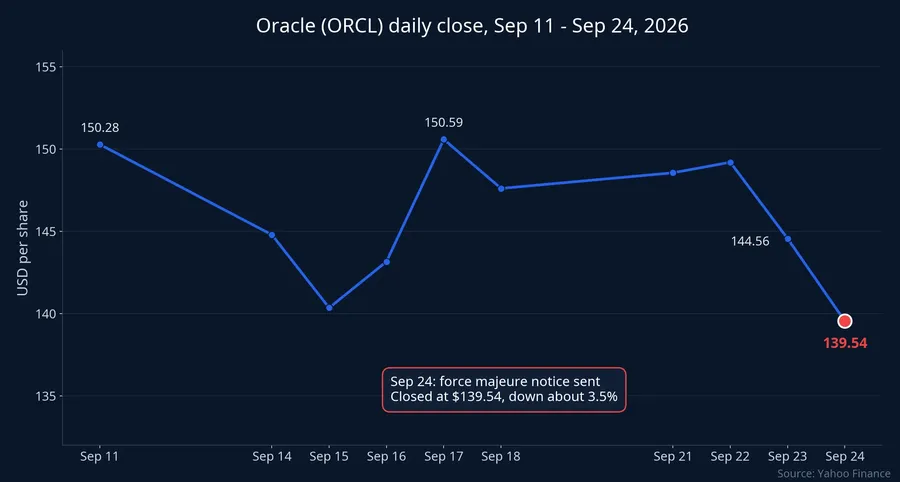
In a statement to CNBC, Oracle said Project Jupiter "remains on track."CNBC To see why investors sold anyway, you have to look beneath that reassurance, at the infrastructure and at the contract.
A data center that has to make its own power
Project Jupiter is designed for 2.45 gigawatts of capacity.TechCrunch The campus covers about 1,400 acres in Doña Ana County.Reuters It is one of the flagship sites of Stargate, the AI infrastructure program involving Oracle, OpenAI and SoftBank. Oracle is the anchor tenant and will use the site to supply computing capacity to OpenAI.

What matters is where the electricity comes from. The campus will not draw from the grid. It will generate power on site with a fleet of Bloom Energy fuel cells running on natural gas. That choice spares the project a long wait for a grid connection, but it hangs the whole schedule on two things: a gas pipeline and an air permit.
The Green Chile pipeline, developed by Energy Transfer subsidiary Transwestern, runs about 18 miles. The New Mexico State Land Office has twice refused to let it cross a stretch of state trust land just 0.6 miles long, on the grounds that the line would not benefit state land.El Paso Matters As a result, the pipeline's in-service date, originally planned for August 2026, has slipped nearly six months to February 1, 2027.TechCrunch

At the federal level, staff at the Federal Energy Regulatory Commission (FERC) have completed an environmental assessment and found no significant negative impact. That is not final approval, however, and the public comment period runs until October 5.El Paso Matters
The air permit for the fuel cells has not been issued either. The permit hearing was put on hold for several weeks by lawsuits that opponents filed with the state Supreme Court. The court has allowed the process to resume, but the state has yet to appoint a hearing officer or set a date. The New Mexico Environment Department faces a November 23 deadline to decide.TechCrunch
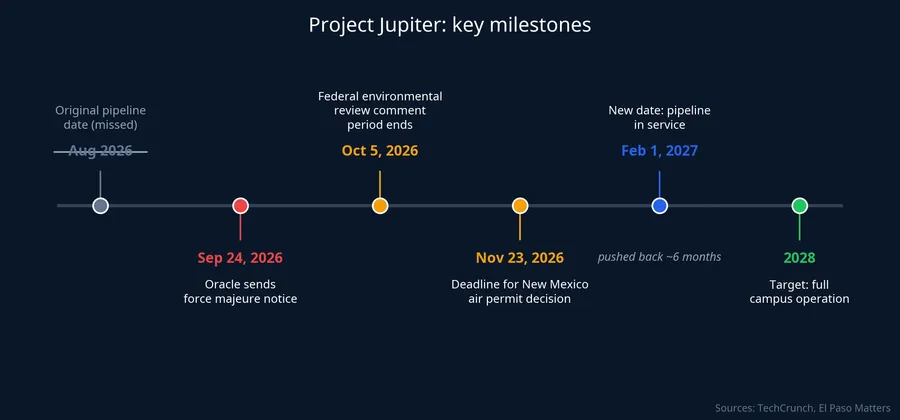
So the buildings and the tenant are in place. What is missing is the right to run a pipeline across less than a mile of land, and a signature from an environmental regulator. Headline figures on capital spending or compute capacity do not capture this kind of risk.
The lease puts the power risk on the tenant
The key question in reading the force majeure notice is who is responsible for supplying power. According to Reuters' source, the contract makes securing power for the campus Oracle's responsibility, not the infrastructure owner's.Reuters
The financial structure Reuters described looks like this:
- Blue Owl contributed about $3 billion of equity to the project.
- During development, Blue Owl earns a 9% return on that equity. Once the project is complete, its levered return is expected to rise to about 11%, in line with a higher rent.
- Oracle covers the project's debt costs and cannot terminate the lease under any circumstances.
By invoking force majeure, Oracle extends the period during which it pays the lower development-phase rent. Blue Owl still collects the higher rent for the full original term; the start date simply moves later. According to El Paso Matters, citing Bloomberg, Oracle could defer part of the rent for up to three years if both sides agree the force majeure event relates to the power commitment.El Paso Matters
Put simply, force majeure changes when Oracle starts paying the higher rent. It does not change the fact that Oracle carries the debt costs for as long as the campus has no power and therefore no revenue. Blue Owl also told CNBC that the notice does not alter the project's financial commitments.TechCrunch
Oracle offers a more measured reading. A company spokesperson said force majeure notices are common on projects of this scale, are typically used to preserve contractual rights between partners, and do not in themselves establish that a project is delayed.El Paso Matters That is a reasonable explanation, since sending notice early is how a party protects its rights before an event occurs. The structural lesson still holds, though. If the permit and the pipeline drag on, the tenant pays for the wait.
The debt market moved first
Six days before the force majeure notice, Reuters, citing the Financial Times, reported that the roughly $18 billion of loans tied to Project Jupiter were being quoted at 89 to 91 cents on the dollar by banks in the lending syndicate itself, including Santander and Jefferies. Efforts to sell the debt on to a wider pool of investors had stalled over concerns about Oracle's rising borrowing.Manila Times
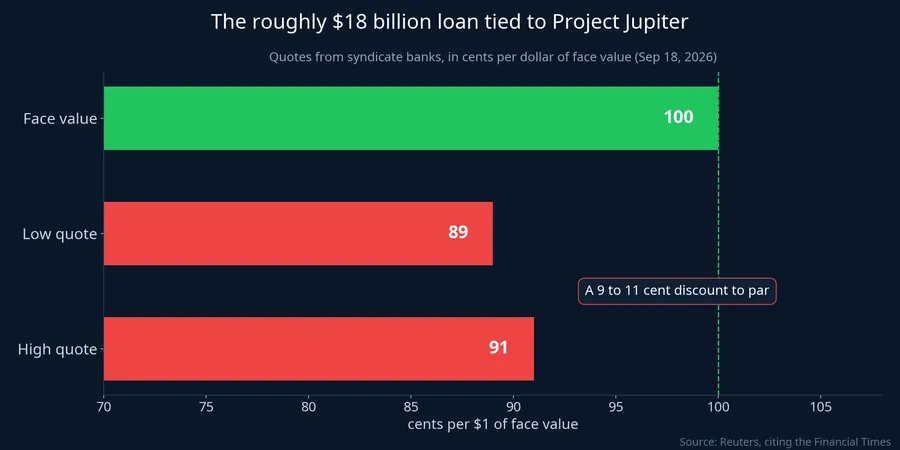
Healthy loans usually trade close to par. A discount of 9 to 11 cents is not a default signal. What it shows is that buyers of the debt want more compensation for taking on the schedule risk of a project tangled up in permits, a pipeline and local opposition.
The concern goes beyond one project. According to El Paso Matters, S&P Global Ratings cut Oracle in early July to the lowest rung of investment grade, saying it had underestimated the scale of Oracle's AI infrastructure spending. Oracle's capital spending this fiscal year is estimated at $90 billion to $95 billion, with free cash flow expected at negative $42 billion. S&P also estimates Oracle has about $260 billion of lease commitments, mostly data centers, due to begin in fiscal years 2027 through 2029.El Paso Matters
Taken together, these figures explain why a force majeure notice hit a nerve. The company carrying a lease book of that size is also the party that bears the power risk in the contract. Every delayed project stretches the period in which Oracle pays costs with no revenue to offset them.
Why the stock fell: several forces at once
The September 24 decline had a direct trigger in the force majeure news, which broke during the session and moved the stock as it spread. Still, it is hard to pin the entire drop on the notice alone. The worry was already there: the Jupiter loans had been marked down the week before, the credit rating had been cut in July, and free cash flow had turned negative on surging capital spending. The better reading is that the news confirmed an existing concern rather than creating a new one.
There is also a view that the near-term impact is small. Brokerage William Blair said Oracle's fiscal 2027 is largely unaffected, since Jupiter was not expected to contribute revenue this year.Reuters That is correct on revenue. What it leaves open is what happens to debt costs and leverage if the project slips by years, and that is exactly what the debt market is pricing.
Reading the signal as a Vietnamese investor
Many investors in Vietnam follow the AI boom through US tech stocks, ETFs, or local companies in the data center supply chain. Project Jupiter highlights a layer of risk that rarely shows up in headlines about chip orders: physical infrastructure and contract terms.
When news breaks about a new data center project, two questions are worth asking. First, does the power source already have its permits and fuel supply, or is it still on paper? Second, under the contract, who pays if the power arrives late? For Project Jupiter, the answers are "not yet" and "the tenant." That is why a notice framed as precautionary was still enough to push the stock down.
Balance matters here. Oracle says the project remains on track, and nothing so far shows that the 2028 target has slipped. This is a signal of schedule risk, not a verdict that the project has failed.
What to watch
The bottom line: force majeure does not move schedule risk off Oracle, and how large that risk turns out to be will be decided by permits, not by reassurances. The first date is October 5, when the comment period on the pipeline's federal environmental review closes. The more important one is November 23, the deadline for the New Mexico Environment Department to rule on the fuel cells' air permit.
If the permit arrives on time and the pipeline holds its February 1, 2027 date, a 2028 start remains achievable, and the force majeure notice most likely amounts to preserving rights. If the permit keeps slipping, each month of delay is another month in which Oracle pays debt costs on a data center that earns nothing.
Between those two dates, the secondary-market price of the roughly $18 billion loan is the earliest gauge. A move back toward par would mean lenders are less worried about the timeline. A slide below 89 cents would mean they are pricing in a longer delay.