


Picture every piece of jewelry PNJ has ever sold lined up in rows of ten. The 2026 business plan PNJ has just put to shareholders assumes that in each of those rows, eight pieces will be brought back to the counter, either to be sold back or swapped for something else. According to documents released on the afternoon of September 25, that assumption translates into a provision of VND 7,071 billion.CafeF It is large enough to turn the full-year plan from a profit into a net loss of VND 6,271 billion.Thanh Niên
That loss figure invites two opposite misreadings. One says PNJ is now selling at a heavy loss. The other says it is just a paper loss and nothing to worry about. Both skip the mechanism underneath the number, and that mechanism is what will decide dividends, funding needs and the dilution risk shareholders now face.
Two scenarios in the proposal
PNJ's board will present two versions of the 2026 plan at an extraordinary general meeting on October 21, 2026.Thời báo Tài chính These are proposals, not resolutions. Shareholders still have to vote on them.
In the scenario that excludes the provision, net revenue is cut from VND 48,660 billion to VND 39,057 billion, roughly 20% below the original plan. Net profit falls from VND 3,408 billion to VND 800 billion, a cut of about 77%.CafeF
The scenario that includes the provision keeps revenue at VND 39,057 billion, still about 10% above 2025. Once the VND 7,071 billion provision is added, however, gross profit is projected at minus VND 2,340 billion and pre-tax profit at minus VND 6,059 billion.Thanh Niên CafeF describes the VND 6,271 billion net loss as the largest planned loss in PNJ's history.
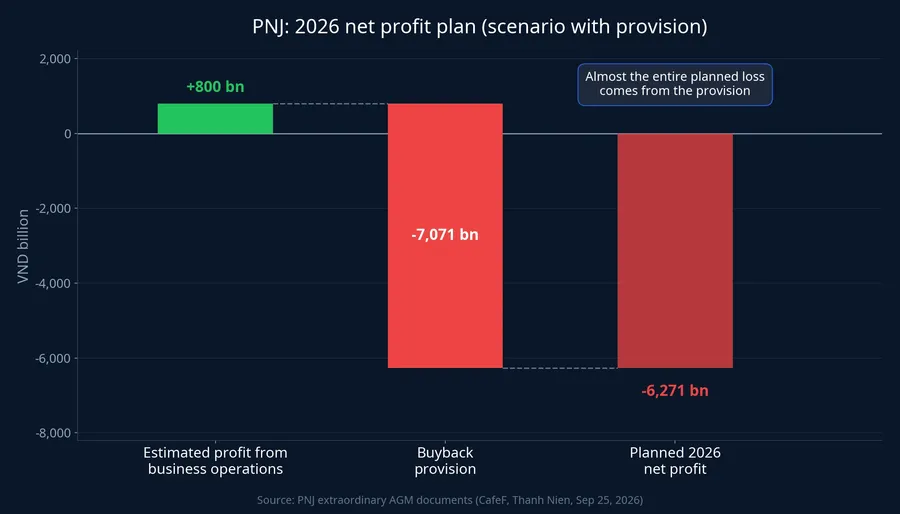
Put the two scenarios side by side and the arithmetic is simple: roughly VND 800 billion of estimated profit minus VND 7,071 billion of provision gives exactly minus VND 6,271 billion. Almost the entire planned loss is the provision. Alongside it, the board proposes cutting the 2026 cash dividend from 20% to 0% and trimming the 2025 dividend from 20% to 10%, which matches the interim payout already made to shareholders on record as of January 12, 2026.CafeF If both proposals pass, shareholders will receive no further cash dividends for either year.
What a provision is, and why PNJ books it now
A provision is the accounting rule that makes a company recognize a probable loss up front, as soon as the obligation becomes visible. It hits this year's expenses and cuts this year's profit accordingly, even though no cash has left the company when it is booked.
PNJ's obligation comes from its buyback and exchange policy. The company said a diamond-related incident in 2026 arose unexpectedly and created financial pressure from buying back goods it had already sold.Thời báo Tài chính When a customer returns a piece, PNJ takes it back into inventory at the committed buyback price. The loss arises when that price exceeds what PNJ can recover when it processes or liquidates the item.
According to PNJ's explanation, the cost covers processing and liquidating goods that were bought back or recalled, plus obligations stemming from sales policies in earlier periods. The company also said independent sample testing by Vinacontrol and the Asian Institute of Gemological Sciences (AIGS) found 100% of samples were natural diamonds meeting the stated standards.Người Quan Sát If that holds, the loss does not come from defective goods. It comes from the decision to commit to buybacks to preserve customer trust, and from the gap between the committed price and the recoverable value.
One percentage drives the whole year
The key point is that the provision does not measure a loss that has already happened. It measures the loss that would occur if 80% of goods sold came back, so the size of the planned loss is tied directly to that 80% figure.
The AGM documents do not break the calculation down by product group, so it is impossible to say exactly how much the provision would change if the assumption changed. If the relationship were roughly proportional, each 10 percentage points would be worth about VND 880 billion of provision. That is a rough estimate of our own to illustrate sensitivity, not a figure disclosed by the company.
The accounting principle is clearer. Provisions are reassessed every reporting period. If the actual return rate comes in below the assumption, the excess is reversed and added back to profit in later periods. If the actual rate is higher, the company has to book more. PNJ said that for products sold through September, it does not expect further provisions of this kind in 2027.Người Quan Sát In other words, PNJ has chosen to take one heavy charge at a high assumption rather than adjust gradually over several quarters.
A book loss is not the same as cash out the door
The VND 7,071 billion provision is not money PNJ has spent. Cash only leaves when a customer returns an item and chooses a refund. If the customer swaps it for another piece, PNJ pays no cash; it hands over an item from inventory and takes back a used one.
Calling it "just a paper loss" is still wrong. Returned goods sit in the warehouse and tie up capital. At the end of June, PNJ's inventory stood at VND 15,186.6 billion, about 70.3% of total assets. Every returned piece adds working capital locked in inventory until it is processed or resold.
That explains why a company still expecting roughly VND 800 billion of operating profit needs more capital. PNJ said its current cash flow covers its planned payment obligations. It has also drawn part of a loan of about VND 700 billion from the family of its Chairman of the Board to top up working capital and stock materials for the peak season.Người Quan Sát
The core business is weakening too
Looking only at VND 800 billion minus VND 7,071 billion, it is tempting to conclude that PNJ is fine once the provision is stripped out. The data paint a weaker picture. The VND 800 billion figure is itself about 77% below the original plan.
In July and August, PNJ's net revenue rose 4.5% year on year, but gross profit fell 45.4% to VND 550 billion. Gross margin shrank from 18.5% to about 10%, and the company posted a net loss of VND 61 billion for the two months, against a VND 325 billion profit a year earlier.Người Quan Sát PNJ attributed this to lower gross margins, an unfavorable diamond market and the seasonal lull of the seventh lunar month, without separating how much each factor contributed. Seasonality will pass on its own. The other two are tied to the incident and to diamond prices, so how long they last is hard to call.
For the first half as a whole, net revenue reached VND 25,709.2 billion, up about 49% year on year.CafeF Reviewed net profit, however, was only VND 728.4 billion, with a net loss of VND 739 billion in the second quarter alone. The company is also shrinking its network: as of August 31, PNJ had 432 business units, and it expects to close 25 to 30 stores and open about 10 new ones in 2026.Người Quan Sát
A VND 8 trillion raise and a zero dividend
To fund its rebuild, PNJ plans to raise up to VND 8,000 billion through various channels.Thanh Niên The figure is based on working-capital needs and its development strategy for the next three years, and the detailed plan will be presented at the October 21 meeting.
To gauge the size of that raise, set it against PNJ's own market value. The stock closed at VND 33,000 on September 25. With about 511.7 million shares outstanding, PNJ's market cap is roughly VND 16,890 billion.Stockbiz The maximum raise is therefore equal to about 47% of the current market cap.
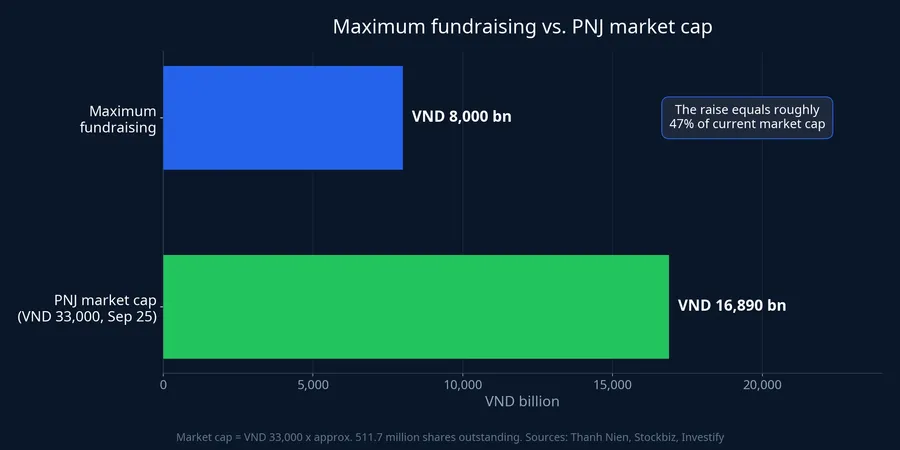
That ratio shows how much the form of the raise matters to existing shareholders. If most of it comes from issuing new shares near current prices, dilution will be significant. If most of it is debt, shareholders avoid dilution, but the company takes on more interest cost at a time when profits are thin. The zero dividend fits the same logic: a company that needs to preserve cash for working capital and expects to book a multi-trillion-dong loss has little basis for paying out cash.
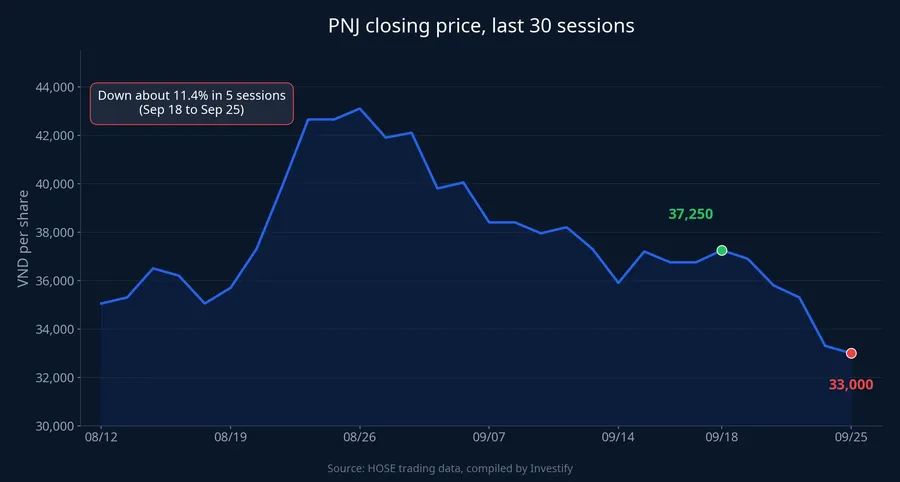
As for the share price, PNJ fell from VND 37,250 on September 18 to VND 33,000 on September 25, about 11.4% over five sessions, including a 5.67% drop on September 24. That slide happened before the AGM documents were released. Trading data do not reveal a specific cause, so it would be a stretch to say the market had already priced in the planned loss. The documents came out after Friday's close, which makes Monday, September 28, the first session in which the share price can respond to the full picture.
What shareholders should watch
The VND 6,271 billion planned loss is built on a conservative scenario the company chose for itself. Our thesis is that almost all of it is provision, and that provision will be tested against reality every reporting period. The core business is genuinely weakening, though, so the "VND 800 billion profit" is not a solid floor either. Three verifiable developments will show which way the number is heading.

The actual return rate versus 80%. Q3 financial statements and monthly results will show whether the volume of returned goods is rising or falling. If the actual rate runs well below 80%, the odds of provision reversals in later periods increase. If it approaches or exceeds 80%, the planned loss is only a floor.
The structure of the VND 8,000 billion raise. The detailed proposal at the October 21 meeting will reveal how much comes from share issuance, at what price and to whom. That will determine the dilution for existing shareholders.
Gross margin in the core business. A gross margin of about 10% in July and August is well below the 18.5% of a year earlier. If margins recover as the year-end peak season arrives, the VND 800 billion operating profit has a basis. If not, that VND 800 billion may need to be revised as well.