
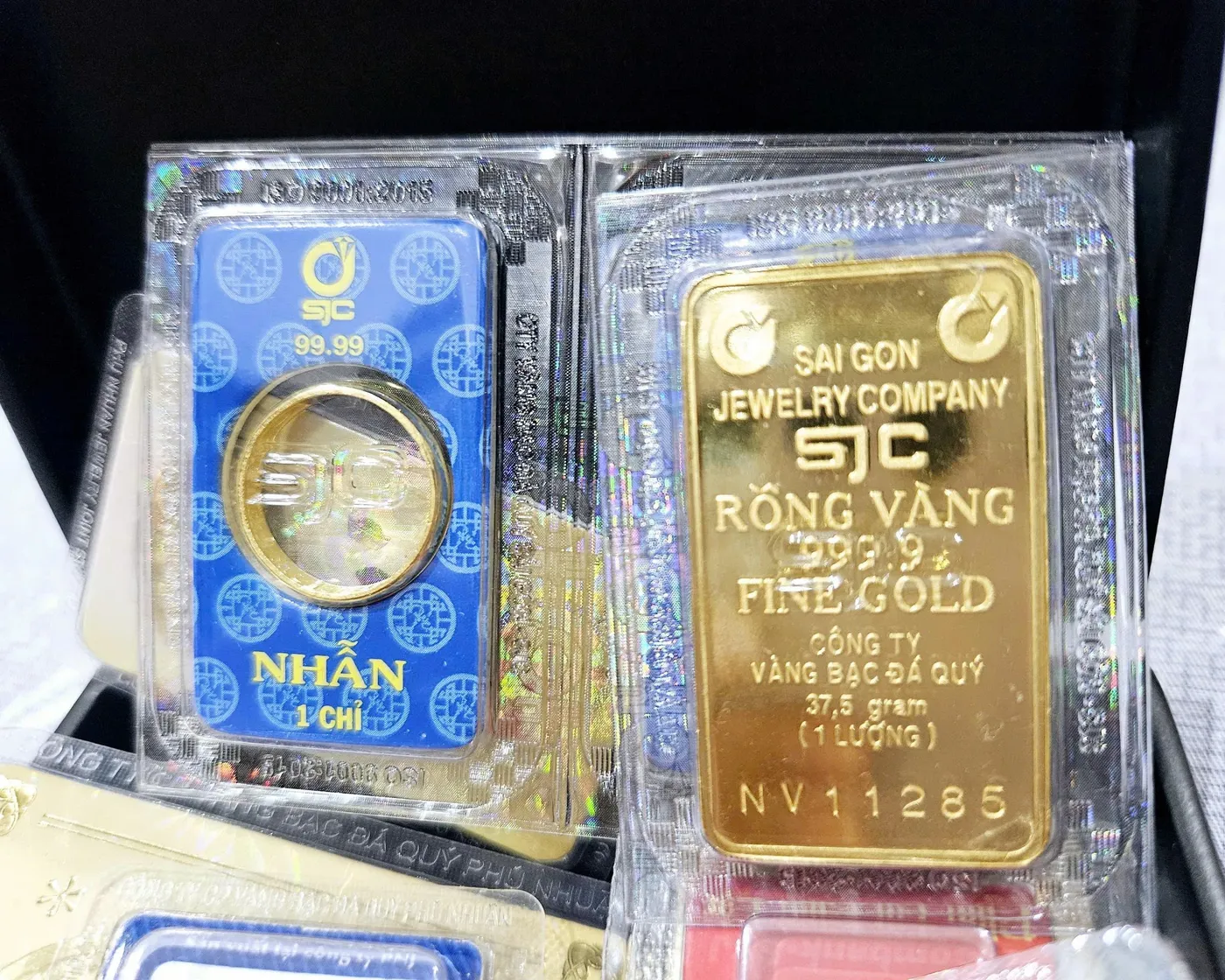

Many Vietnamese gold buyers hold a familiar belief: plain gold rings are "safer" than SJC bars because they usually cost less and get less caught up in market frenzy. The slide from January's peak has been a clean test of that belief. The result is a little surprising. Someone who bought rings at the top lost almost exactly as much as someone who bought SJC bars.
This post puts the two side by side so you can see where the loss actually came from. Once the price structure is clear, you will know which numbers to check before buying more, whichever form you prefer.
Bought at the peak, bars and rings lost the same
On the afternoon of January 29, SJC gold bars at major dealers hit a record VND 188.3 million per tael to buy back and VND 191.3 million to sell. That same afternoon, plain gold rings also reached all-time highs. SJC quoted its rings at VND 187.8–190.8 million per tael, while Bao Tin Minh Chau quoted VND 188.3–191.3 million, level with the bars.Người Đưa Tin
By September 24, the price board looked very different. SJC bars stood at VND 141.4–144.4 million per tael, down VND 1.1 million from the previous session.Dân trí SJC's 1–5 chi rings fell to VND 140.9–143.9 million, and Bao Tin Minh Chau's plain rings were at VND 141.8–145.8 million.Vietnamnet
Take what you paid at the peak (the dealer's selling price) and subtract what the dealer will pay you today, and you get the loss per tael:
| Form | Paid at Jan 29 peak | Sold back Sep 24 | Loss per tael |
|---|---|---|---|
| SJC gold bar | VND 191.3 mn | VND 141.4 mn | VND 49.9 mn |
| SJC ring | VND 190.8 mn | VND 140.9 mn | VND 49.9 mn |
| Bao Tin Minh Chau ring | VND 191.3 mn | VND 141.8 mn | VND 49.5 mn |
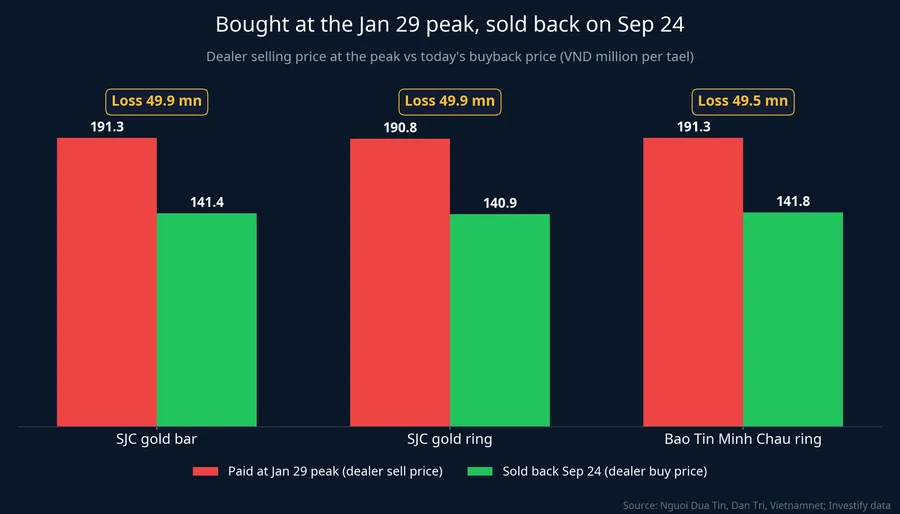
The rows differ by a few hundred thousand dong on a loss of about VND 50 million. Put simply, for anyone who bought at the height of the frenzy, choosing bars or rings barely changed the outcome.
The VND 50 million loss is built from three layers
Think of the domestic price of a tael of gold as a three-layer cake. The bottom layer is the world gold price converted into dong. The middle layer is the extra that Vietnamese buyers pay above the world price. The top layer is the gap between what a dealer sells for and what it buys back at. A peak buyer of SJC bars lost money on all three.
The first layer, the world price, did most of the damage. At the late-January peak, world gold converted at Vietcombank's exchange rate was worth about VND 175.5 million per tael, before taxes and fees.Người Đưa Tin On September 24, with spot gold below USD 4,300 an ounce, that figure was only about VND 135.3 million.Dân trí That drop of roughly VND 40.2 million accounts for about four-fifths of the total loss.
The second layer, the premium over the world price, has shrunk. In late January, SJC bars traded about VND 15.8 million per tael above the converted world price. On September 24, by Dân trí's calculation, the gap was a little over VND 9 million.Dân trí Nearly VND 7 million that buyers paid for the frenzy is no longer in the price.
The third layer is the buy-sell spread. You buy at the dealer's selling price but can only sell back at its buying price. For SJC bars, that gap is currently VND 3 million per tael.
Add them up: 40.2 + 6.7 + 3 = VND 49.9 million. The two conversions use each period's exchange rate, so treat this as an illustrative estimate rather than an official breakdown.
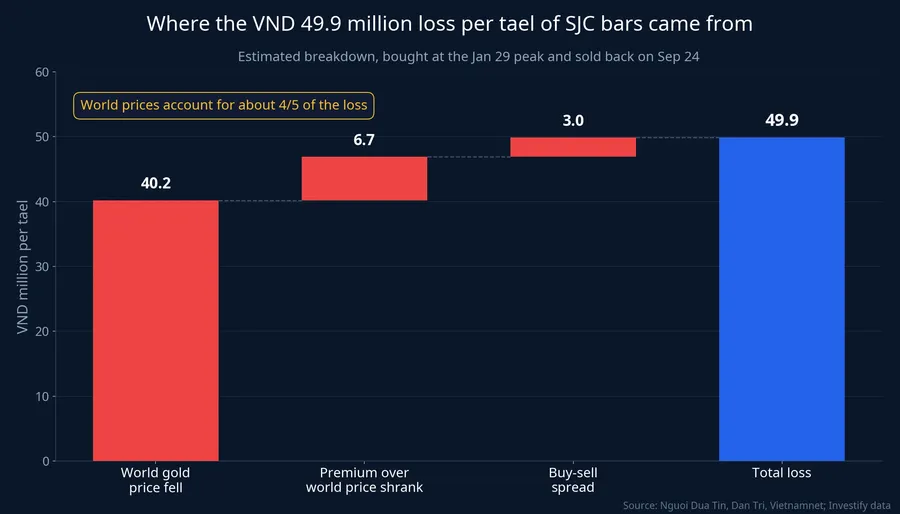
The math also exposes something few buyers notice at the counter. The moment you walk out of a shop with an SJC bar today, you are already carrying about VND 12 million per tael: VND 3 million of spread plus a little over VND 9 million of premium over the world price. The world price does not need to fall at all. Those two layers are already baked into what you paid.
The premium: the least predictable layer
The world price is the biggest layer, but the premium over it is the most erratic. According to Investify data, calculated from SJC's selling price and the world gold price converted at the USD/VND rate (before taxes and fees), this gap has swung widely within just a few weeks.
On August 19, SJC bars sold for almost exactly the world price, only about VND 0.1 million per tael above it. That was a session in which world gold jumped more than 4% while SJC's selling price fell VND 1.6 million, and in the sessions that followed, the premium settled back at VND 2–4 million. In September it widened steadily, peaking for the month on September 16 at about VND 12.9 million per tael. On September 23 it was still around VND 11 million.
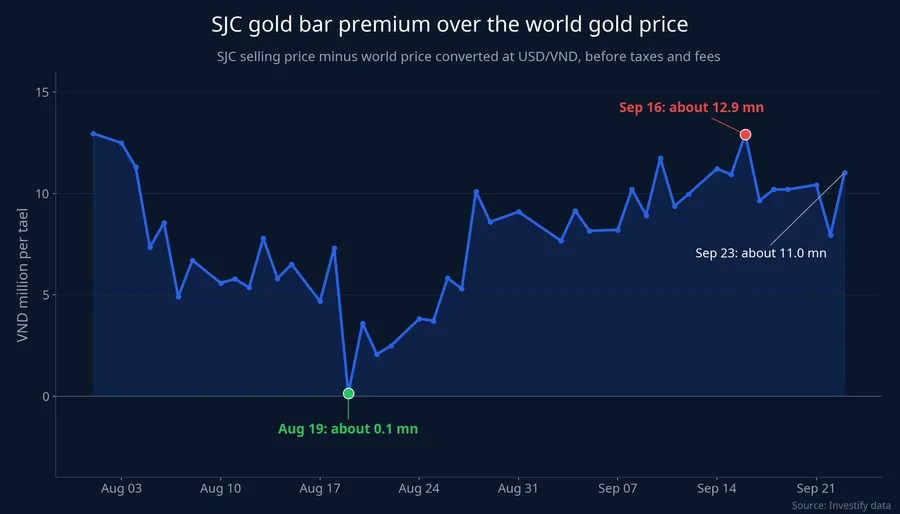
This layer explains why domestic gold has fallen far less than world gold over the past month. From August 24 to September 24, world gold dropped about 7.9%, from USD 4,652 to USD 4,285.6 an ounce. Over the same period, SJC's bar selling price fell only about 3.7%, from VND 150 million to VND 144.4 million per tael, and SJC's 99.99% ring selling price fell about 3.4%.
For current holders, this cushion cuts both ways. It kept domestic prices from following world prices down in September. But if the premium shrinks back to the levels of late August, holders of SJC bars could lose anywhere from a few million to nearly VND 9 million more per tael, even if the world price stays flat.
Whether the premium widens or narrows depends largely on the domestic supply of gold bars. Decree 232/2025 ended the state monopoly on gold bar production and broadened who may import raw gold, with the expectation that more supply would pull the gap down.Báo Chính phủ Even so, September showed that when sentiment heats up, the premium can still widen by several million dong in a matter of weeks.
Why rings did not cushion the fall
The belief that rings lose less does hold in calmer periods. On September 24, SJC rings sold at VND 143.9 million, about VND 0.5 million per tael below bars.Vietnamnet In August, Investify data shows the average premium of SJC 99.99% rings over the world price was about VND 4.3 million per tael, below the VND 6.2 million for bars.
That lower premium, however, is not a fixed feature of rings. It closes up precisely when the market is hottest. On the afternoon of January 29, ring prices were raised level with bars, so peak ring buyers also paid a premium nearly as large as bar buyers did, and lost it once the market cooled.
Even now, the ring price advantage varies by brand. Bao Tin Minh Chau rings sell at VND 145.8 million, VND 1.4 million above SJC bars. Their buy-sell spread is VND 4 million per tael, wider than the VND 3 million on bars.Vietnamnet PNJ rings were quoted at VND 142.5–145.5 million per tael on the same morning.CafeF "Rings are cheaper" is only true for a specific brand at a specific moment.
The two forms do differ, just not in the way many assume. Rings can be bought one chi at a time, which suits people building up gold gradually with small sums. SJC bars carry a single, uniform brand, with prices quoted in lockstep across the major dealers.

Outside pressure has not eased
The bottom layer of the cake, the world price, is under strain. According to Dân trí, hawkish signals from the Fed have raised expectations that US rates could rise further, pushing the dollar index to 101.08, a two-month high, while the 10-year US Treasury yield sits at 5.1%.Dân trí A stronger dollar and higher yields raise the opportunity cost of holding gold, an asset that pays no interest.
On the other side, BMI still forecasts an average gold price of USD 4,400 an ounce for 2026 and argues that central bank buying could provide support around USD 3,800.Dân trí That is a forecast, not a certainty, and the distance between those two levels leaves plenty of room for domestic prices to keep swinging.
Two numbers to compare before you buy
The comparison points to a clear conclusion: in the slide from January's peak, the form of gold barely determined the size of the loss. What mattered was the price paid relative to the world price at the time, plus the buy-sell spread. So whether you are eyeing bars or rings, two numbers deserve a look first.
- The domestic selling price versus the converted world price. For SJC bars the gap is currently around VND 9–11 million per tael, depending on the exchange rate used, compared with VND 2–4 million in the second half of August. Buying when the gap is wide means accepting the extra risk that it shrinks.
- The buy-sell spread of the exact brand you plan to buy. Today it ranges from VND 3 million for SJC bars to VND 4 million for Bao Tin Minh Chau rings.
Add the two together and you know how far the world price must rise just for you to break even. As of September 24, that figure is roughly VND 12 million per tael of SJC bars.
The signal worth watching in the coming weeks is therefore the premium over the world price, not just the world price itself. In early September the gap was around VND 7.7 million per tael; by mid-month it had reached about VND 12.9 million. If it falls back below VND 8 million, the extra paid for market sentiment is being squeezed out. If it climbs back toward VND 13 million, buyers at that point are paying more for sentiment than for the gold itself.