


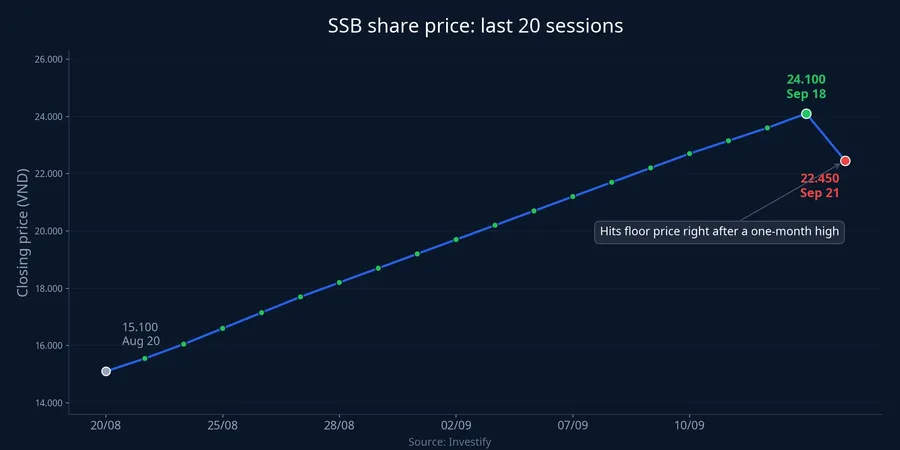
On the morning of September 21, shares of SeABank (HOSE: SSB) fell to their floor price of VND 22,450, down 6.85%. It was the only bank stock to hit its floor that session, while most of its peers stayed in the green: VPB rose 1.28%, ACB rose 0.91%, MBB rose 0.75%, and TCB rose 0.63%. The VN-Index stood at 1,806.36 points at the same time, down 0.51%.
The size of the drop was not the most telling number. Volume was. By 11:22 a.m., SSB had matched just over 2.06 million shares, worth VND 46.8 billion: only about 17% of its 20-session average volume. A genuine sell-off pushes volume up sharply. SSB did the opposite: the price hit the floor on a matched-volume base that was nearly dry. The correct read here is not "someone sold hard," but "no one was left to buy."
Who drove SSB's 59.6% run-up
From VND 15,100 on August 20, SSB climbed to around VND 23,450 by September 17, then closed at VND 24,100 on September 18.DNSE That is a 59.6% gain in just 18 sessions, including three consecutive ceiling-price days from September 14 to 16.
Over those same 18 sessions, SeABank released no new earnings, closed no deals, and gave no updated profit outlook. What changed was somewhere else entirely: SSB was added to three international indices in quick succession. Per Báo Công Thương, MSCI added SSB to the MSCI Frontier Markets Index, effective September 1.Báo Công Thương MarketVector Indexes' Q3 review, published September 12, picked SSB as the sole new addition to the MarketVector Vietnam Local Index, the benchmark for the VanEck Vectors Vietnam ETF, which held nearly $520 million in assets as of September 10. SSB was assigned an estimated weight of 1.76%, equivalent to roughly $9.2 million in buying, or about 13 million shares. In the same window, SSB also joined the FTSE Global All Cap.
That estimate lines up almost exactly with what actually traded. In the week of September 14-18, foreign investors net-bought 13.3 million SSB shares worth VND 282.6 billion, concentrated most heavily in the first two sessions and tapering off toward week's end. This is the core of the whole story: index-fund buying is not money with a view on SeABank. It is a mechanical order, sized and timed in advance, executed exactly once.
Why September 21 was the hinge point
Báo Công Thương reported that VNM ETF's portfolio rebalancing was expected to complete by the September 18 session, with the new index composition taking effect September 21. In other words, last Friday was the final session in which index-tracking funds were obligated to buy SSB. This morning was the first session after that buying pressure disappeared entirely. No unusual sell order was needed: once the forced buyer stepped away and momentum traders looked to take profit, the price simply drifted down because nothing was left to support it from below.
The 2.06 million-share volume is the clearest evidence of that. Compare it with SSB's own prior week: 6.51 million shares matched on September 15, 6.22 million on September 16, 5.05 million on September 17.
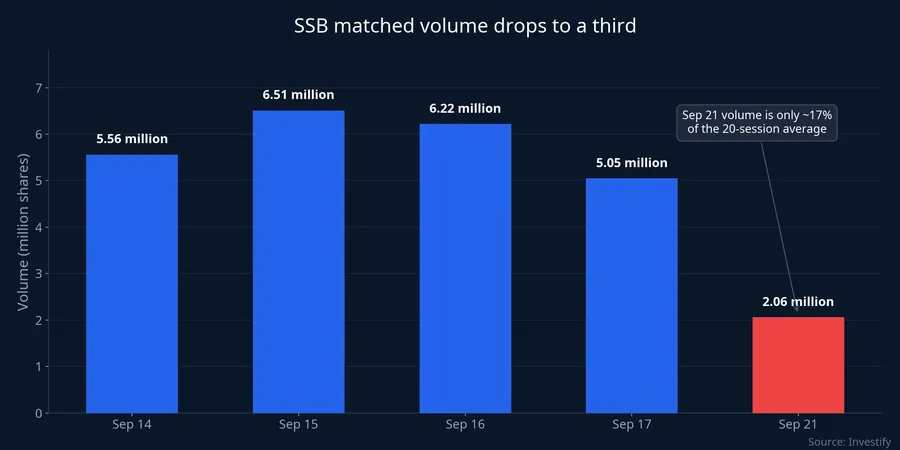
The actual supply hitting the market this morning was far lower than the prior week's, yet it was enough to push the price to the floor. That is the signature of an order book with an empty buy side, not an active dump.
A large block changed hands right at the peak
There is a data layer that got little attention. In the week of September 14-18, SSB recorded 58.75 million shares in negotiated (block) trades worth VND 1,158.5 billion, more than 2.2 times the week's ordinary matched volume of 25.62 million shares. On September 14 alone, nearly 37.78 million shares changed hands through the negotiated channel, worth VND 688.8 billion, at an average price of about VND 18,234 versus that day's closing price of VND 19,550. September 18 added another 15.32 million negotiated shares worth VND 359.3 billion.
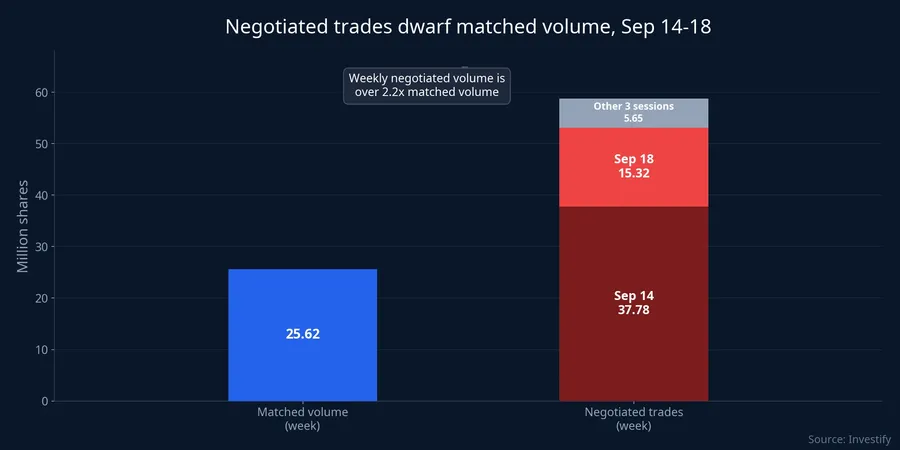
Large block trades at a discount to market price are routine between institutions. But set against the price action, the implication is clear: in the very week the stock hit its highest level since listing, a stake equal to roughly 1.7% of charter capital changed hands off the order book.
The insider sell orders haven't started yet
On September 20, SeABank disclosed a series of planned trades by insiders.DNSE Lê Tuấn Anh, son of Nguyễn Thị Nga (Standing Vice Chairwoman of SeABank's Board of Directors), registered to sell 8 million SSB shares, reducing his stake from over 38.16 million to over 30.16 million units. Another relative of a board member registered to sell 214,100 shares, nearly her entire holding. Three deputy CEOs registered to sell a combined 221,000 shares, all citing personal financial restructuring.
Timing matters here: the two largest transactions can only be executed between September 23 and October 22, and as of this morning not a single one of those shares had actually been sold. So what is the real significance of this disclosure? Not mechanical supply pressure, since that supply does not exist yet. It is a valuation signal: when the people with the closest view of the bank choose this exact price zone to trim their stakes, other shareholders read it as a verdict on the current price level, and the resolve to hold weakens well before the trades themselves take place.
What is not the cause
SeABank's planned issuance of 40 million ESOP shares is often cited as a hidden supply overhang, but a close read of the terms shows it has nothing to do with this year's price action. Per the plan disclosed on July 23, all 40 million ESOP shares, issued to 684 staff at VND 10,000 each, carry a 12-month transfer restriction from the completion of issuance.MekongASEAN After that, holders may transfer up to 60%, with the remaining 40% locked until month 18. The issuance is set to close in August 2026, meaning the first batch cannot reach the market before roughly August 2027. Folding ESOP into today's selling pressure is simply misreading that issuance's own legal timeline.
Three explanations, and where the evidence points
This morning's move can be explained by three different stories, each plausible to some degree: profit-taking after a hot rally, a psychological reaction to the insider sell disclosure, or technical demand from index rebalancing running out.
The evidence points most clearly to the third. It is the only explanation that accounts for what the other two cannot: thin liquidity. A broad round of profit-taking or a panic reaction to insider news would push matched volume up, not down to a sixth of normal. A floor-price drop on so little traded volume only happens when the buy side withdraws, and the dominant buyer over the past month was precisely the index funds that finished deploying capital on September 18. The other two explanations still play a role, but as amplifiers rather than the primary driver.
Fundamentals do not support the run-up either. In the first half of 2026, SeABank posted VND 2,625 billion in consolidated pre-tax profit, about 37% of its full-year plan of VND 7,068 billion. Total assets reached over VND 427,100 billion, up roughly 8% from the end of 2025, with a non-performing loan ratio of 2.25%. That is a picture of steady growth, not one that justifies a 59.6% gain in 18 sessions.
What to watch next
For a stock that just lost its technical buying support, the number worth watching over the next few sessions is matched volume, not price. If liquidity returns to the 5-6 million-share range per session and the price holds, that signals fresh capital has stepped in to replace the index funds. If the price keeps sliding on volume under 3 million, it means the new price level still hasn't found a buyer.
The second marker falls after October 22, when the insider trading window closes and each seller must disclose actual results. Earlier this year, Lê Tuấn Anh himself registered to sell 6 million SSB shares and sold none, citing unfavorable market conditions. The number of shares actually sold, set against the number registered, is always more reliable data than the registration notice itself.
The broader lesson extends beyond SSB: when a stock rallies because it was added to an index, the capital flow behind that rally has a publicly known expiration date. Reading a fund's rebalancing calendar is something you can do in advance, not something you have to guess.