

On September 20, 2026, Bloomberg ran an analysis that unsettled US investors: what happens to Wall Street if AI growth doesn't keep pace with expectations, given that nearly $33 trillion in market value has been added to the S&P 500 since late 2022, when ChatGPT launched.Bloomberg
The same day, a much smaller story ran in Vietnamese media: Asia Vital Components (AVC), the Taiwan-listed group trading as 3017 in Taipei, signed a NT$7.781 billion contract, equivalent to more than VND 6,300 billion, for the next phase of its five-plant project in Vietnam.CafeF The two stories describe the same capital cycle from different vantage points: one is a valuation question on Wall Street, the other is concrete, steel, and mechanical-electrical contracts at an industrial park in northern Vietnam.
A company that makes neither chips nor models
AVC doesn't make chips and doesn't train AI models. It makes cooling fans, heat sinks, liquid cooling systems, and server chassis, hardware that manages heat for these massive computing clusters. This used to be a thin-margin business, but AI chips changed that: a new-generation GPU cluster runs hot enough that ordinary air fans can't keep up, forcing data centers to switch to liquid cooling. AVC's leadership estimates the share of data centers using liquid cooling will exceed 50% by 2027.Investing.com

The financials reflect that shift closely. AVC's full-year 2025 revenue hit NT$139.64 billion, nearly double the NT$71.76 billion booked in 2024.StockAnalysis In Q2 2026, revenue reached NT$49.1 billion, up 66% year-on-year, while gross margin improved to 32.57%, 8.16 percentage points higher than a year earlier.Taipei Times Net profit for the quarter was nearly 2.4x the prior-year period, and AVC's market cap now stands around NT$1,080 billion, roughly $34 billion at an exchange rate of NT$31.79 per dollar.StockAnalysis
A quarter of global revenue from one industrial park
AVC's first Vietnam plant, at Dong Van III Industrial Park in Ninh Binh, began operating in 2020 on a site of more than 200,000 square meters, with roughly $400 million invested. By 2025, that single facility alone generated about $1.1 billion in revenue and employed more than 12,000 workers.CafeF
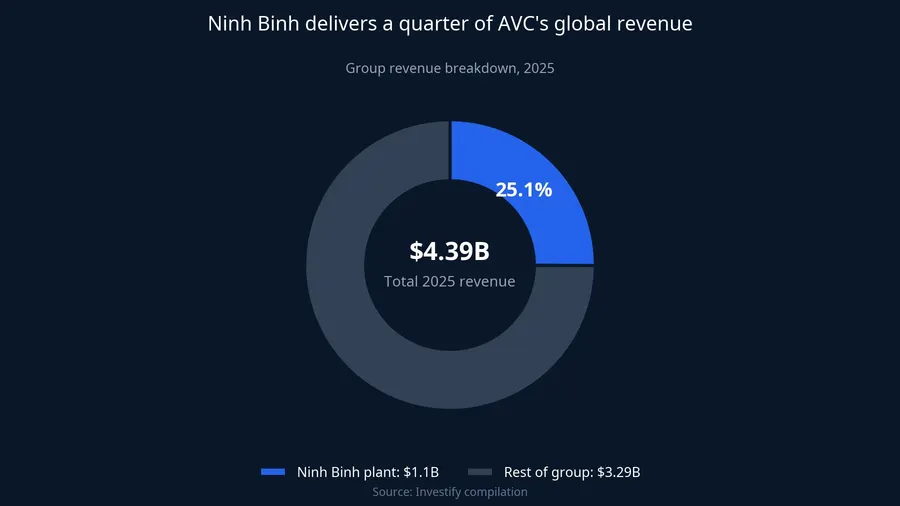
Set that figure against global revenue and the real weight becomes clear: AVC's NT$139.64 billion in 2025 revenue converts to roughly $4.39 billion at NT$31.79 per dollar, and the Ninh Binh plant contributed $1.1 billion of that, about a quarter of the entire group's revenue, equivalent to roughly VND 28,600 billion.
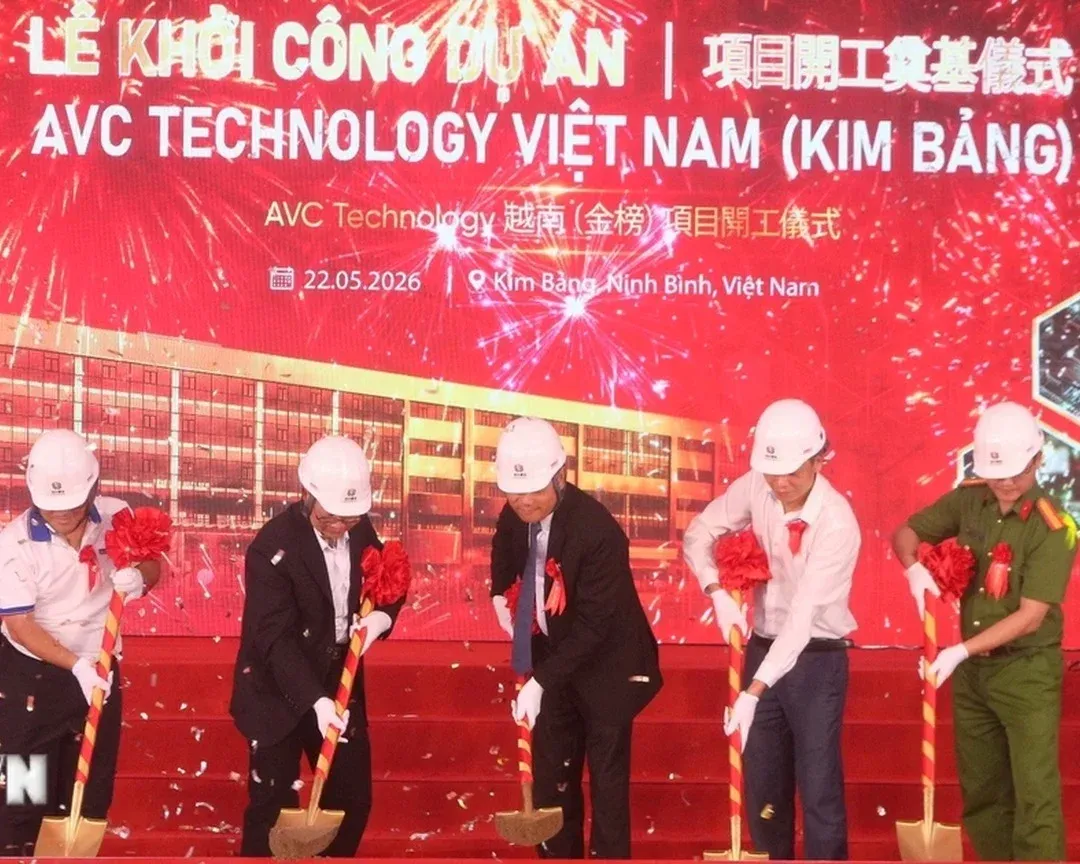
In May 2026, AVC Vietnam broke ground on a second plant at Kim Bang I Industrial Park, also in Ninh Binh, spanning more than 461,000 square meters, with an investment of roughly $600 million and a design capacity exceeding 84 million units a year.TNGlobal The project is expected to add about 20,000 jobs and start operating before January 2027.VietnamPlus Combined, AVC's total investment in Vietnam now stands at roughly $1 billion.
A construction contract is the hardest commitment to unwind
The VND 6,300 billion just signed isn't a new investment pledge; it's a civil construction and mechanical-electrical contract for the next phase of a project already under way. That distinction matters for investors nervous about AI valuations in the US: paper FDI pledges can be delayed, cut, or withdrawn when the market turns, but a contract already signed with a builder locks in a schedule and payment terms, and stopping midway always costs more than finishing. This is about the least sensitive category of spending to short-term stock price swings.
The scale of this contract is also notable against AVC's own capex budget: the company says 2026 capital expenditure will run around NT$15 billion, with 2027 guidance set higher.Investing.com The two contracts just signed for the Ninh Binh site alone total NT$7.781 billion, more than half the group's full-year capex budget. Worth noting: contract value is disbursed as construction progresses and can span more than one fiscal year, so this is a scale comparison, not a direct addition to a single year's cash flow.
More than one driver
It would be a rushed read to attribute this entire expansion to AI demand alone. At least three forces are pushing at once, and they aren't mutually exclusive. The first is the computing-infrastructure spending cycle: Nvidia reported its latest quarterly revenue at $96.2 billion and guided next quarter to roughly $108 billion; as long as GPU orders keep flowing, cooling demand follows.Fili The second is a technology shift within the cooling industry itself: data centers moving from air to liquid cooling force suppliers to build new production lines even if the total number of servers doesn't grow, a replacement cycle rather than pure expansion. The third is supply chain relocation: Taiwanese hardware suppliers set up in Vietnam years before the AI boom began, to reduce dependence on China ahead of tariff risk, consistent with Dong Van III's 2020 groundbreaking date.
These three forces don't carry equal weight. The evidence tilts most heavily toward the first: AVC's gross margin jumped 8.16 percentage points in a single year, a shift hard to explain by production relocation alone. But if the AI cycle slows, the other two forces still hold up part of demand, which is why a sudden capital-flow stop is unlikely in the near term.
Where Vietnam sits in this cycle
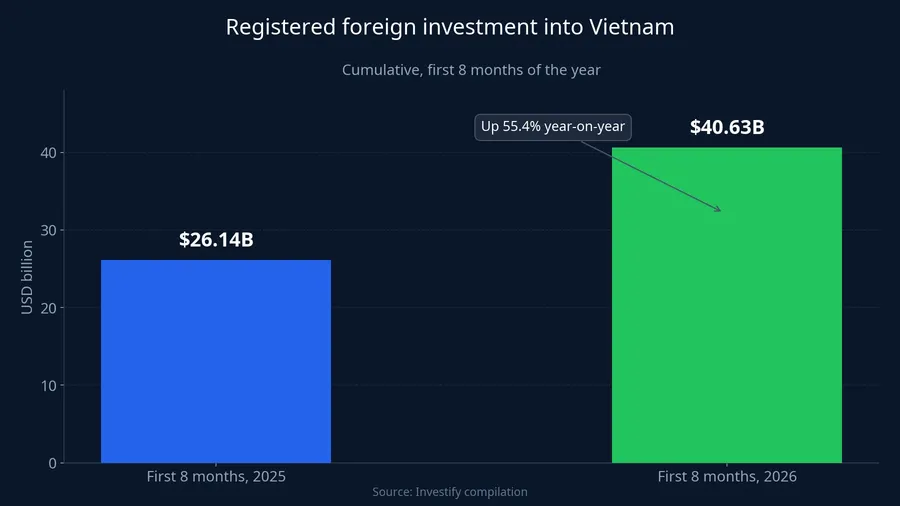
AVC isn't an isolated case. In the first half of 2026, northern Vietnam attracted roughly $8.63 billion in newly registered manufacturing FDI, 80.5% of the national total, with computers, electronics, and optical products accounting for more than $7.03 billion of that.MarketTimes Per data released in early September covering the period through August 31, 2026, total registered foreign investment into Vietnam reached $40.63 billion, up 55.4% year-on-year, with manufacturing accounting for $12.15 billion of newly registered capital.Doanh Nhan Phap Luat
For individual investors, the closest link is the group of industrial park stocks. At the close on September 18, 2026, VGC traded at VND 41,000, KBC at VND 26,000, IDC at VND 32,400, and SZC at VND 17,850, while the VN-Index closed at 1,815.66 points.
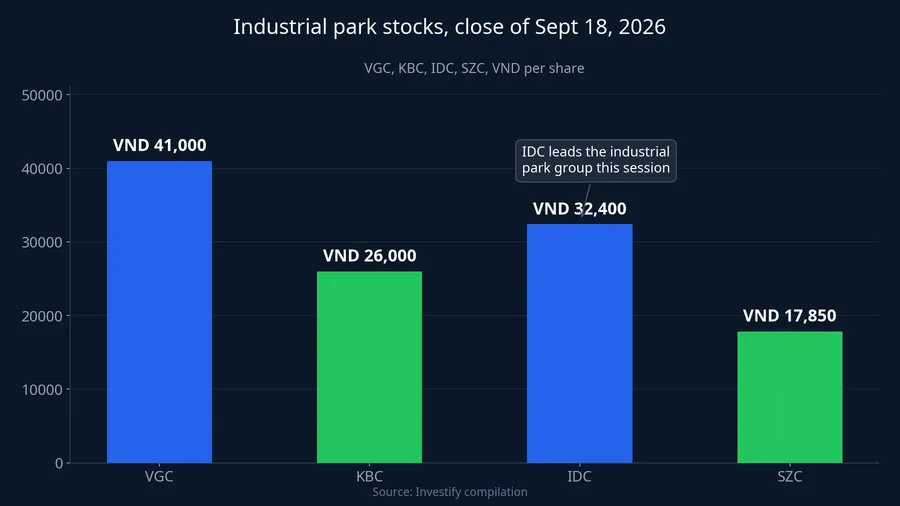
The distinction worth drawing is that the land-bank narrative and actual business performance are diverging. VGC has a sturdier earnings base, with ROE at 16.88% and after-tax profit up 54.14%. KBC holds a large land bank right in the path of incoming electronics capital, but its after-tax profit fell 93.61%, and its stock still trades below book value at a P/B of 0.91x. The market hasn't yet priced in FDI expectations; it's waiting on actual land-handover data.
The reasonable framework at this stage is to separate two time layers: the 12-to-18-month layer is already locked in by construction contracts and building schedules, largely insulated from the valuation fight on Wall Street; the layer from 2028 onward is where AI valuation risk genuinely reaches Vietnam, because that's the next investment-decision round, with no contracts binding it yet.
Signals worth watching
Three markers will answer whether this capital flow continues. First, January 2027, the target start date for Kim Bang I: running on schedule means the supply chain is holding its pace. Second, AVC's 2027 capex plan: leadership has said it will exceed the NT$15 billion level set for 2026, so coming in above that means the cycle is still running, while falling below would be the earliest warning sign for the whole supplier group. Third, Q4 industrial park land-handover results, which will show whether actual leasing demand is keeping pace with registered capital.
The external valuation backdrop remains tense: the US market's CAPE ratio has reached 41x, more than double the 16-to-17x historical average, while AI infrastructure-related debt has climbed to roughly $489 billion counting both bonds and syndicated loans.FireAntFireAnt
If the AI cycle turns, Vietnam will feel it first through the paychecks of the 12,000 workers at Dong Van III and the 20,000 jobs planned at Kim Bang I, before it feels it through the stock ticker. Those three markers, not Wall Street's daily swings, are the more reliable signal for Vietnam's industrial park stocks.