

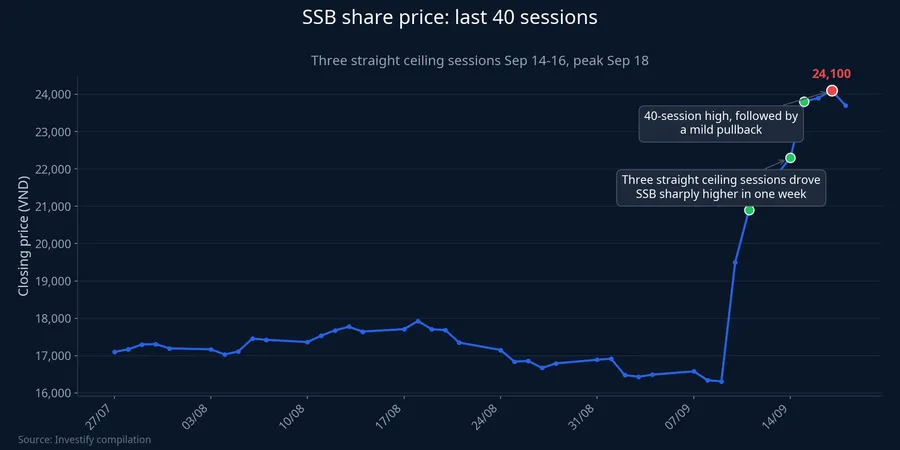
The week of September 14-18, 2026 was the best week in SSB's trading history. Three consecutive ceiling sessions pushed the price from VND 19,550 to VND 22,350 per share, the highest level SSB had ever reached since listing.DNSENguoi Quan Sat The rally didn't stop there: the stock rose another 4.92% on September 17 to VND 23,450, then gained 2.77% more on September 18 to close at VND 24,100.DNSE From its August 27 close of VND 16,000, SSB had gained 50.6% in just 13 trading sessions.
That same week, Southeast Asia Commercial Joint Stock Bank (SeABank) disclosed a series of share-sale registrations from insiders and related persons. The real question isn't that they registered to sell, it's reading the scale and motive behind each filing correctly, so retail investors neither panic over a signal smaller than it appears nor miss a moment that actually deserves attention.
Who registered to sell, and how much of their own stake
The largest block belongs to Le Tuan Anh, son of Nguyen Thi Nga, Standing Vice Chairwoman of SeABank's Board of Directors. He registered to sell 8 million SSB shares, reducing his holding from 38,160,852 shares (1.100% of voting shares) to 30,160,852 shares (0.869%), in a window from September 23 to October 22, 2026, with the stated purpose of personal financial restructuring.DNSE At the September 18 closing price of VND 24,100, this block is worth roughly VND 193 billion.
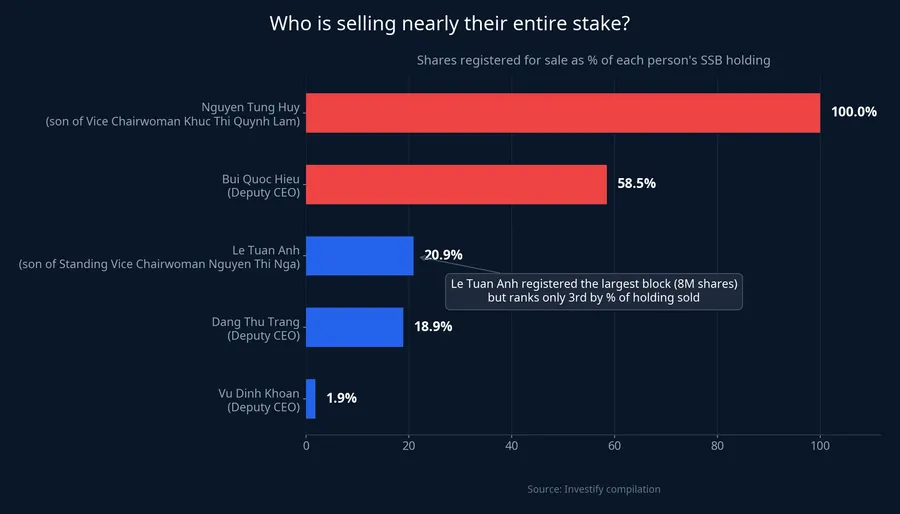
Four other people registered in the same round, all either executives or related persons at SeABank. Nguyen Tung Huy, son of Khuc Thi Quynh Lam, Vice Chairwoman of SeABank's Board of Directors, registered to sell 214,100 of the 214,148 shares he holds, leaving just 48 shares if the sale goes through.DNSE Vu Dinh Khoan, Deputy CEO, registered to sell 95,000 of his 5,081,338 shares (0.146% down to 0.144%). Dang Thu Trang, Deputy CEO, registered to sell 70,000 of her 370,076 shares (0.011% down to 0.009%). Bui Quoc Hieu, Deputy CEO, registered to sell over 56,000 shares, planning to keep 40,000, in a window from September 18 to October 16.
Percentage sold is the real measure, not raw volume
By raw volume, Le Tuan Anh dominates, accounting for roughly 95% of the group's total registered sale. But raw volume is not a measure of how determined someone is to exit. Once the registered sale is measured against each person's actual holding, the ranking flips completely: Huy is selling 99.98% and keeping only 48 shares, Hieu is selling roughly 58%, Tuan Anh is selling roughly 21% while still keeping over 30.1 million shares, Trang is selling roughly 18.9%, and Khoan is selling only about 1.9%.
The person selling the most shares in absolute terms is also the person keeping the most in his portfolio. The person leaving entirely is selling a block so small the market can barely feel it.
The real scale of this sale is smaller than it feels
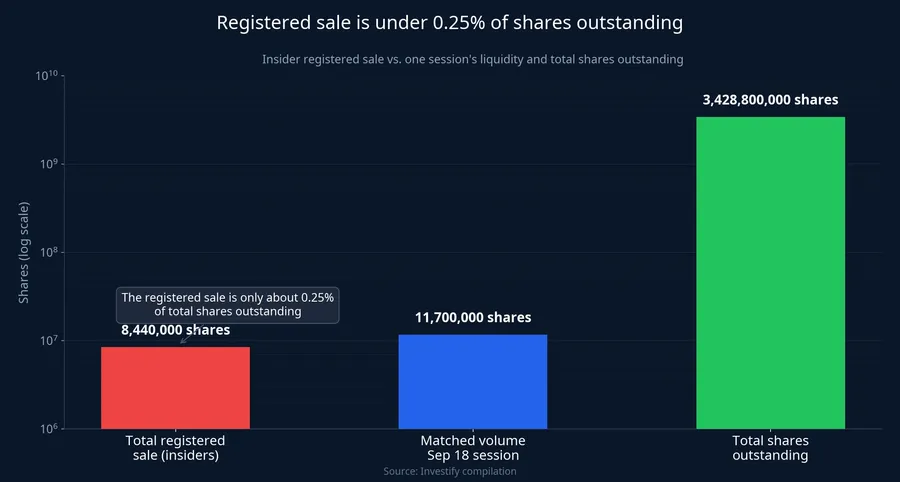
The group's total registered sale is about 8.44 million shares. SeABank has completed a charter capital increase to VND 34,288 billion, equivalent to nearly 3.43 billion shares outstanding.DNSE The entire registered sale is under 0.25% of shares outstanding.
Placed next to liquidity, the number shrinks further. The September 18 session alone saw more than 11.7 million shares matched, plus over 15.3 million shares in negotiated deals worth more than VND 359 billion.DNSE The September 14 session saw nearly 38 million shares change hands via negotiated deals, worth about VND 690 billion. The entire insider group's registered sale is smaller than a single session's matched volume. This is a signal about how insiders view the current price, not a supply large enough to weigh it down.
Registering to sell doesn't guarantee a sale
There is a specific precedent on this exact stock. In a window from January 9 to February 6, 2026, Le Tuan Anh registered to sell 6 million SSB shares and reported the entire sale failed, with the stated reason being unfavorable market conditions.CafeBiz By the end of that window he still held 1.28% of charter capital, equivalent to over 36.4 million shares. SSB was trading in the VND 14,000 to 15,000 range at the time.
What investors see in a disclosure is only an intention within a time window, not a completed transaction. Once the October 22 window closes, the registrant must disclose the actual execution results, and that follow-up report is the real data point to evaluate.
The names missing from the sale list
The family's two largest shareholders sit outside this round entirely. Per a February 2026 filing, Nguyen Thi Nga holds nearly 120.1 million SSB shares (4.221% of capital), while Le Thu Thuy, Vice Chairwoman of SeABank's Board of Directors, holds over 65.6 million shares (2.307%).CafeBiz Neither appears on September's sale registration list.
This is where two interpretations diverge. If the group controlling the bank were pulling out en masse, the signal would carry far more weight. But when most of the registered volume comes from one relative and three executives with small ownership stakes, while the two controlling shareholders keep their positions unchanged, the personal-portfolio-rebalancing theory holds up just as well as the theory that insiders think the price has run too far. The available data isn't enough to settle on either one.
Where the rally came from
MSCI added SSB to its Frontier Markets Index in the Q3 review, announced August 13 and effective September 1.FiLi The stock then entered the FTSE Global All Cap Index effective September 21, the same day FTSE Russell upgraded Vietnam's market status.FiLi

One timing detail matters here: the steepest leg of the rally happened during the September 14-18 week, before the FTSE inclusion took effect. Most of that week's buying pressure likely came from domestic investors' expectations about upcoming capital inflows, not from passive funds actually deploying capital by index weight yet. The unusually large negotiated volumes on September 14 and 18 also suggest a meaningful share of the volume changed hands between pre-arranged counterparties, rather than reflecting pure order-book supply and demand.
On fundamentals, SeABank posted VND 2,625 billion in consolidated pre-tax profit for the first half of 2026, with total assets over VND 427,100 billion, up roughly 8% from the end of 2025.DNSE Outstanding credit reached VND 264,453 billion, with a non-performing loan ratio of 2.25%.
A reading framework for retail investors
Insider filings are public, useful data, but how you read them determines their value. Three criteria help classify a sale registration before reacting to it.
First, look at percentage of holding, not absolute volume. An executive selling 20% of their stake and someone selling down to just 48 shares are two very different messages, even when the absolute numbers differ by dozens of times.
Second, consider the seller's position in the ownership structure. A hands-on executive insider is different from a related person, and a controlling shareholder is different from an executive with a small stake.
Third, watch the gap between registration and actual execution. This exact stock already had one registered sale of 6 million shares that never went through, and the current registration is still at the intention stage, not a closed transaction.

What to watch next
The registered group's trading window runs through October 22, and the execution results will be disclosed after that. This deadline, not the current registration, is what will actually decide how this story reads.
If the group manages to sell most of what it registered, that means they accepted the current price level to exit, giving the market another data point on what insiders consider a reasonable level to take profit. If the early-year pattern repeats and most of the sale fails, those shares remain in their portfolios, and investors will likely see a similar notice again at a different price level down the road. With the data available now, neither outcome can be called in advance. The execution report after October 22 will be the answer.