

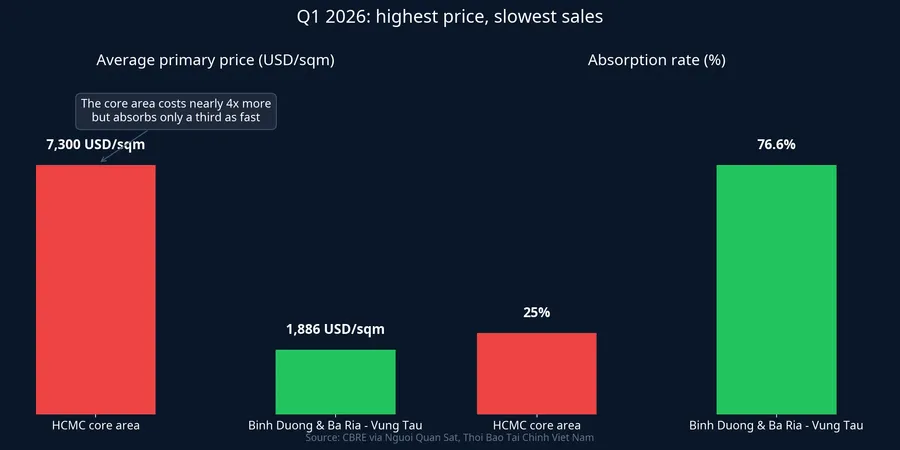
In Q1 2026, primary apartment prices in Ho Chi Minh City's core districts hit nearly USD 7,300 per square meter, up 19% quarter-on-quarter and 53% year-on-year, the highest level ever recorded in the area.Nguoi Quan Sat Yet in that same core area, fewer than 1,000 units sold during the quarter: about 25% of new supply, down 74% from the prior quarter.Thoi Bao Tai Chinh Viet Nam
In the same quarter, Binh Duong and Ba Ria - Vung Tau (former administrative boundaries) launched 7,017 new units, nearly six times the core area's supply, at an average primary price of about USD 1,886/sqm.Nguoi Quan Sat The absorption rate in that expanded area reached 76.6%, three times the core.Thoi Bao Tai Chinh Viet Nam
The city center hasn't lost its appeal. What's changing is how the market measures the value of a location.
The unit of location has shifted from kilometers to minutes
The old "location, location, location" formula quietly assumed that geographic distance to the center is a fixed measure of value. That assumption only holds when the transport network stays roughly still for decades. Once infrastructure starts running, the same coordinate on a map can change value entirely without a single meter of physical movement.
That network is now moving at a pace Vietnam hasn't seen before. On June 22, 2026, Hanoi broke ground simultaneously on five urban rail lines, targeting completion by 2030.FireAnt In the south, Ho Chi Minh City's Ring Road 3 — more than 76 km long, with capital of VND 75,300 billion — has reached 75% completion and is expected to open fully in 2027.Vietstock At a CBRE seminar during the Nam Long Experience 2026 exhibition in mid-September, Duong Thuy Dung, General Director of CBRE Vietnam, emphasized the role of the interregional infrastructure group — the Ben Luc - Long Thanh expressway, Ring Roads 3 and 4, and the Nhon Trach bridge — in linking Ho Chi Minh City to Binh Duong, Dong Nai and Long An.Nguoi Quan Sat
Analysts call this a shift from measuring in kilometers to measuring in minutes of travel: buyers now care how long it takes to reach work, school or the airport, not the kilometer figure printed on a brochure.MarketTimes In Ho Chi Minh City, apartments next to Metro Line 1 stations have risen an average of USD 200-250/sqm per year, roughly 8% annually, double the market's overall rate of increase in 2025.FireAnt The zone that benefits most sits within a 300-500 meter radius of a station, roughly a 5-to-10-minute walk.CafeBiz In Hanoi, projects well connected to metro stations have appreciated 10-20 percentage points faster than the broader market over the past two years.Nguoi Quan Sat

Infrastructure redistributes value, it doesn't lift it evenly
This is where many individual investors get it wrong. A major infrastructure project does not raise prices uniformly along its entire route. It pulls value from one spot and concentrates it in another, depending on how much connecting infrastructure and urban ecosystem already exist nearby.
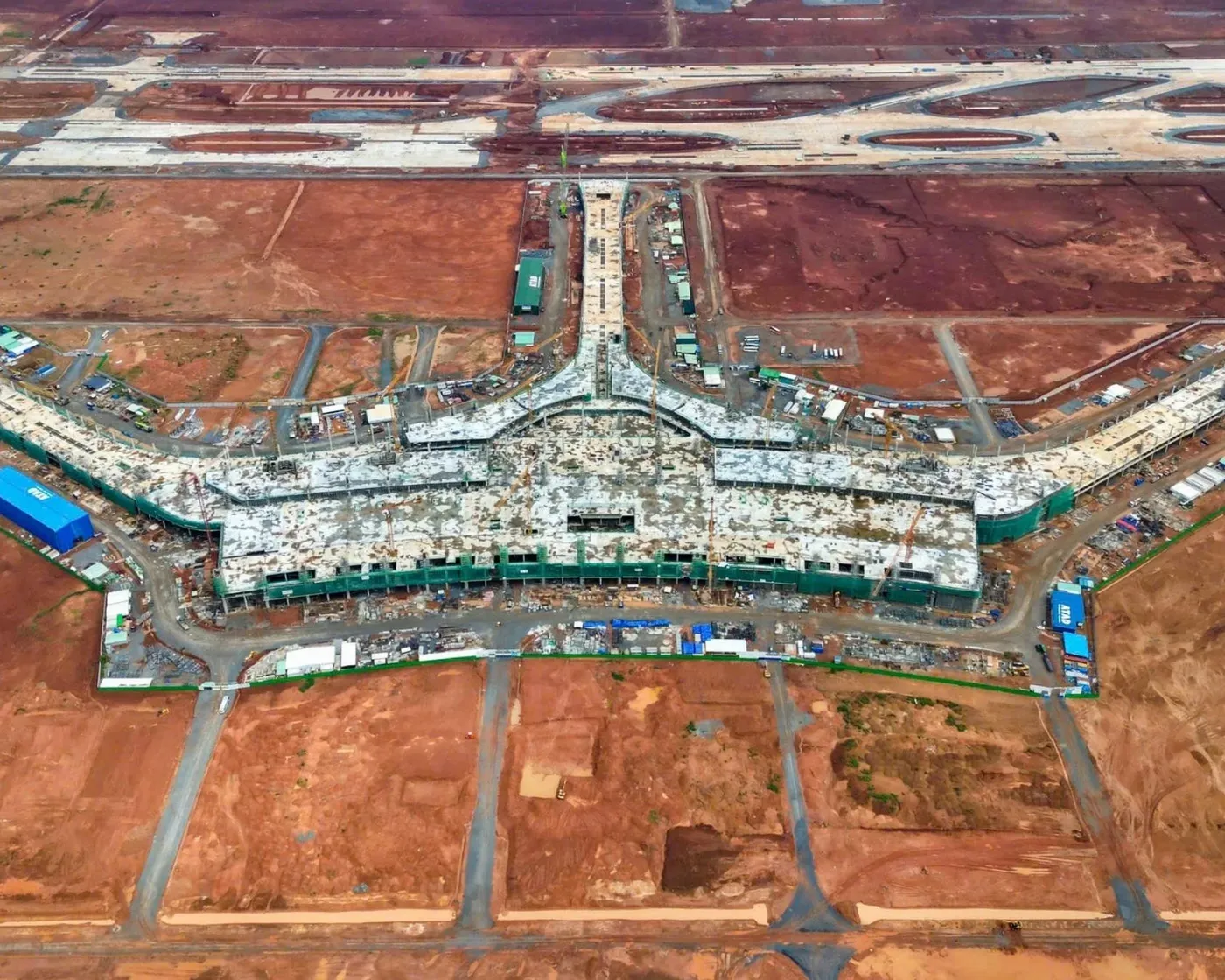
Long Thanh International Airport is the cleanest example of this mechanism. From Q2 2020 to February 2025, land prices in Tan Hiep commune rose 3.3x, Phuoc Binh 2.3x, and Long An 2x.Vietstock Yet Binh Son commune, which had the largest land area seized for the airport itself, rose only 13%. Two communes right next to the airport, Binh An and Loc An, rose just 40% and 31% respectively, both well below the district average. Bau Can commune and Long Thanh town even fell 20% and 14% over the same five years.Vietstock
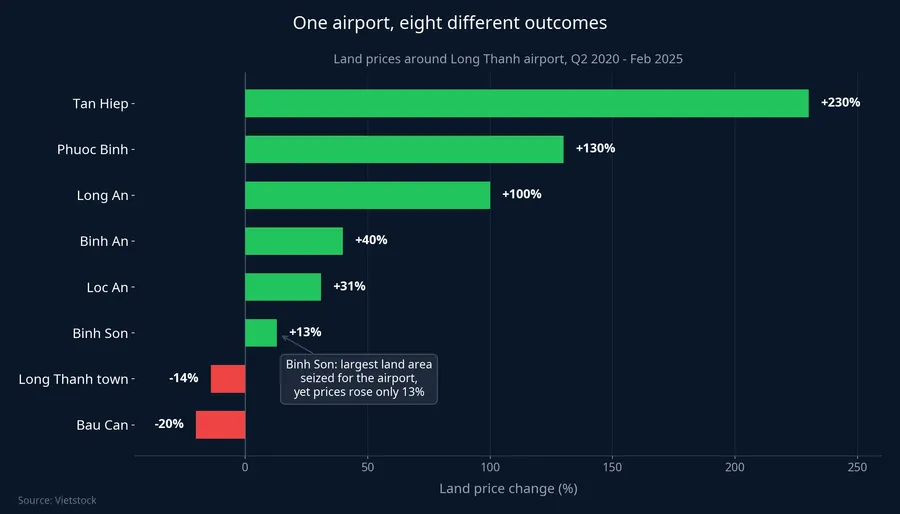
Same USD 16 billion airport, same district. Yet outcomes span from more than tripling to losing a fifth of value. The differentiating factor isn't distance to the airport; it's the connecting infrastructure and specific urban projects that had already taken shape around each commune.
Metro Line 1 tells the same story at a smaller scale. CBRE Vietnam estimates projects near stations have risen 25-75% from their original launch prices.Vietstock But both CBRE and Savills note the metro isn't the only factor: neighborhoods with an already-complete urban ecosystem, like Thao Dien and An Phu, absorb the benefit far faster than areas still holding large tracts of empty land. The station is only one piece of the valuation puzzle. The rest is schools, markets, hospitals, jobs, and sidewalks people actually use.
Buyers have changed the question they ask
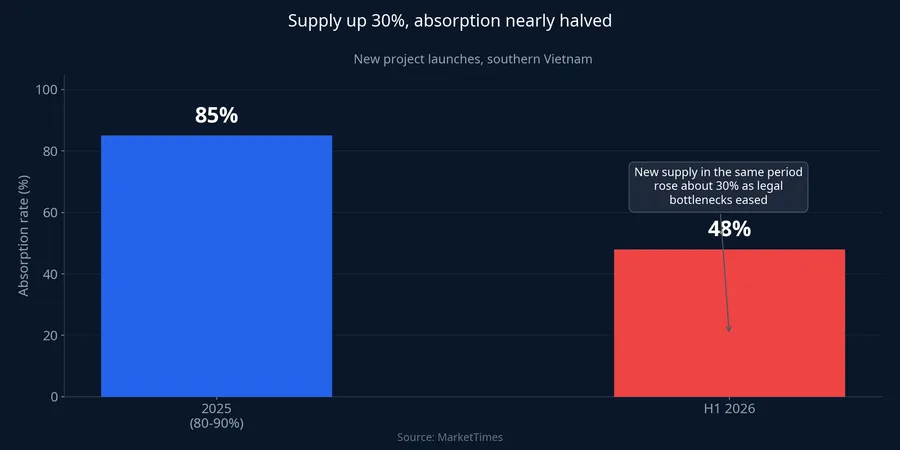
The remaining mechanism comes from the demand side, and it's tightening faster than anything else. Southern projects launched in 2025 achieved absorption rates of 80-90%. In the first half of 2026, that figure fell below 50%, even as supply rose about 30% thanks to eased legal bottlenecks.MarketTimes
In Hanoi, average secondary apartment prices in Q2 2026 sat at around VND 60 million/sqm, down almost 3% from the prior quarter, the first quarterly decline since 2022.Thoi Bao Tai Chinh Viet Nam The annual growth rate has also narrowed to 13%, roughly half the 24-26% peak of 2024-2025. Mortgage rates holding at 12-14% after promotional periods expire is part of why buyers have grown more cautious. When capital is expensive, they're no longer willing to pay for a promise of future appreciation; they demand an asset that does something useful right now: livable, or able to generate rental cash flow.
Nguyen Van Dinh, Chairman of the Vietnam Association of Realtors (VARS), described the shift bluntly in late May 2026: there used to be a time when buying anywhere was a winning bet, even in places with no infrastructure and no access roads, but that era has closed.CafeBiz
Part of the price has already been paid for the future
There's another explanation worth weighing alongside the infrastructure story for why the core is selling slowly: 72% of new Q1 2026 supply in HCMC's core was luxury-segment apartments, meaning the buyer pool was already narrow.Nguoi Quan Sat Some of the weak absorption comes from product mix, not purely buyer sentiment. But product mix doesn't explain why Hanoi's secondary prices reversed after four straight years of gains, nor the wide spread among communes around Long Thanh. These three data points, drawn from three different markets, are pointing the same direction.
The concrete risk individual investors face is that prices have already priced in infrastructure that doesn't exist yet. The Vietnam Association of Realtors has warned against front-loading the entire future value of infrastructure into today's asking price, since buyers may be paying for benefits that haven't materialized.Nguoi Quan Sat This pattern is already visible in Hoai Duc, where land plot prices rose 20-30% from the start of 2025 despite actual transaction volume staying low.FireAnt
Three questions replacing "how many kilometers to the center"
The prevailing evaluation framework is shifting from one old question to three new ones. This is also the direction individual investors should apply when reading any project going forward.
First: actual peak-hour travel time, based on infrastructure that is already operating, not infrastructure still on a planning map. The gap between a metro line that's running and one that's still a blueprint is exactly the gap between Line 1's 25-75% price gains and Binh Son commune's 13%.
Second: real population density and amenities already operating within walking distance. Thao Dien and An Phu absorbed the metro's benefit faster not because of proximity to a station, but because the urban fabric was already alive before the trains started running.
Third: rental cash flow measured against purchase price. An asset that can actually be rented out proves there's genuine housing demand behind it. That's the liquidity cushion that matters when the market slows, as it did in the first half of this year.
CBRE forecasts primary apartment prices could continue rising by an average of roughly 11% per year in the coming years.Nguoi Quan Sat That figure is a market-wide average, and the Long Thanh data shows how wide the dispersion around that average can be: from tripling in value to losing a fifth of it, within the same district.
The signal most worth watching in Q4 is the absorption rate of new project launches on the market's periphery. If it holds above 70%, as Binh Duong did in Q1, capital is still following genuine usable value. If it slides back below 50%, matching the first-half average, that's a sign purchasing power — not location — is now the factor tightening the market.