


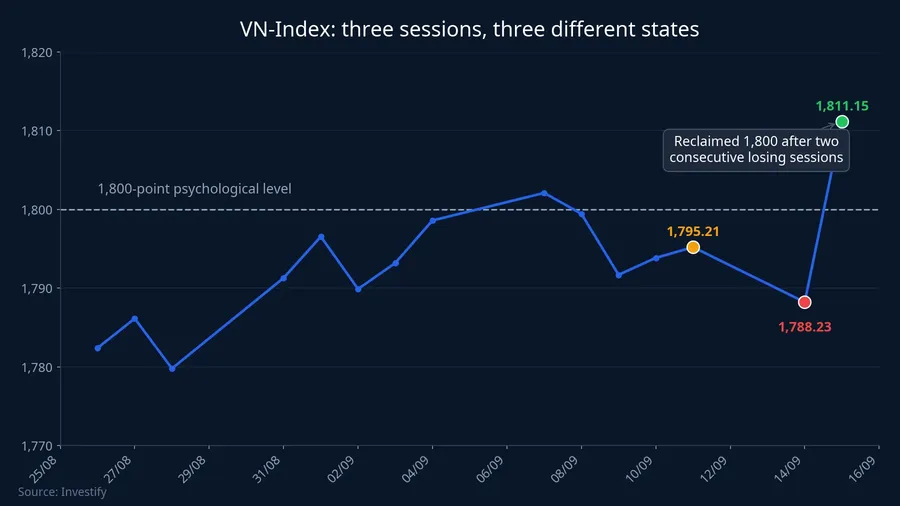
On September 15, VN-Index closed at 1,811.15 points, up 22.92 points, or 1.28%.CafeF The 1,800-point psychological level returned to the board after three sessions below it. But look at the numbers closely, and the most interesting part of this rebound isn't the up session itself. It's the session right before it, when the index was still falling and foreign investors had already quietly repositioned.
Three sessions, three different states
On September 10, VN-Index stood at 1,829.23 points. On September 11, the index lost 34.02 points, sliding to 1,795.21 and breaking below 1,800, with ugly breadth: 46 advancers versus 278 decliners.
On September 14, selling pressure hadn't let up. The index fell another 6.98 points to 1,788.23, the low of the whole correction, with 83 advancers and 219 decliners. Stocks in the GELEX ecosystem all hit the floor that session. Market-wide trading value rose 15% to VND 19,583.6 billion, but nearly all of that increase came from negotiated trades (up 137%), while matched-order value barely moved, up just 1.3%.HDBS In other words, the money actually flowing through the order book that day stood still.
September 15 reversed everything: 245 advancers, 91 decliners, 10 stocks hitting the ceiling and none hitting the floor. Matched trading volume topped 642 million shares. Breadth flipping from 46-versus-278 to 245-versus-91 in just three sessions is a major shift, suggesting the rally spread broadly rather than riding on a handful of large-cap names.
The real turning point was September 14
This is the most easily missed detail of the week. On the very session the index bottomed, while the board was still red and mid- and small-cap stocks were still getting sold off, foreign investors net bought more than VND 825 billion.Người Quan Sát That money wasn't spread evenly: TCB, MBB and VPB each saw net buying of roughly VND 130-150 billion, while BID, SSB and VCB were also among the ten most heavily bought names, each around or above VND 100 billion. Big foreign money moved into bank stocks exactly one trading session before the index turned.
On the morning of September 15, most strategy notes were still leaning cautious. HD Securities argued the index was shifting into a test of the 1,780-1,785-point support zone after the MACD crossed below its signal line and the index lost both its 20-day and 200-day moving averages, recommending risk management over chasing technical rebounds.HDBS The condition for the market to regain balance, per that same note, was for the index to clear the 1,800-point zone with improving breadth. By 3pm, both halves of that condition had happened.
Same net-buying session, two opposite directions of money
This is the most important layer of data from September 15. Foreign investors net bought roughly VND 730 billion market-wide, with VND 717 billion of that on HOSE alone.CafeF That positive headline number hides a fairly clear split underneath.
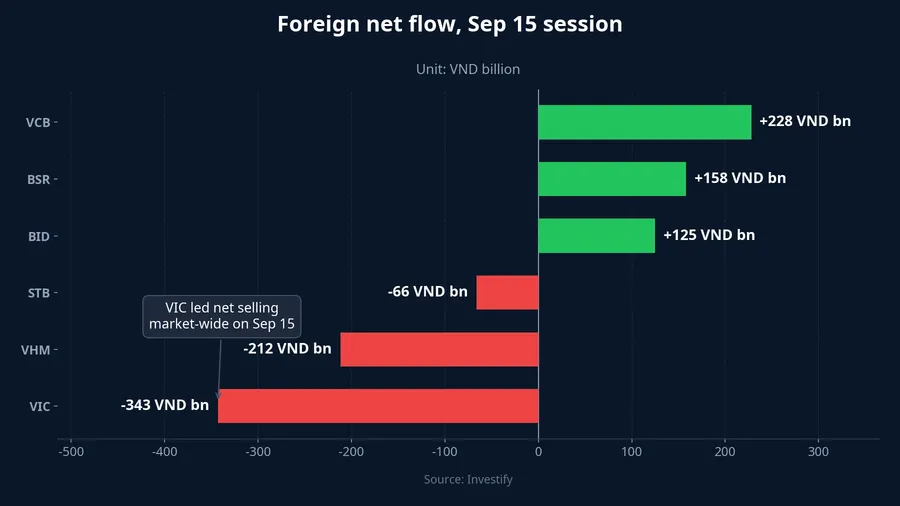
On the buy side, per Vietcap data cited by CafeF, VCB led with more than VND 228 billion, followed by BSR at VND 158 billion and BID at VND 125 billion. All three rose that session: VCB climbed to VND 60,000, up 2.56%; BID rose to VND 36,800, up 2.94%; BSR jumped a sharp 6.84% to VND 30,450.
On the sell side sat the market's two largest-cap names. VIC saw net selling of VND 343 billion, the most of any stock on the exchange, VHM was net sold VND 212 billion, and STB ranked third at VND 66 billion. Those three names alone accounted for VND 621 billion of selling, nearly matching the entire market's net buying. Despite absorbing the session's heaviest net selling, VIC barely moved, closing at VND 241,300, down just 0.04%. VHM closed at VND 71,400, down 0.42%. Domestic money soaked up nearly all of the foreign selling in both names. STB, down 0.52% to VND 76,000, was the single biggest drag on the index during an otherwise up session.
Why VIC and VHM got sold: rule out before concluding
It would be premature to read the selling in VIC and VHM as a verdict on either company's outlook. There are at least three plausible explanations for the same data: index-rebalancing mechanics, sector-level profit-taking after real estate stocks ran ahead of the market for months, or pure valuation rotation into banks that now look relatively cheap.

The rebalancing explanation carries particular weight for VIC. FTSE Russell has upgraded Vietnam to secondary emerging market status, with the first tranche taking effect from September 21, 2026.Tuổi Trẻ The Xtrackers Vietnam Swap UCITS ETF currently holds VIC well above the 15% cap the index methodology allows. Per estimates from VPS Securities, that fund must trim VIC down to the cap during September's rebalancing window, while VanEck and Fubon are also in the process of paring back.Thời báo Tài chính Việt Nam This is technical, mechanical selling, not a statement about the underlying business.
September's flow data splits VIC and VHM into two distinct cases. For VIC, foreign trading has been fairly balanced both ways: cumulative net buying from the start of September through September 14 stood at VND 78.6 billion, across four buy sessions and four sell sessions. Today's VND 343 billion sell-off is a spike on top of that two-way baseline, and it lines up exactly with the rebalancing calendar. The rebalancing explanation therefore carries the most weight for VIC.
VHM looks completely different. Foreign investors net sold this stock for five straight sessions from September 8 through September 14, with a cumulative September net sell of VND 572 billion, including two sessions on September 9 and 10 that each saw roughly VND 293 billion in net selling. That's a steady, sustained outflow, not a random swing around a single rebalancing event. For VHM, sector rotation or valuation-driven selling deserves more weight, though there still isn't enough evidence to settle on one single cause.
How durable is this rebound
The point for caution is domestic liquidity. HOSE trading value on September 15 came in at more than VND 16,600 billion, roughly matching the 20-session average.CafeF The index gained nearly 23 points while liquidity failed to expand, which means fresh money hasn't genuinely entered yet. And at 1,811.15 points, VN-Index still sits 18.08 points below the 1,829.23 it held on September 10. Reclaiming a psychological level isn't the same as recovering the ground already lost.
Signals worth watching
On September 21, the first tranche of FTSE's upgrade roadmap takes effect, and index funds begin deploying capital into 27 Vietnamese stocks. Between now and then, two numbers worth checking side by side after every session are HOSE's matched-order value and foreign net buying in bank stocks.
The scenario for a rebound with real foundations: matched-order liquidity breaks clearly above the roughly VND 16,700 billion zone, while foreign investors keep net buying banks. That would signal domestic money has joined foreign flows. Conversely, if the index keeps drifting higher while matched-order value stays around the average, as it did on September 15, the gain is resting almost entirely on a single source of money, and a single source tends to reverse direction far faster than the broader market.