


On September 13, 2026, Forbes' real-time billionaire tracker dropped Nguyen Dang Quang, Chairman of Masan Group. His net worth is now estimated at $981 million, ranking 3,394th globally, after MSN shares fell nearly 23% over the past year.Tuoi Tre Vietnam now has 7 dollar-billionaires left on the list.
Taken at face value, this looks like a contradiction: in the first half of 2026, Masan just reported its highest profit in company history. The two facts don't actually conflict. They measure two different things. One is operating performance. The other is a multiplication between share count and share price.
A billionaire title is a multiplication, not a state
Forbes runs two separate rankings. The annual list, published every March, is a snapshot: as of March 2026, Vietnam had 8 dollar-billionaires, including Quang.VnExpress The real-time list updates continuously with the stock price. That's the one that just dropped him. The math is simple: shares held, multiplied by the latest price, plus other recorded assets. For an entrepreneur whose wealth sits almost entirely in listed shares, that multiplication reruns after every trading session. The $981 million figure isn't a bank balance: it's the converted value of a block of shares at the latest closing price.
The gap between "billionaire" and "not a billionaire" for Quang currently sits at roughly $19 million, or under 2% of MSN's share price. On September 10, MSN closed at VND 68,700, keeping his figure just above the billion-dollar line. One session later, on September 11, MSN fell 3.2% to VND 66,500, and the title flipped. Quang has cycled on and off this list before: he rejoined in June 2025 at $1.1 billion when MSN traded around VND 76,800,MarketTimes then dropped off again in July 2026 as the price slid to around VND 63,900.MarketTimes The title swings because the measuring stick swings, not because the business changed six times in two years.
The chairman holds exactly 18 shares in his own name
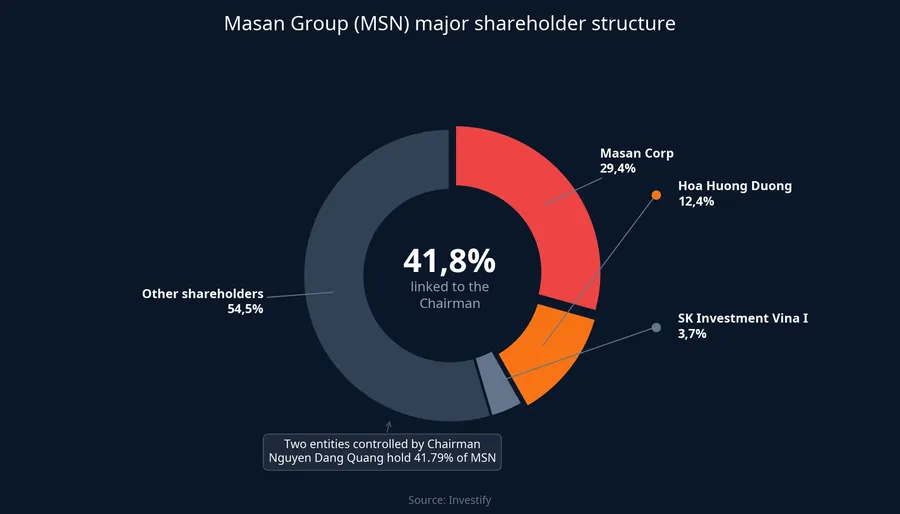
The most surprising detail sits in the shareholder registry: Nguyen Dang Quang directly holds just 18 MSN shares, effectively nothing next to the group's scale. The wealth Forbes attributes to him comes from two entities he controls.
Masan Corporation holds 446,278,464 MSN shares, or 29.35% of equity.Nguoi Quan Sat Hoa Huong Duong Construction Co. holds another 189,081,487 shares, or 12.44%. Combined, the two entities hold 635.36 million MSN shares, equal to 41.79% of charter capital. His wife, Nguyen Hoang Yen, a Board Member at Masan Group, separately holds 50.9 million shares, or 3.36%.
Quang's second leg of wealth is his stake in Techcombank, where he serves as Vice Chairman. Over the same 12 months, Techcombank's market cap fell from VND 261.0 trillion to VND 223.9 trillion, down 14.2%. Both legs are listed stocks, and both moved lower in the same year.
Multiplying 635.36 million shares by the VND 19,500 price gap between September 12, 2025 and September 11, 2026, the paper value lost on that block of shares alone comes to roughly VND 12,390 billion, assuming the share count stayed constant. Not a single dong of that was withdrawn or lost in cash: it's simply the result of the same multiplication run against a lower price.
Record profit isn't pulling the stock up
If the billionaire title tracked business health, the first half of 2026 should have pushed Quang higher, not lower. The consolidated numbers move in the opposite direction from the stock price. Net revenue hit VND 52,137 billion, up 40.1% year-on-year.Thanh Nien Profit after tax reached VND 5,773.5 billion, up 121.9%; net profit attributable to parent shareholders hit VND 4,371.0 billion, up 206.6%; and basic earnings per share rose from VND 942 to VND 2,875.
In Q2/2026 alone, profit after tax before minority interest reached VND 3,800 billion, 2.3 times the year-earlier quarter and the highest quarterly figure in Masan's history. Management proposed raising the full-year target to VND 98,000-105,000 billion in revenue and VND 10,000-11,500 billion in profit.Bao Chinh Phu
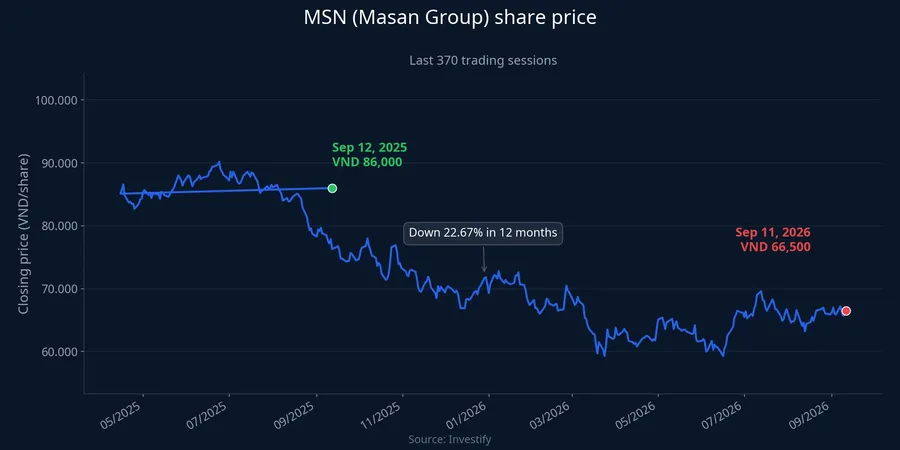
Meanwhile, MSN went from VND 86,000 on September 12, 2025 to VND 66,500 on September 11, 2026, down 22.67%; group market cap shrank from VND 130.8 trillion to VND 97.1 trillion. Earnings per share nearly tripled while the stock lost more than a fifth of its value. The market is clearly pricing in something other than the quarterly report just released.
What the market is actually pricing
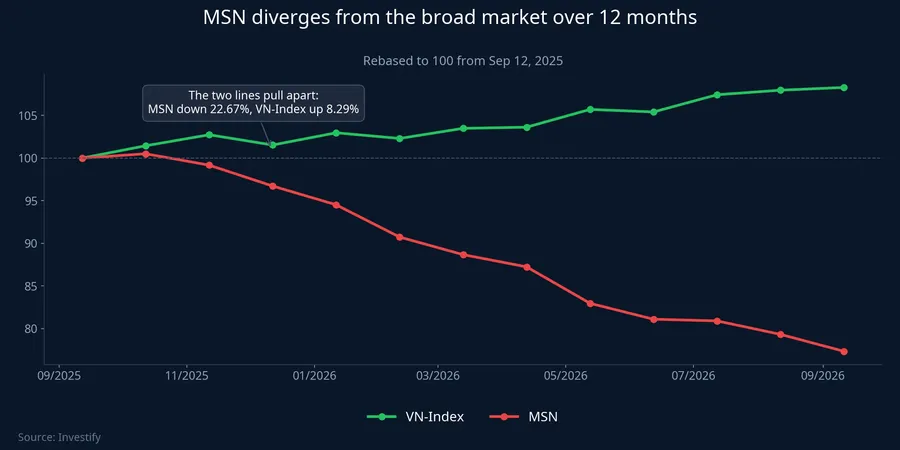
The easiest answer is "the whole market fell," but the data doesn't support that. Over the same period, the VN-Index rose from 1,657.75 points to 1,795.21 points, up 8.29%. The benchmark climbed while MSN fell nearly 23%, so the cause has to sit inside Masan's own story.
Three explanations are equally plausible, carrying different weight. The first is a supply shock from a foreign shareholder. In mid-October 2025, SK Group divested nearly all of its Masan stake; SK Invest VINA II sold roughly 42.6 million MSN shares in block trades at VND 78,000-79,300, right as the price sat near its peak.Nguoi Quan Sat On October 20, 2025, MSN was the most heavily net-sold stock by foreign investors that session, at over VND 655 billion.Bao Moi SK Investment Vina I still holds 55.5 million shares, or 3.67% of equity. That stake is an overhang still sitting on the order book. The timing lines up closely with the October 2025 price peak, making this the explanation the data supports most.
The second is balance-sheet structure. As of June 30, 2026, Masan's consolidated debt stood at VND 69,140 billion, with total liabilities at VND 93,390.4 billion, about 65.3% of total capital.StockBiz For a diversified conglomerate in a rising-rate environment, that part of the balance sheet explains why investors are discounting the profit line heavily, even as that same profit line is multiplying.
The third is skepticism about consumer spending power. Retail and consumer goods remain Masan's core, while domestic purchasing power is recovering more slowly than accounting profit is growing. At the 2026 annual shareholder meeting, CEO Danny Le argued MSN shares are trading roughly 60% below fair value.MarketTimes
All three factors likely compound each other, and none alone explains the full decline. What they share is that all three sit outside the quarterly profit line, exactly the place individual investors tend to look first.
What individual investors should take from this
Quang's asset structure is a magnified version of a very familiar setup: almost all of one's net worth concentrated in a single stock, plus a second stock in the same market. When the primary holding falls 22.67% in a year, no other part of the portfolio offsets it.

Three takeaways at the framework level, not as buy or sell advice:
Wealth tied to one stock is paper value until it's sold. Both the $981 million figure and the VND 12,390 billion in lost value are products of multiplication, not cash flow. That reading applies just as directly to the portfolio balance in your own trading app.
A concentrated portfolio amplifies moves in both directions. A common allocation guideline for individual investors is to cap any single stock at 15-20% of the total portfolio: that limit exists precisely so one stock's move can't decide the entire year's result.
Operating results and share price can diverge for a long time. Revenue up 40.1% while the price falls 22.67% over the same 12 months is a textbook case. The reason sits in share supply and debt structure, two things that never show up on the profit line.
What to watch next
Masan's Q3/2026 financial results are due out in late October. The two lines worth reading first are gross margin and interest expense versus Q2: that's where the VND 69,140 billion debt load actually touches profit.
If profit holds the pace of the first half and the stock still doesn't react, the more reasonable conclusion is that the market is working through share supply, not operating performance. At that point, the number to watch shifts to what's left of SK's stake: 55.5 million shares, or 3.67% of charter capital. And if the price simply rises about 2% from VND 66,500, Nguyen Dang Quang returns to the billionaire list — a return that would say no more about Masan than last week's exit did.