


On September 12, 2026, Dario Amodei, co-founder and CEO of Anthropic, published an essay titled "We Must Pace the Frontier" on his personal site, calling on the entire AI industry to slow the pace at which model capabilities are upgraded. OpenAI's Sam Altman and xAI's Elon Musk publicly agreed within hours.Daily Caller Three AI labs that compete directly with each other said the same thing for the first time.
Less than a day later, US President Donald Trump rejected the call in front of reporters, describing those raising the alarm as "negative forces" and insisting the US cannot cede its AI edge to China.KSAT On Monday morning, September 14, Nasdaq 100 futures fell 1.2%, after the underlying index had gained 0.9% the previous Friday.CNBC But the fuller picture is more nuanced than the headlines: at the very same time, Big Tech's compute infrastructure spending plans didn't shrink at all.
What they're asking to slow down
Amodei's essay doesn't call for halting AI development. It proposes widening the time gap between capability jumps, giving safety evaluation processes room to keep pace. He warns that humans could lose control of models capable of self-improvement, and worries that within 6 to 12 months, a swarm of AI agents could hijack internet infrastructure through persistent botnets, causing hundreds of billions of dollars in damage.CNBC
The warning arrives alongside a freshly published report. Anthropic's "Detecting and countering misuse of AI: September 2026," a 154-page document, catalogs abuse cases the company blocked between December 2025 and August 2026, spanning cyberattacks, disinformation campaigns, citizen surveillance, financial fraud, and research tied to biological weapons.Anthropic Anthropic also committed to giving independent evaluators like METR permanent, employee-level access to its systems, so third parties can verify its safety commitments themselves.

What they're not asking to slow down
The rest of the plan points outward: tighter chip export controls to China, blocking unauthorized model copying, and stronger security against the theft of model weights. That outward-facing portion reveals the real motive. The proposed chip export restrictions are explicitly aimed at extending America's lead by 3 to 5 years, buying room to pace the frontier safely.CNBC In other words, this call isn't asking the US to fall behind China. It's asking the US to use the lead it already has to buy more time for safety evaluation.
Amodei himself admits the proposal's hardest problem is that rival nations may not follow suit, since "the incentive to race ahead and the military advantage from doing so are simply too large." Meanwhile, capital pouring into AI infrastructure shows no sign of slowing. Anthropic raised USD 65 billion in its May 2026 funding round at a post-money valuation of USD 965 billion.GraniteShares Over the weekend, market reports indicated Nvidia is negotiating to invest up to USD 10 billion in Anthropic's own IPO, targeting a USD 2.3 trillion valuation.Yahoo Finance
The five biggest compute infrastructure spenders — Microsoft, Alphabet, Amazon, Meta, and Oracle — plan to spend USD 660 to 690 billion in 2026, nearly double the roughly USD 388 billion spent in 2025.Futurum Group
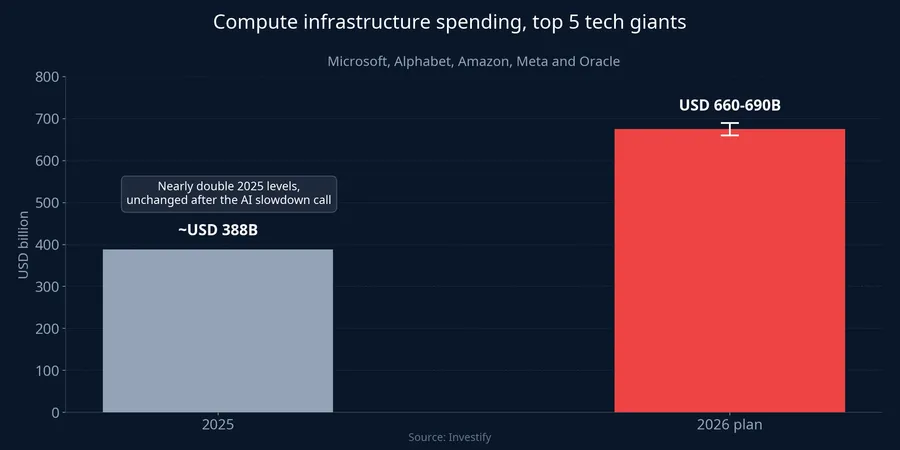
Both things are true at once because they describe two different variables. What's being asked to slow down is the release cadence of new model capabilities. What's ramping up is the scale of machines, power, and data centers serving both training and inference. A model that's evaluated longer before launch still consumes the same amount of compute, often more, since safety evaluation itself needs machines running.

Why the White House pushed back
The interesting part is that the two sides don't actually disagree on China policy. Trump wants to keep America's lead; Amodei is proposing chip restrictions to protect that exact lead. The real disagreement is domestic: whether US labs should impose a voluntary speed limit on themselves. To the White House, a voluntary cap like this is an unnecessary risk, since there's no mechanism guaranteeing rivals will hold back too. That's precisely the point Amodei himself concedes is the hardest part of his own proposal.
How markets are reading this
The first reaction hit chip stocks. Per Bloomberg's analysis, chipmakers and their supply chain could face short-term selling pressure, but the long-term investment case remains intact since compute infrastructure spending hasn't cooled.Business Standard
It's also worth acknowledging that this morning's 1.2% futures decline doesn't have a single explanation. At least three factors converged in the same window: concerns about the pace of AI development, a hotter-than-expected US August CPI reading of 3.4% year-over-year (versus a 3.3% forecast, pushing up expectations for a Fed rate hike at the September 15-16 meeting), and oil prices climbing back up in the same session.CBS News The latter two factors were already present in the market before the weekend, meaning AI news's standalone contribution is smaller than the headlines suggest.
The transmission channel to Vietnamese stocks
Vietnam's tech sector sits outside the value chain this proposal touches. No listed company here sells advanced chips or trains frontier models. The only transmission channel is market sentiment and foreign capital flows, and notably, this group had already worked through most of its correction beforehand.
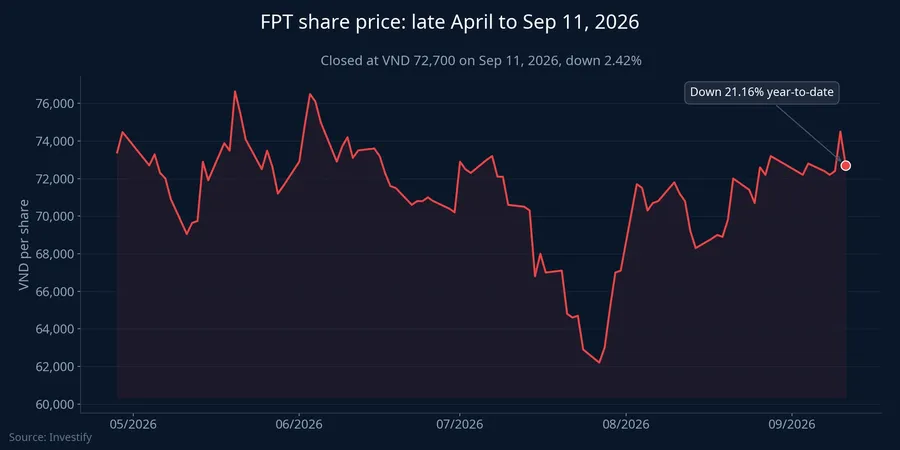
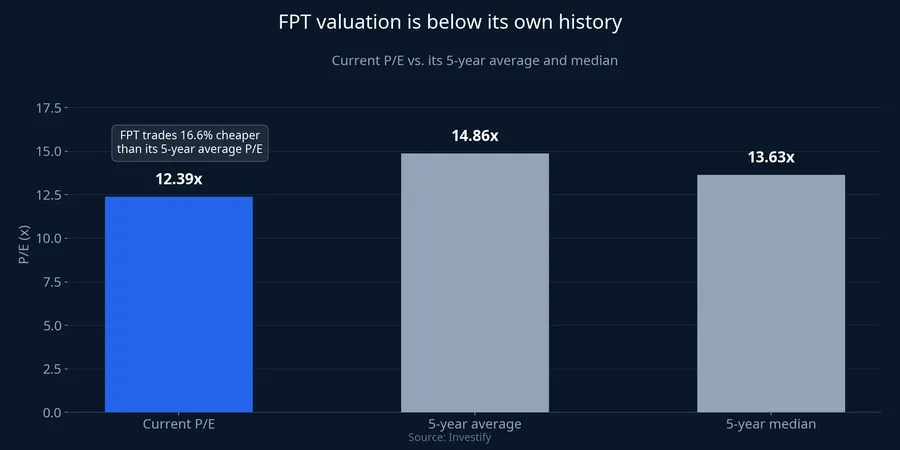
On September 11, FPT closed at VND 72,700, down 2.42%, and the stock has lost 21.16% of its value year-to-date. Valuation has adjusted accordingly: FPT's current P/E stands at 12.39x, 16.6% below its own 5-year average of 14.86x.
FPT's standing in the broader market, though, remains intact. The stock holds a 6.83% weight in the VN30 basket as of September 11, and appears in 18 of 23 equity open-end funds in Vietnam as of the August 31, 2026 reporting period, with an average weight of 4.10% of net asset value. That 4.10% figure sits well below its 6.83% market-cap weight, suggesting active funds are holding FPT below the market-implied weight rather than chasing it.
The broader backdrop isn't light either. The VN-Index closed the September 11 session at 1,795.21 points, down 1.86%, with 278 decliners against 46 advancers on the Ho Chi Minh City exchange. The index had already lost the 1,800-point level before the AI news broke. That timing shows most of the selling pressure in Vietnam came from other factors, not from the AI slowdown call.
What to watch this week
The real question for the week of September 14-18 is what kind of decline this global tech selloff actually is. If it's a reaction to the pace of AI capability upgrades, pressure should concentrate in semiconductors and equipment, while compute infrastructure and power names hold their ground, since the USD 660-690 billion spending plans of the top five providers don't change because of one essay. Confirmation would come from those same five companies updating their own capex guidance.
If it's instead a reaction to inflation and the Fed meeting, the decline should spread evenly across the whole market rather than concentrating in tech, and the rate decision early Thursday morning Vietnam time will be the resolving signal. For domestic investors, the indicator worth watching isn't AI headlines but net foreign buying and selling in large-cap names over the first few sessions of the week. Sentiment imported from Wall Street typically fades within two to three sessions if foreign capital flows don't reverse alongside it.