

On September 21, 2026, global index funds began buying Vietnamese stocks under the FTSE All-Cap basket, after Vietnam's upgrade to Secondary Emerging Market status officially took effect.Dân Trí The banking sector has eight names on the list: VCB, BID, VPB, HDB, SHB, STB, SSB, and MSB.
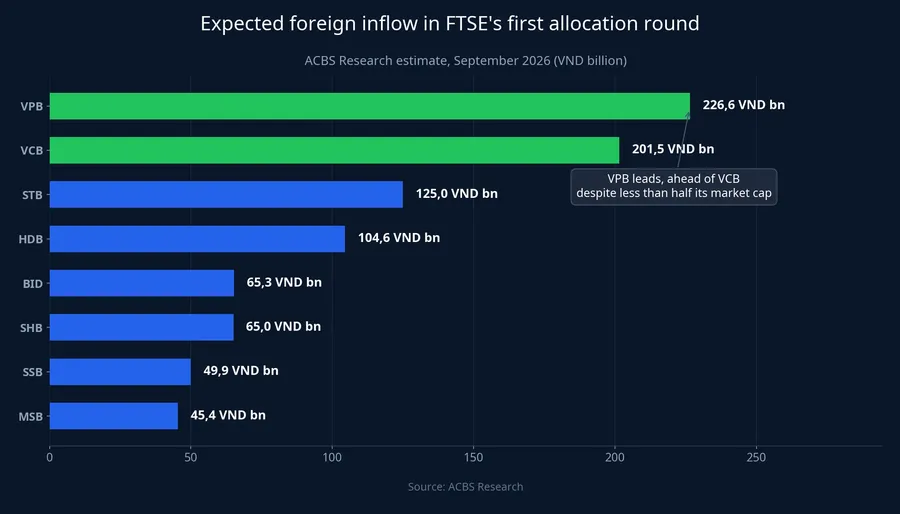
Looking at the allocation numbers, the picture reads against ordinary intuition. At the close on September 11, Vietcombank (VCB) had a market cap of VND 486.3 trillion, more than double VPBank's (VPB) VND 213.8 trillion. Yet per ACBS Research's estimate for the first allocation round in September, VPB leads the whole group with VND 226.55 billion, while VCB gets only VND 201.54 billion.Dân Trí
The four banks at the bottom of the table, BID, SHB, SSB, and MSB, together receive VND 225.62 billion, still less than VPB alone. The simplest reading, "the biggest bank benefits the most," fails on the very first example.
Why exactly these eight banks made the cut
FTSE Russell's semi-annual review on August 21, 2026 added 27 Vietnamese stocks to the FTSE All-Cap basket: 3 large-cap, 3 mid-cap, and 21 small-cap names.Fili Among the banks, VCB sits in the large-cap group, BID and VPB in mid-cap, and the remaining five in small-cap.
The screening criteria cover investable market cap, liquidity, free-float ratio, and foreign ownership room. For new constituents, FTSE Russell's rule requires unused foreign room to remain at least 20% of the ownership ceiling, not 20% of charter capital.FTSE Russell That is why some large names sat out this addition despite meeting size and liquidity thresholds, including Techcombank (TCB) and Mobile World (MWG), whose foreign ownership was already close to the cap.
In other words, the ticket into the basket does not go to the largest bank, but to the bank with room left for foreigners to buy more. That is the first clue explaining why the money allocation table later does not follow market-cap order.
Free-float-adjusted cap, not full cap, drives the weighting
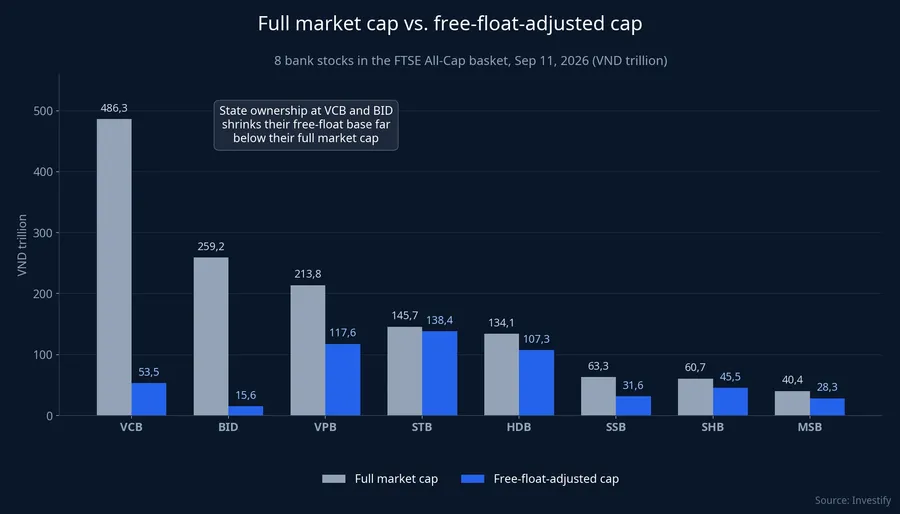
FTSE All-Cap weights constituents by free-float-adjusted market cap, after stripping out shares held by the state and strategic shareholders. This adjusted figure, not the full market cap, is the actual base for allocating money.
The state holds 74.8% of VCB, so its free-float ratio is only 11%, pulling its allocation base down to VND 53.49 trillion. BID is even more constrained: it has the group's second-largest market cap, but a free-float ratio of just 6%, leaving an allocation base of only VND 15.55 trillion, the lowest of all eight stocks.
On the other side, Sacombank (STB) reaches a free-float base of VND 138.44 trillion, VPB reaches VND 117.60 trillion, and HDBank (HDB) reaches VND 107.31 trillion, all far above VCB despite much smaller full market caps. This is the direct reason VPB ranks above VCB in the foreign money allocation table.
Two indices, two fund layers tracking them
VCB, BID, and VPB are also added to FTSE All-World, alongside VIC, VHM, and HPG. That index focuses on large- and mid-cap names and has its own tracking fund layer. These three banks therefore receive money from two fund groups instead of one, an important offset for VCB.
This second layer explains why VCB still ranks above STB in the final allocation table, even though VCB's free-float base is less than 40% of STB's. But it does not rescue BID: the second fund layer still multiplies on top of too small a base, so BID receives only VND 65.29 billion, roughly the same as SHB, a bank with one-fourth its market cap.
Foreign room determines how much a bank can absorb
The third axis is current foreign ownership and remaining room, two different numbers that should not be conflated. The ownership ratio is what foreign investors already hold; remaining room is the unused portion of the cap.
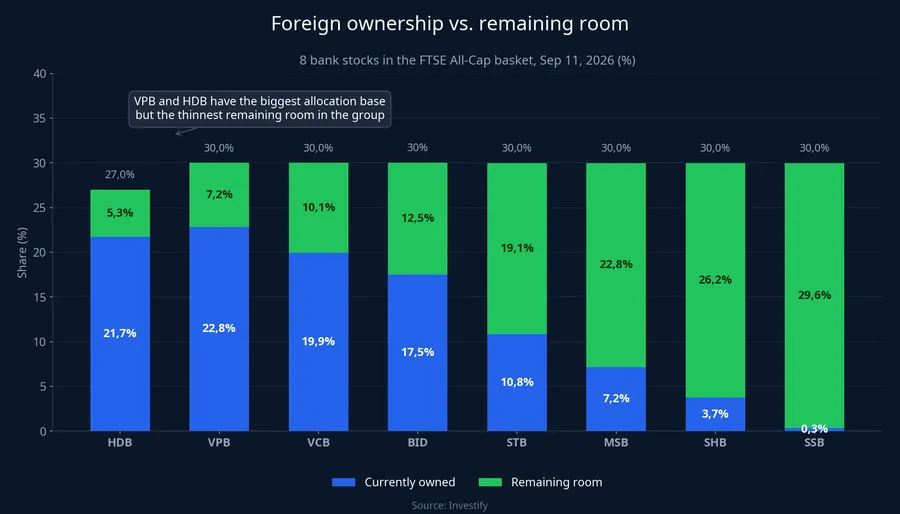
The data reveals a paradox right within the leading group. VPB and HDB have among the highest free-float-adjusted bases, yet their remaining room is the thinnest in the group, at 7.15% and 5.28% respectively. The thinner the unused ceiling, the narrower foreign investors' capacity to buy more, and the actual allocated weight gets cut below the theoretical level.
The reverse is not automatically an advantage either. SeABank (SSB) has almost all its room intact at 29.65%, and SHB has 26.24% left, but their free-float-adjusted bases are only VND 31.65 trillion and VND 45.50 trillion. Wide room paired with a small allocation base still means little index money flows in.
For VCB, the nominal room stands at 10.05%, but Mizuho holds 15% of the bank's capital under a strategic partnership agreement, which narrows the actual tradable room below the headline figure.Vietstock VPB has SMBC holding 15% and BID has KEB Hana holding 14.2% under similar arrangements, so the nominal room at all three banks needs a discount before comparison.
The real scale of the first tranche
The VND 883.27 billion figure needs to be measured against the daily trading liquidity of these same eight stocks to see it in proportion. On September 11, total trading value across the eight stocks was around VND 2,980 billion. VPB alone traded nearly VND 742 billion in a single session, while the index money allocated to it in this first round was only VND 226.55 billion, less than a third of that.

The reason lies in the schedule: the September 21 round only loads 10% of the target weight. Three more rounds follow: 20% in March 2027, 35% in June 2027, and the final 35% in September 2027.
It should be noted that the per-stock allocation figures are all brokerage estimates, not official FTSE data, and they diverge significantly across firms. SSI Research estimates VPB will draw around USD 71.3 million over the full schedule and ranks HDB above VCB.Người Quan Sát MBS Research estimates all eight banks will draw around USD 26.7 million in the first round and also places HDB in the lead.Người Quan Sát A September 13 update citing MBS shows notably higher estimates for VPB and VCB.CafeF
The specific ranking, then, depends on each research house's assumptions. The more durable common thread across estimates is that VPB is almost always at the top, while BID, SSB, and MSB consistently sit at the bottom.
How individual investors should read this signal
The easiest wrong reading is to treat basket inclusion as a single ticket benefiting the whole banking sector. All eight stocks are in the same basket, but money is split by free-float-adjusted base and capped by remaining room, so the gap between the top and bottom stock reaches nearly fivefold in the very first round.
The second easy mistake is expecting this money flow to move prices noticeably in the short term. At less than a third of a single day's trading value for this same group, the first allocation round is a gradual support factor spread across a four-year schedule, not an immediate catalyst. The September 11 session shows the whole group still declining: VPB fell 2.00% to VND 26,950, HDB fell 2.37% to VND 26,800, and BID fell 2.06% to VND 35,600.
The signal worth watching after September 21 is the foreign ownership ratio at VPB and HDB, the two stocks with the thinnest room in the group. If room gets filled further in the sessions after the effective date, that is evidence the index money has actually arrived. If room stays flat, the first allocation round has not yet reached these two stocks' price level.
VPB carries one more variable of its own: a planned private placement to foreign investors. If that placement closes, VPB's available room changes, and its absorption of index money in the three remaining rounds of the schedule will change with it. That is a point worth watching when VPB announces the placement's progress in coming quarters.