
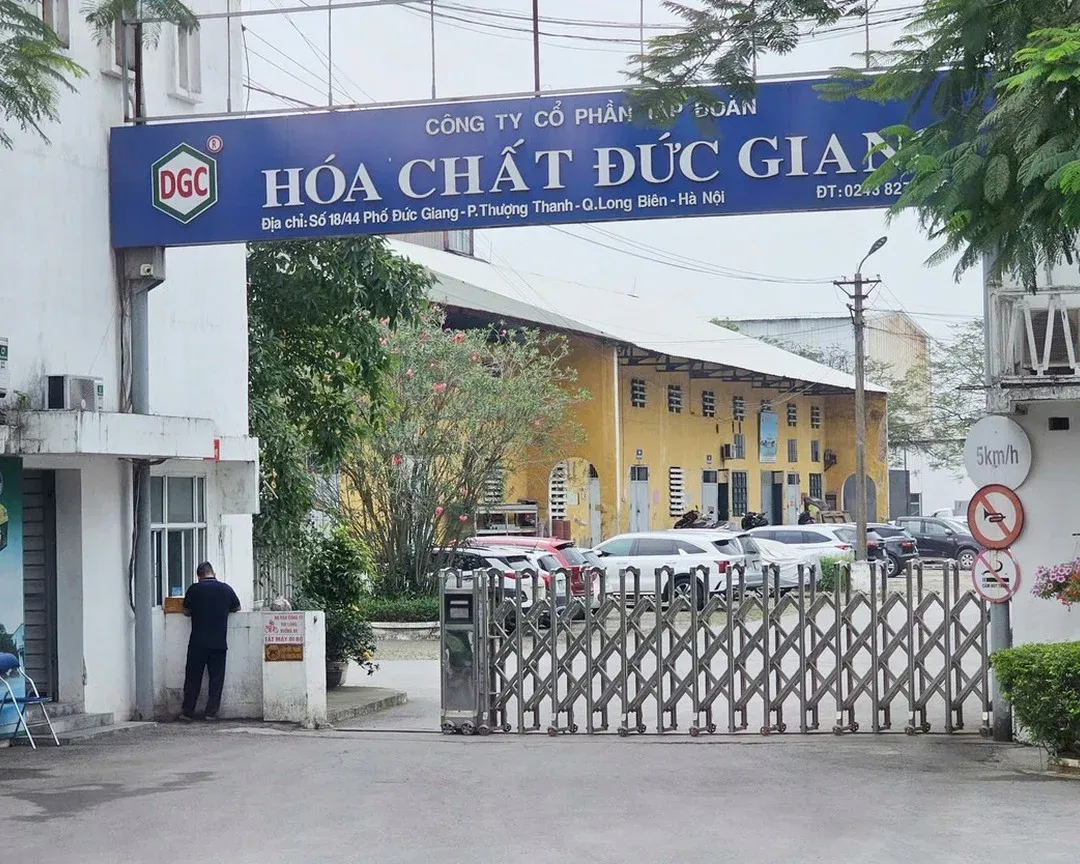

On the morning of Monday, September 14, Duc Giang Chemicals' reference price will open exactly VND 8,000 lower than Friday's close. Nobody dumped the stock, and nothing went wrong with the company. That gap is a mechanical adjustment the exchange applies on the ex-dividend date, and it's the single most misunderstood moment for new investors every dividend season.
Here's the simple way to think about it: a cash dividend isn't a bonus that appears out of nowhere. It's a slice of value already sitting inside the share price, converted into cash in your account. The week of September 14-18, 2026 is one of the busiest ex-dividend weeks since early Q3, with nearly 40 companies going ex-dividendMekongAsean, including 32 cash payouts spread across HOSE, HNX, and UPCoM.CafeF
The calendar and the deadline most people miss
To collect a dividend, you must own the stock before the ex-dividend date. Buy on that date or later, and the right already belongs to whoever sold it to you, no matter how long you go on to hold the shares.
This week's key dates: DGC and Duoc Hau Giang (DHG) both go ex-dividend on September 14, so the cutoff to buy already passed on Friday, September 11. DGC is paying a total of VND 8,000 per share (VND 5,000 remaining from 2025 plus a VND 3,000 advance for 2026's first installment), with payment expected September 25. DHG is paying VND 5,000 per share, expected September 30, for a total outlay of VND 653.5 billion.
Habeco (BHN) goes ex-dividend September 15, making Monday the 14th the last day to buy in time; it's paying a combined VND 2,840 per share covering both the 2024 and 2025 fiscal years. Viettel Global (VGI) goes ex-dividend September 17 at a 33% ratio, or VND 3,300 per share, and is also the largest company by market cap on this week's list at roughly VND 255.7 trillion. An Giang Mechanical (CKA) closes out the week with an ex-dividend date of September 18. Beyond cash payouts, Techcom Securities (TCBS, ticker TCX) set September 18 as the record date for a 20% stock dividend, issuing nearly 555 million new shares.CafeF
Why the reference price drops by formula, not by selling pressure
On the ex-dividend date, the new reference price simply equals the prior close minus the dividend paid per share.CafeF The logic is straightforward: the company just moved a chunk of cash off its balance sheet to pay shareholders, so each remaining share now represents less underlying value, by exactly the amount distributed. Think of it like slicing a pie to hand out a piece to everyone at the table: the piece left on the plate is naturally smaller.
Applied to this week's numbers, some of these cuts are large. DGC closed at VND 46,750 on September 11; its reference price on September 14 drops to VND 38,750, a 17.1% decline. DHG closed at VND 95,500 and drops to VND 90,500, down 5.2%. BHN closed at VND 31,500 and drops to VND 28,660, down 9%. CKA closed at VND 67,900 and drops to VND 55,900, down 17.7%.
The cuts on DGC, BHN, and CKA all exceed the daily price-band limit for a normal trading session, but none of these are limit-down sessions. The trading board uses the adjusted reference price as its baseline for calculating percentage change, so you won't see a red 17% drop flash across the screen. What you will see is your portfolio's value dip while the dividend cash hasn't landed in your account yet.
Headline payout ratios are on VND 10,000 face value, not on what you paid
This is where confusion runs deepest, and it's worth walking through carefully. The cash dividend ratio a company announces is always calculated on the VND 10,000 face value of the shareGoValue, never on the market price you actually paid.
An Giang Mechanical's headline "120%" means VND 12,000 per share, the highest cash payout in the market this weekMarketTimes and the highest this company has paid since listing on UPCoM. But set against its market price of VND 67,900, that payout is only 17.7% of what an investor actually spent. The number worth comparing is 17.7%, not 120%.
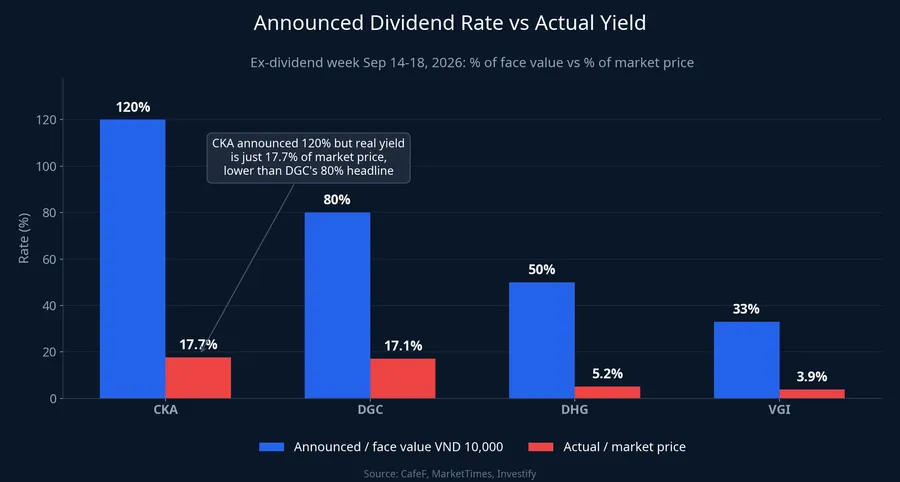
Run the same conversion on the rest of the list and something interesting shows up: DGC's 80% headline works out to 17.1% of market price, nearly matching CKA despite a much lower announced ratio. DHG's 50% is only 5.2%, and Viettel Global's 33% is just 3.9% at its September 11 close of VND 84,000. Two stocks with headline ratios more than twice apart end up almost swapping rank once you look at actual yield. That's exactly why you shouldn't rank how attractive an ex-dividend event is just by scanning the percentage on the announcement.
One note on ownership structure at CKA: the company has only about 3.3 million shares outstanding, and total dividend outlay this round is just over VND 39.4 billion, with three major shareholders holding 94.8% of equity. Very little of that dividend flows to outside investors, and the stock's daily liquidity runs to only a few thousand shares.
The 5% tax and the time gap between the two ends
The amount cut from the price and the amount that lands in your account are not the same, and this is the part that hits your wallet directly. Cash dividends count as investment income and are subject to a 5% personal income tax withheld at source before the paying company transfers any cash.Cong Ty Luat ACC
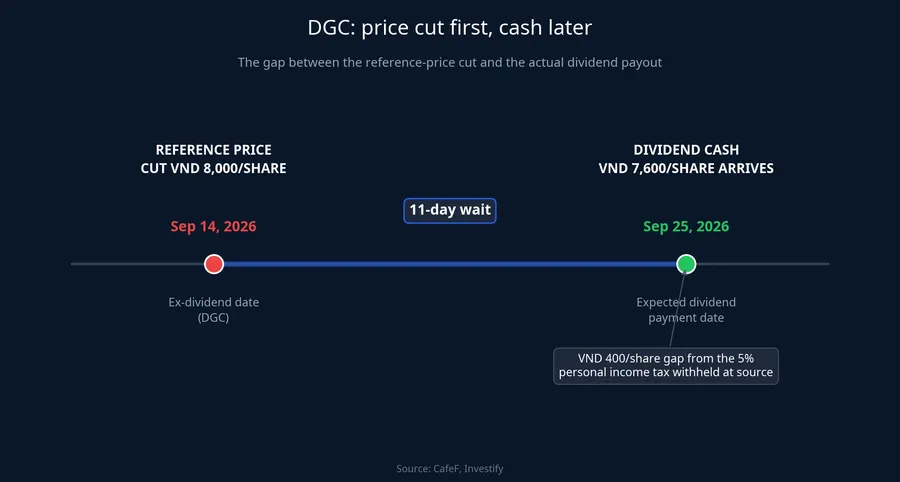
For DGC, the reference price drops by VND 8,000 but the actual cash received is only VND 7,600 per share, a VND 400 gap equal to 0.86% of the September 11 market price. For DHG, the gap is VND 250. For CKA, it's VND 600 per share.
Then add the payment lag on top: DGC cuts its price on September 14 but pays out on an expected September 25, 11 days later. DHG pays September 30, 16 days later. Habeco cuts its price September 15 but isn't expected to pay until October 16, a 31-day gap. During that window, the value has already left the share price without yet showing up in your cash balance, and the stock keeps trading with all the normal volatility of any other day.
Three things to check before you look at an ex-dividend calendar
None of this means cash dividends are bad news, quite the opposite. A company that pays cash dividends consistently is showing real operating cash flow, which is very different from a stock dividend that simply splits existing shares into more, smaller pieces without moving any actual cash to shareholders. DHG raised its total 2025 payout ratio to 100% after already paying its first installment in late May, and Habeco is back to paying two fiscal years together. Both are worth noting as signals about a company's cash-generating ability.
So what should you actually do when an ex-dividend calendar crosses your feed? Three simple checks.
- Convert the announced ratio to market price to find your real yield, and don't let a big headline percentage create a false sense of the payout.
- Cross-check the ex-dividend date against your own trading calendar to know the last session you can still buy in time, so you don't accidentally buy after the right has already transferred.
- Read where the dividend cash comes from in the latest financial statement, checking whether it's funded by current-period profit or by retained earnings built up over prior years.
The specific line item to look for is net cash flow from operating activities in the most recent quarterly report. If a company generates more operating cash than the dividend it's about to pay, that payout is sustainable. But if it has to draw down years of accumulated retained earnings while current results are declining, this round's high payout tells you little about the next one. The following quarter's earnings report is where that question actually gets answered.