

On September 21, 2026, Vietnam officially moves from frontier to secondary emerging market status in FTSE Russell's index system. The common assumption among retail investors is simple: foreign capital flows in, and the largest-cap stock benefits most.
Vingroup (VIC) is indeed the largest-weighted stock in FTSE Russell's Vietnam basket. Per an estimate from BIDV Securities (BSC), VIC could receive around VND 1,706 billion in the first tranche alone from funds tracking the FTSE GEIS index, the largest inflow among the 27 Vietnamese stocks added to the basket.CafeF
But that is only one side of the flow. The same week, three foreign ETFs mid-way through their Q3 rebalancing are selling that very stock.

Three foreign ETFs are selling VIC in the same week as the upgrade
Those three funds are Fubon FTSE Vietnam ETF, VanEck Vietnam ETF and Xtrackers Vietnam Swap UCITS ETF, with combined assets under management BSC estimates at more than USD 1.25 billion. After adding in the expected selling from these three funds, BSC calculates VIC's net flow this period could still be negative by roughly VND 960 billion.CafeF
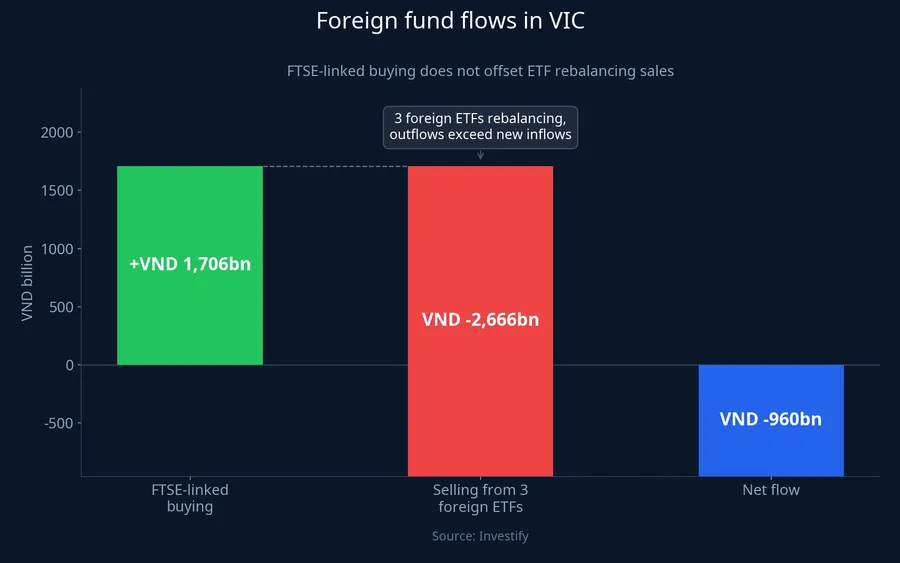
The notable overlap is in timing: funds tracking FTSE GEIS must complete their buying no later than September 18, the same day the three foreign ETFs finish their rebalancing. Two opposing flows are converging in the same week, on the same stock.
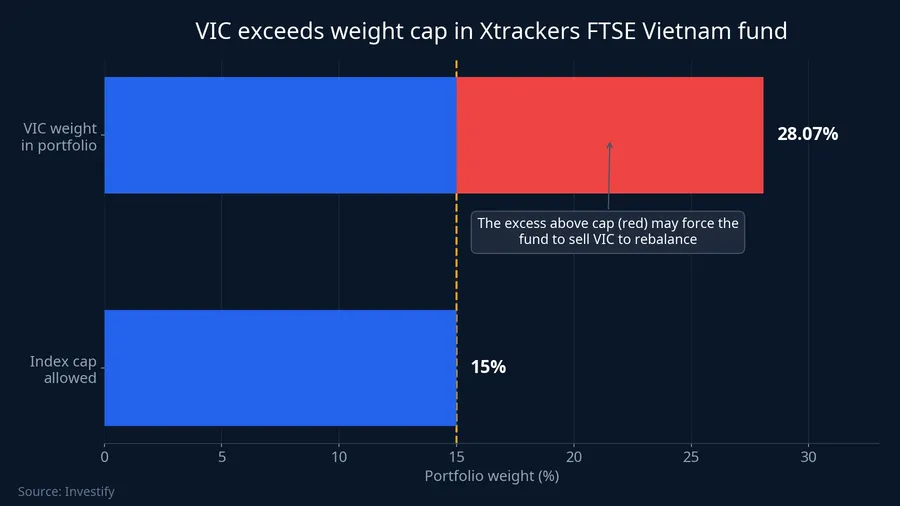
The heaviest selling pressure comes from Xtrackers. Per Yuanta Securities Vietnam (YSVN), VIC's weight in this fund's portfolio could fall from 28.07% to the 15% cap, implying sales of roughly 5.55 million shares worth nearly VND 1,310 billion at the August 28 closing price.CafeF VPS estimates around 6 million shares and nearly VND 1,240 billion, while BSC estimates around VND 1,490 billion. Three different figures, but all pointing the same direction: selling.
For VanEck, the Q3 review of the MarketVector Vietnam Local Index, published September 11, shows the fund expected to sell about USD 12 million of VIC, equivalent to 1.3 million shares.CafeF
Why funds are selling the largest-cap stock
The reason is not that funds are downgrading their view of Vingroup. It is VIC's own price surge. From VND 202,000 per share on August 20, the stock rose to VND 256,100 on September 4, up 26.8% over eleven sessions, before closing at VND 243,300 on September 11, still 20.4% higher than August 20. Vingroup's market capitalization rose to roughly VND 1.87 quadrillion as a result.
When a stock rises faster than the rest of a portfolio, its weight balloons without the fund buying a single additional share. The STOXX Vietnam Total Market Liquid index that Xtrackers tracks caps any single stock at 15%, precisely to guard against concentration risk: an index fund putting nearly a third of its assets into one name stops being an index fund and becomes a bet on a single company. Once VIC hit 28.07%, nearly double the cap, the rule forces the fund to sell down to the threshold, regardless of what the fund manager thinks about Vingroup.
The evidence for this explanation sits right inside the portfolio itself: capital freed up from VIC is not leaving the Vietnamese market but, per YSVN's forecast, is being reallocated to other names in the same basket, including roughly VND 349 billion into VHM, VND 240 billion into STB and VND 211 billion into FPT.CafeF After the reduction to 15%, VIC remains the largest holding in the Xtrackers portfolio.
Two alternative explanations deserve acknowledgment: the selling could partly reflect fund redemptions forcing a pro-rata sale across the whole portfolio, or a change in the liquidity criteria used in the review could have altered the index composition. Neither is supported by the data available: if redemptions were the driver, other names in the portfolio would also be sold rather than bought, as VHM, STB and FPT were; and on composition, this review added no new names to the STOXX index and removed only one steel stock. The gap between 28.07% and the 15% cap remains the direct explanation, and it is sufficient to account for most of the selling volume.
This week's price action does not yet reflect the sale
One easy misread: VIC dipped slightly during the week of September 8-11, and many attributed this to the rebalancing news. The data does not support that reading.
During this week, foreign investors were still net buyers of VIC to the tune of roughly VND 210.1 billion, with September 10 alone seeing net buying of nearly VND 248.7 billion. VIC fell just 0.69% for the week versus the September 7 close, while the VN-Index alone lost 1.86% on September 11. This shows VIC actually fell less than the broader market, because the actual rebalancing sale has not happened yet. Foreign ETFs typically concentrate their trading in the closing auction (ATC) session on the day their portfolios lock, which is September 18.
Read net flow, not gross flow
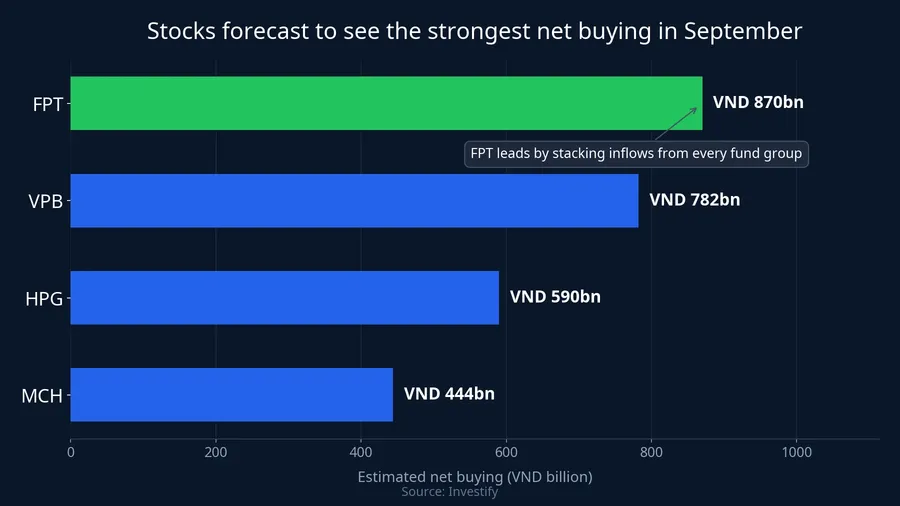
Placing both sides side by side, the list of stocks that benefit most on a net basis this September does not match the list of stocks receiving the most upgrade-related inflows.
Per BSC's tally, FPT is the stock forecast to see the strongest net buying, at roughly VND 870 billion after netting the impact from every fund group, followed by VPB at around VND 782 billion, HPG at around VND 590 billion and MCH at around VND 444 billion.CafeF The logic is straightforward: these names are being bought from both directions, sitting in the FTSE GEIS basket while also being added by Fubon during its rebalancing, with VPS estimating Fubon's purchases at nearly VND 600 billion for VPB and more than VND 554 billion for FPT.
Another case following the same logic is SeABank's SSB, newly added to the MarketVector basket, with VanEck expected to buy about 13.2 million shares, worth roughly VND 253 billion per YSVN's estimate.CafeF On the other side, CEO is being dropped from the MarketVector basket, and VanEck will sell its entire holding.
The common thread across all these cases: each fund follows its own index, run by its own provider, with its own selection criteria, weight cap and review calendar. MarketVector, STOXX and FTSE Russell are three independent organizations. FTSE's upgrade of Vietnam does not change a single line in MarketVector's or STOXX's rules, so two fund groups can perfectly well buy and sell the same stock in the same week without any contradiction.
The scale of upgrade inflows and the dates that matter
On overall scale, estimates vary widely. BSC believes the four tranches through September 2027 could bring in a combined total of roughly USD 2 billion for the 27 Vietnamese stocks, while VPS puts the figure higher, at nearly USD 2.4 billion, with most of it coming from Vanguard-affiliated funds.CafeF These are all securities-firm forecasts, not final fund figures, and actual volumes will still depend on share prices, fund inflows and outflows, and each fund's asset value at the time its portfolio locks.
The calendar to remember over the next two weeks is straightforward. September 18 is the deadline for both the FTSE GEIS fund group's buying and the three foreign ETFs' portfolio lock, with most of the volume concentrated in the ATC session. September 21 is when the new index compositions take effect for trading, and the day the market upgrade officially applies.
A framework for investors
The practical lesson from this episode is not that "the upgrade doesn't matter." Passive capital flowing in over the four-tranche roadmap through September 2027 remains a genuine support for liquidity and valuations among large-cap names. The lesson is about how to read the numbers: for any individual stock during this period, the figure that matters is the net flow after netting buying and selling from every fund group, not the gross size of upgrade-related inflows. VIC is the clearest example: it received the largest upgrade inflow among all 27 stocks, and its net flow could still be negative.
Two numbers worth watching over the next two weeks are the ATC matched volume for VIC on September 18 versus its average of roughly 5.9 million shares per session, and foreign net buying and selling in the week starting September 21. If the rebalancing sale is fully absorbed in the September 18 session and foreign investors turn net buyers again right after, this pressure is exactly the one-off technical event it appears to be. If net selling persists into late September, the story has moved beyond the scope of index rebalancing.