

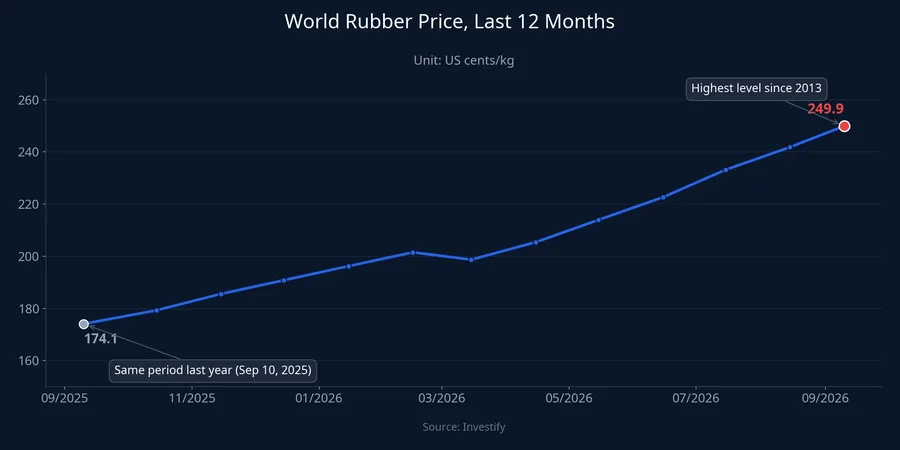
World rubber prices are sitting at their highest level since 2013. On September 10, 2026, the international benchmark contract closed at 249.9 US cents/kg, up 43.5% year-on-year. TSR20, the grade closest to what Vietnam exports, has climbed to USD 2,468/ton, the highest in nearly 13 years.Doanh Nghiệp Hội Nhập
For investors, the next question follows almost automatically: how much of this price environment is flowing through to listed rubber companies? Vietnam Rubber Group (GVR), the largest rubber company on the exchange, just posted a very large profit number. But read the financial statement closely, and the structure behind that number looks nothing like what most people would assume.
Why rubber prices are climbing
This rally has two layers of causes with very different staying power. The first is weather: prolonged heavy rain in Thailand, the world's largest natural rubber producer, disrupted tapping right at the peak of the Southeast Asian harvest season, pulling combined seven-month export volumes from Thailand, Vietnam and Indonesia down almost 15%, to roughly 2.98 million tons.Doanh Nghiệp Hội Nhập That's a temporary factor: once weather normalizes, supply recovers.
The second layer is more durable and gets less attention: oil prices. Elevated crude has made butadiene, a byproduct of oil refining, scarce, pushing up the cost of synthetic rubber and prompting downstream factories to shift part of their demand to natural rubber.Doanh Nghiệp Hội Nhập Add in forecasts of an intensifying El Niño from September through November 2026, and the short-term supply-demand balance still tilts toward higher prices.
Reading GVR's profit number
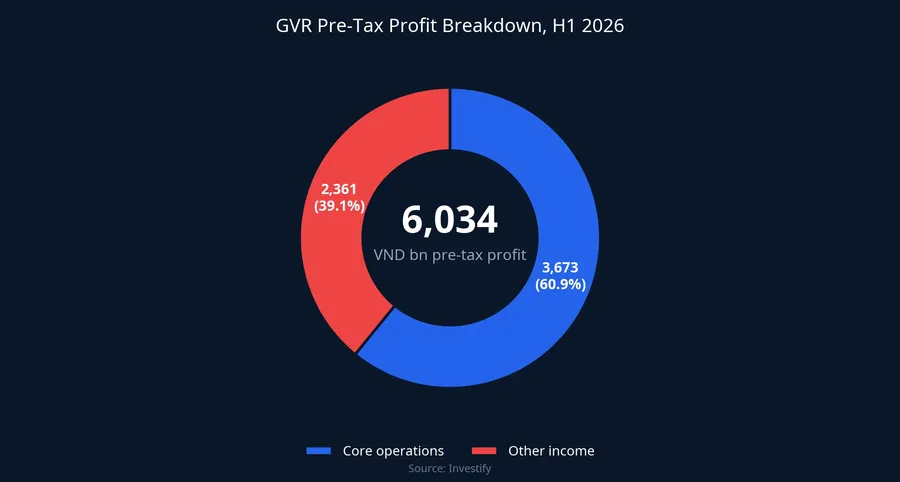
Per GVR's consolidated Q2 2026 financial statement, pre-tax profit for the first half of the year reached VND 6,034 billion, up almost 72% year-on-year. Net profit after tax was VND 5,070 billion, up roughly 73%. Net revenue for the six months came to VND 15,943 billion, up nearly 38%.CafeF
The line worth pausing on is one that gets far less attention: other income of VND 2,361 billion for the period, up 192% from VND 808 billion in H1 2025, equal to 39.1% of pre-tax profit. Put differently, of every 10 dong of pre-tax profit GVR booked in the first half, nearly 4 never came from selling latex.
The group's own disclosure spells out the source: Q2 profit rose mainly on higher rubber prices versus the year-ago period, plus proceeds from liquidating rubber plantations and compensation received when land was handed back to local authorities at member units. In Q2 alone, other income hit VND 1,323 billion, up roughly 140%, while net profit from core operations came to about VND 1,750 billion, up 36%. These two figures need to be read side by side: the core business really did grow, at 36%, not an illusion, but the leap in the headline profit figure came from land-related cash flow.
Two revenue streams, two very different natures
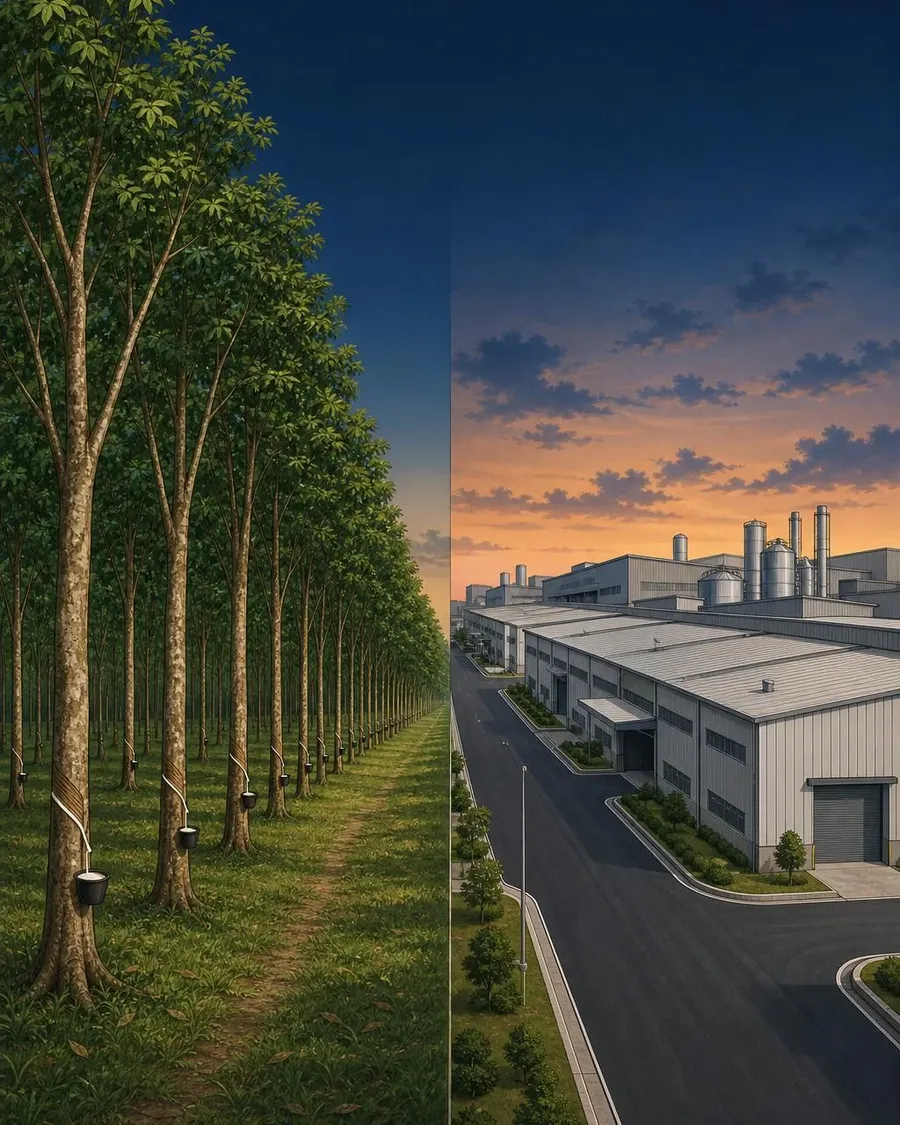
GVR is effectively running two business models on the same land bank. The first is tapping and selling latex, which accounted for 82.1% of H1 revenue per Vietcap's breakdown, with a gross margin of around 27.9%. This is a recurring, quarter-to-quarter revenue stream that moves with world rubber prices.
The second is converting rubber land into industrial parks. New industrial land leasing contributed just 2.7% of H1 revenue, but carries a gross margin of up to 55%, nearly double the latex business. More importantly, most of the cash from land right now isn't arriving as leasing revenue at all: it's arriving as one-off compensation when land is handed back to local governments, booked straight into other income rather than as a recurring line.
The scale behind this is substantial. Almost 23,500 hectares of rubber land have already been approved for conversion to industrial land,Tạp Chí Công Thương and SSI projects GVR's industrial park land bank will reach 23,444 hectares by 2030, 3.6 times the 2024 level.DNSE That's a real long-term story. The problem is the recognition pattern is uneven: in years with heavy land handovers, profit jumps; in years without, that line disappears from the report.
Why global prices take longer to reach the business than expected
There's a detail the international price chart alone doesn't show: the pass-through into domestic raw material prices is quite slow. In the first week of September 2026, as world prices kept climbing, procurement prices at major rubber companies stayed flat for a sixth straight week.Doanh Nghiệp Hội Nhập For companies that buy latex to process, flat procurement costs against rising export prices mean widening margins, which is exactly the mechanism behind the genuine 36% improvement in core profit noted above. But it also shows that the rise in world prices doesn't flow through in full, or immediately, into the results of Vietnamese producers.
The sector-wide export picture makes this even clearer. Over eight months, Vietnam exported 944,900 tons of rubber worth USD 1.88 billion, down 15.4% in volume and 5.1% in value year-on-year.Người Quan Sát The average selling price over seven months reached USD 1,986/ton, up 11.9% year-on-year.Báo Văn Hóa Put these two figures side by side and something important for new investors emerges: the international benchmark rose 43.5% over the year, while Vietnam's actual average selling price rose only about 11.9%. The two numbers measure different things. One is a spot contract for a premium grade; the other is the contracted selling price for Vietnamese output, mostly SVR grade. That gap is why sector-wide export revenue over eight months still fell 5.1% even as prices hit a multi-year high.
What the market is actually pricing in
GVR shares closed the September 11, 2026 session at VND 30,000, down 5.36% on the day. Over three months, GVR has lost 15.25% from VND 35,400 on June 11, and versus its March 3, 2026 peak of VND 45,750, the current price is 34.4% lower. Notably, over that same three-month window the VN-Index was essentially flat, down just 0.19%, so GVR's move can't be explained by broader market direction.
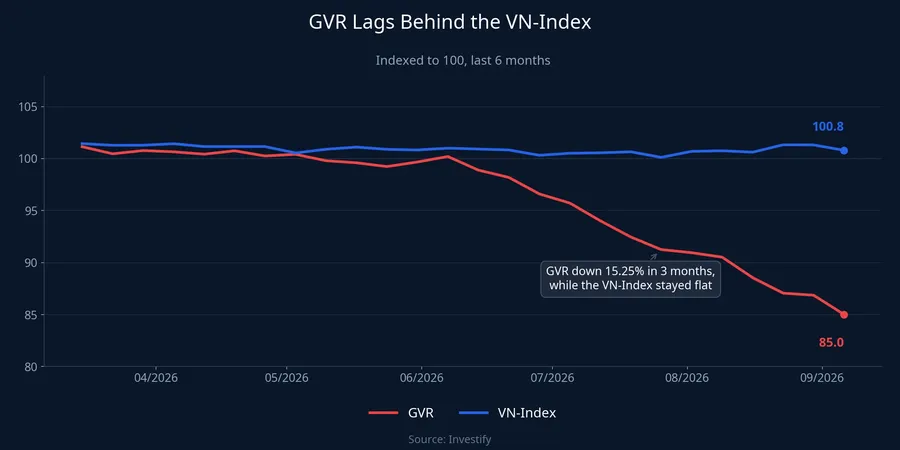
At least three explanations coexist. First, expectations were already priced in early: GVR jumped 66% in just the first two months of the year, from VND 27,550 to VND 45,750, well before rubber prices reached their current highs, so the subsequent pullback may simply be valuation catching back down to a run that got ahead of itself. Second is earnings quality: when nearly 40% of pre-tax profit comes from a one-off item, markets typically apply a lower multiple to that portion. Third, the September 11 session saw the broader market fall 1.86% with 278 decliners on HOSE, so part of GVR's 5.36% drop that day reflects general market pressure.
The available evidence leans more toward the first explanation, since the 66% run-up early in the year far outpaces the improvement in core operations over the same stretch. That's a reasoned inference, not a firm conclusion. All three factors were at play simultaneously, and it's difficult to cleanly separate each one's exact contribution.
Risks to watch
Three risks stand out. The most immediate is the very factor pushing prices up: once the flooding in Thailand ends and harvest conditions normalize across producing countries, supply recovers and the portion of the price gain driven by weather disruption could fade, typically by late Q3 or Q4. The second is export market concentration: China still accounted for 58.85% of Vietnam's rubber exports over the first eight months of the year, though that share has fallen sharply from 71.3% in 2025 as India and Indonesia buy more. The third is the EU's anti-deforestation regulation, expected to take effect in late 2026, which adds new traceability requirements on exports. Specific to GVR, the risk is the uneven timing of land-related cash flow: the VND 2,361 billion in other income booked in H1 is real money, but it isn't a recurring quarterly revenue stream.
The number worth reading in the Q3 report
GVR's Q3 financial statement is due out at the end of October, and it will carry two lines worth reading side by side: net profit from core operations, and other income.
If net profit from core operations keeps growing at roughly the 36% pace seen in Q2, the improvement from higher rubber prices is real and durable, and shouldn't reverse just because the share price has already corrected. If, instead, the increase in total profit once again comes mainly from other income, then what's playing out is a land story, not a commodity story — and for investors tracking the rubber sector through the lens of world price charts, that's the single most important distinction to sort out.