


The week of September 7-11, 2026 closed with a result few people were braced for: the three channels Vietnamese retail investors know best all moved down in the same five sessions.
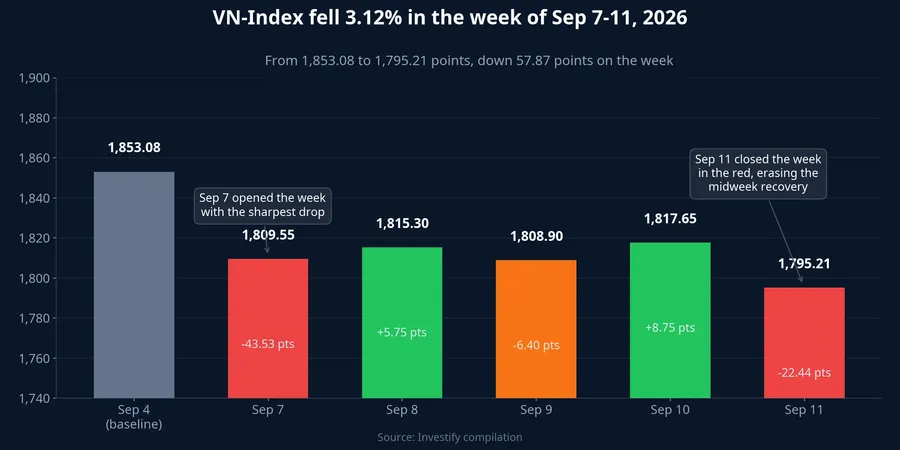
The VN-Index closed at 1,795.21 points, down 57.87 points from 1,853.08 the previous Friday, a 3.12% weekly decline.Nhân Dân SJC gold bars sold for VND 145.4 million per tael, down from VND 148.6 million, a 2.15% drop. The spot USD/VND rate slipped from VND 26,092.5 to VND 25,933.5, meaning the dollar got 0.61% cheaper against the dong. Put simply: anyone who moved out of stocks into gold or dollars this week still lost money, just less of it.
So the question worth asking isn't "why did the VN-Index fall," but something more practical for your wallet: which way of splitting your money actually softened the blow?
Stocks: the sector spread dwarfs the index decline
On Monday September 7, the index opened the week down 31.44 points, with 251 losers against 87 gainers. By Friday September 11, the index lost another 34.02 points while matched trading value jumped to VND 15,260 billion, the highest of the week. Volume spiking on the sharpest drop suggests sellers were acting deliberately, not buyers stepping back in.
Foreign investors sold net throughout the week, roughly VND 1,646 billion on HOSE, concentrated in banking and real estate.MarketTimes On Friday alone, they sold a net VND 944 billion, concentrated in MBB, VPB and VHM, just as 28 of the 30 VN30 stocks fell.Chứng khoán ASEAN
But the number that matters more for anyone holding a portfolio is the spread between sectors. Oil and gas production rose 1.32%, industrial goods rose 1.25%, travel and leisure rose 0.61%, and software was nearly flat. At the other end, electronics and electrical equipment fell a sharp 6.30%, financial services fell 5.32%, chemicals fell 4.67%, real estate fell 4.14%, and banking fell 2.30%.
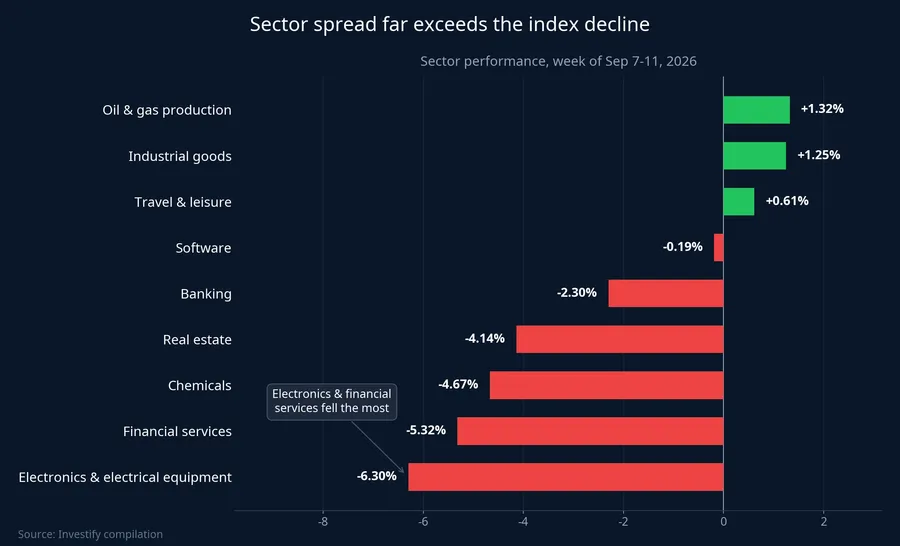
The gap between the best and worst sectors is more than 7.6 percentage points, over twice the index's 3.12% decline. That has a direct impact on your wallet: even within a single asset class like stocks, which sector your money sat in mattered more than whether the broader market rose or fell.
Gold and the exchange rate: no safe harbor this week
The familiar assumption is that when stocks turn red, money runs to gold. That is not what happened this week. World gold fell 1.03%, from $4,432.56 to $4,386.71 per ounce; domestic SJC gold bars fell further, down 2.15%; SJC 99.99% gold rings sold for VND 143.9 million per tael, down 2.18%. Domestic gold falling faster than world gold narrowed the SJC premium over the world price from around 6.57% to around 6.01%, a modest contraction that still leaves the gap very wide.
Both declining together can be read simply: domestic money didn't rotate into gold this week, it leaned toward sitting on the sidelines. On the currency side, the dong strengthened 0.61% against the dollar, meaning anyone holding foreign currency also booked a small conversion loss.
Worth stating plainly to avoid misreading this: it's a single week's result, not a structural trait of gold or the exchange rate. Gold remains a long-term inflation hedge, and a 2.15% weekly drop sits well within its normal range of swings. No single channel is guaranteed to turn green exactly when another turns red.
Bond funds: the asset class that barely moved
One group sailed through the week almost unchanged in value: bond funds, open-end funds that put most of their money into government and corporate bonds rather than stocks, which keeps price swings much smaller.
Per the latest available open-end fund data, Vietnam's 24 active bond funds carry a median year-to-date return of 4.19%, with a median annualized volatility of just 1.32%, versus 20.41% for the VN-Index: more than fifteen times lower. Scaled down to a single week, that group only edged up about 0.08%, essentially flat while the other three channels were all in the red. This isn't one lucky week: 2026 already saw two much deeper corrections, with the VN-Index falling 16.38% and then another 13.46% in separate drawdowns, yet bond funds through both episodes lost only an average of 1.53% and 1.29%, with even the worst-hit fund in the group down just 6.13%.
The label "fund certificate" says nothing about risk
This is where a wrong conclusion tends to creep in for new investors: buying a fund certificate must be automatically safer than picking stocks yourself. The 2026 data says the opposite.
Equity funds carry a median year-to-date return of negative 5.82%, while the VN-Index over the same period is still up 0.60%. Only 3 of 34 equity funds with available data beat the index; the group's median trails the VN-Index by 6.42 percentage points, even as investors keep paying management fees of 1.2-1.95% a year. Dispersion within the group is wide too: the top fund is up 3.13%, the bottom fund down 26.64%.
Balanced funds, a name that sounds like built-in diversification, don't automatically do better either: median year-to-date return is negative 2.84%. Mixing stocks and bonds in one product only means something once you know the actual equity weighting inside it, not when you simply trust the label.
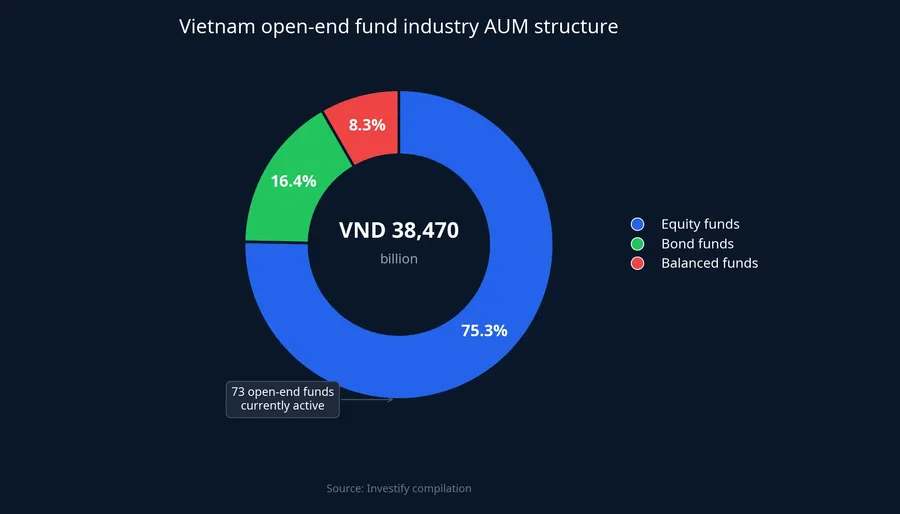
The industry-wide structure shows most money sits on the higher-risk side. Of the VND 38,470 billion in total assets under management across 73 open-end funds, equity funds hold 75.3% (VND 28,977 billion), bond funds only 16.4% (VND 6,313 billion), and balanced funds 8.3%. Three-quarters of the money in Vietnam's open-end fund industry is carrying exactly the risk the index just displayed this week.
Doing the math: how much does the split actually matter
Plugging this week's numbers into a few simple splits: an all-equity portfolio tracking the index fell 3.12%. A 70% equity, 30% bond-fund portfolio fell 2.16%. A 50-50 portfolio fell 1.52%.
What matters more than those three numbers is what they don't say: no split turned this week positive. Diversifying across asset classes softens the drawdown, it doesn't erase the loss.
The flip side deserves an equally honest look. Bond funds stayed steady this week because domestic interest rates didn't move much. If bond yields were to rise sharply, the bonds those funds hold would lose value and the group would post losses too, much like global government bond markets just experienced in early September. In exchange, that same allocation would drag portfolio returns below the index in a week when the market rallies hard. It's a two-way trade-off, not a free lunch.
What to read before rebalancing
A reasonable checklist has three items, and none of them is the product's name. First, the actual equity weighting inside whatever you hold, read from the prospectus or the monthly portfolio report, not inferred from a label like "balanced" or "growth." Second, that fund's own annualized volatility, benchmarked against the VN-Index's 20.41%. Third, how much the fund dropped during this year's two corrections in March and July, since those are the two most recent real stress tests the product has faced.
Capital thresholds are no longer an excuse to wait. Of the 52 funds offering recurring investment plans, the most common minimum per installment is VND 100,000, and some accept as little as VND 10,000. The practical question for individual investors isn't whether they have enough money, it's whether that money sits in one asset class or is spread across several.
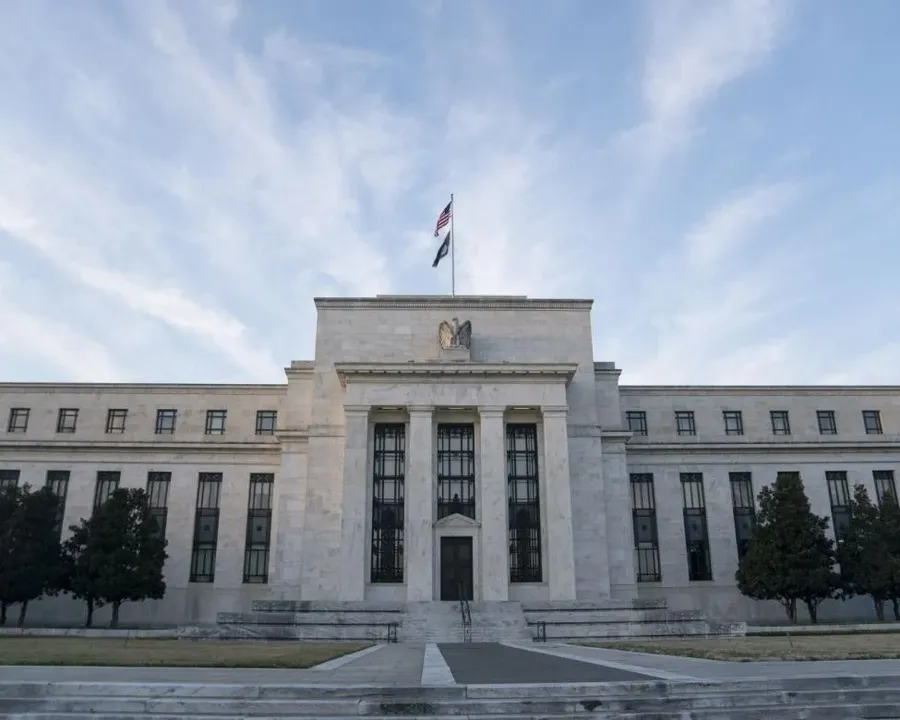
Next week, the Fed's policy meeting on September 15-16 is the earliest point that could answer this question. Per MarketTimes on September 7, markets were pricing in over a 60% probability of a 25-basis-point rate hike.MarketTimes That's still a market-implied probability, not a decision that has been made. If US bond yields and the dollar rise sharply after the meeting, pressure on foreign capital flows into Vietnam will likely persist, and this week may not be the last time this year your portfolio gets asked the same question: is your money sitting in one asset class, or spread across several?