


13% a year was the highest coupon Vietnam's property developers offered in August 2026, per VBMA data compiled from HNX and the State Securities Commission.MarketTimes Set that against today's 12-month savings rates: 6.8% at BIDVThuong Gia and 5.9% for online deposits at Vietcombank.Thuong Gia The 13% figure sounds like nearly double. Plenty of readers stop right there and conclude property bonds are simply paying more generously than a savings account.
What the headline doesn't say up front: that rate isn't a reward for the buyer. It's a risk invoice the market is writing for the seller, and most of the paper offering double-digit yields never reaches an ordinary retail investor in the first place.
A 3.5-point gap is a price, not a promotion
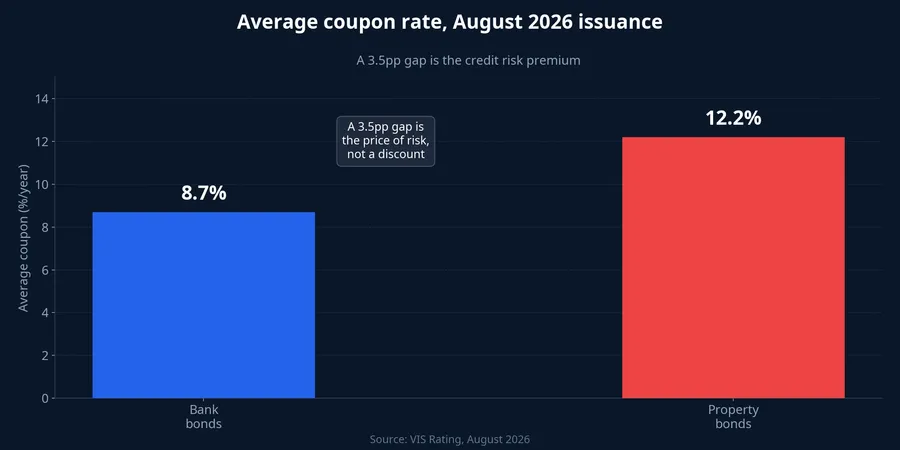
Look at the whole market instead of a single deal and the picture changes. In August 2026, the average coupon on bank bonds was 8.7% a year, versus 12.2% for property bonds.Thoi Bao Ngan Hang That 3.5-point gap is the credit-risk premium investors demand to hold a developer's paper instead of a bank's.
The flow of capital tells you who's winning this race. Banks accounted for 82% of new issuance value for the month, property just 9%, out of roughly VND 35 trillion in total new supply.Thoi Bao Ngan Hang Money is still flowing into the bond market. It's just flowing into the lower-paying group. Developers are pushing rates to the top of the market because that's the price of admission for the capital that's left, not because they're being generous with bondholders.
The standout property deal in August was Vinhomes' VND 2 trillion, 3-year secured bond at an initial 12.5% coupon. That same month, Vietcombank issued VND 2 trillion in 10-year paper at an initial 8% coupon.Thoi Bao Ngan Hang Same size, same month, a 4.5-point gap. These aren't two prices for the same risk. They're two prices for two entirely different risks.
The math the high coupon has to clear
Over the 3-year term typical of a property bond, a 3.5-point annual gap adds up to roughly 10.5% of face value. That's the entire extra return an investor collects for choosing property over a bank.
Now set that against the recovery rate on delinquent residential property bonds: 58.7% in 2026, up sharply from 29.2% in 2024 and 48.8% in 2025.Thoi Bao Ngan Hang That means when a property bond goes delinquent, holders recover, on average and so far, barely 59 dong on every 100, and the recovery process drags on for years. The loss runs about 41.3% of principal, nearly four times the entire extra coupon earned over three years of holding.
So who ends up covering that gap if the bet goes wrong? For the rate premium to fully offset a single default of that size, an investor would need to hold the bond for close to 12 years straight without a single incident. This math doesn't say property bonds are guaranteed to lose money. It says the high coupon only makes sense once the buyer can actually assess the odds that the issuer pays in full, and that probability isn't printed anywhere on the contract's interest-rate line.
To be fair, the 3.5-point gap isn't entirely about default risk. Bank bonds are mostly Tier 2 capital instruments with longer tenors and floating rates pegged to savings rates, so their starting base is lower; secondary liquidity is also better. Still, the payment-quality data leans toward the credit-risk explanation: of VND 1,491 trillion in outstanding bond debt, 90.2% is performing normally, 6.7% is late on interest and 3.1% is late on unresolved principal.Thoi Bao Ngan Hang Residential property is the second-largest segment of that outstanding debt at VND 446 trillion, behind banks at VND 685 trillion. Close to one-tenth of the market's outstanding debt still has a problem, and most of it sits in the exact segment now offering the highest rates.

Who's actually buying the 13% paper?
This is where many readers miss a step. In August, private placements made up 91% of new issuance value, public offerings just 9%. Over the first eight months of 2026, total corporate bond issuance reached VND 348,980 billion, of which VND 295,942 billion was private placement and VND 53,038 billion (15.2%) was public offering.MarketTimes
As of June 5, 2026, Decree 200/2026/NĐ-CP took effect, replacing Decrees 153/2020, 65/2022 and 08/2023.LuatVietnam Under this decree, institutional investors can buy any type of bond, while professional individual investors can only buy privately placed bonds that carry collateral and a credit rating. In practice, most of the paper paying 12-13% a year sits in the private channel, one already closed to individual investors who don't meet the professional-investor threshold.

What's actually open to everyone is the public channel, where rates run much lower. In August, SHB's public offering raised VND 2,081 billion over 7 years at an initial 9.2% coupon, already the high end of this group.Thoi Bao Ngan Hang The gap between the 13% headline number and the 9.2% actually available to buy is worth remembering before anyone pitches a contract promising double-digit returns.
The stress test of the next 12 months
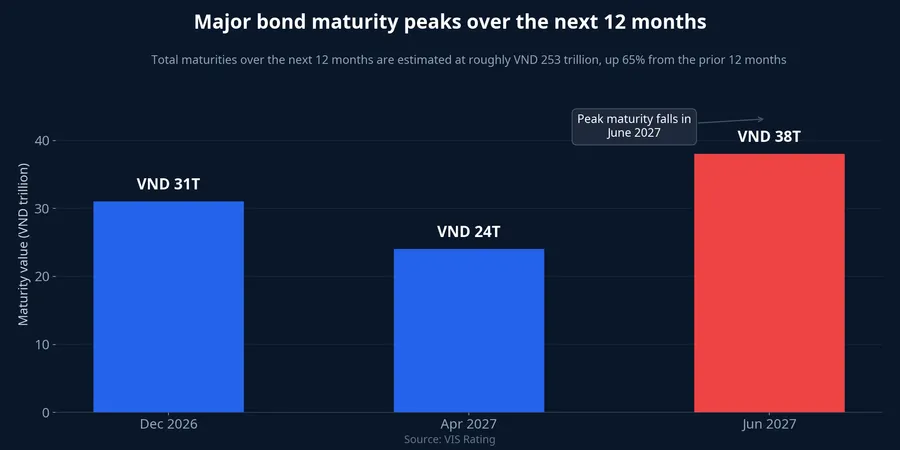
The pressure that hasn't hit yet is the part worth watching. VIS Rating estimates roughly VND 253 trillion in bonds will mature over the next 12 months, well above the VND 153 trillion that matured over the past 12, an increase of about 65%.Thoi Bao Ngan Hang The schedule isn't evenly spread: about VND 31 trillion falls due in December 2026, roughly VND 24 trillion in April 2027, and a peak of about VND 38 trillion in June 2027.
Among non-bank issuers, Vingroup leads with VND 17,736 billion maturing over the next 12 months, followed by Hung Phat Invest Ha Noi at VND 12,650 billion, ParkLand 53 and Hung Long Real Estate Development tied at VND 7,000 billion each, TNR Holdings Vietnam at VND 6,348 billion and Vinhomes at VND 6,090 billion.Thoi Bao Ngan Hang One more detail worth placing alongside this: over the first eight months of the year, issuers bought back a combined VND 18,914 billion in bonds early, down 60% from the same period in 2025.MarketTimes When issuers pull back on early buybacks while maturity volumes rise, obligations get pushed toward the actual due date instead of being cleared ahead of time.
The genuine improvement worth acknowledging: the annualized delinquency rate in August fell to 0.24%, down from 0.30% the prior month and 0.56% in August 2025.Thoi Bao Ngan Hang But that figure was measured before the December 2026 and June 2027 maturity peaks arrive. The improvement of the past 12 months and the maturity pressure of the next 12 are two separate stories, and the second one hasn't been tested yet.
What investors can weigh
For anyone holding or considering a specific corporate bond, three numbers belong side by side, in this order, instead of one coupon figure on a flyer: the rate gap versus a bank bond of the same tenor at the same point in time (the wider the gap, the bigger the risk premium the market is demanding); the credit rating and collateral of that specific bond issue, two conditions Decree 200/2026 now makes mandatory for professional individual investors buying privately placed paper; and the issuer's maturity schedule over the next 12 months, measured against its actual operating cash flow rather than what's promised on paper.
For investors who don't yet qualify as professional, two doors remain open: publicly offered bonds, where rates typically run 8-9.2% and disclosure is fuller, and open-end bond funds, where issuer risk gets spread thin across many holdings instead of concentrated in one name. Both pay less than 13%, and that gap is exactly the risk an investor doesn't have to carry alone.
The signal worth watching over the next three months is VIS Rating's monthly delinquency report as the December 2026 maturity wall approaches. If the annualized delinquency rate holds below 0.24% through that year-end peak, the improvement from 0.56% a year earlier will have proven durable. If that number climbs back up, the 3.5-point gap the market is demanding today will turn out to have been too small.