

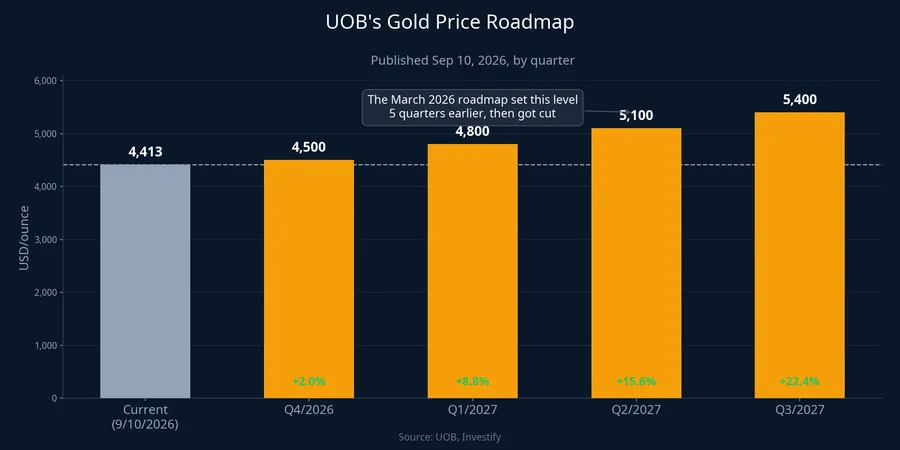
On September 10, 2026, Singapore's UOB published a quarterly roadmap for world gold prices: $4,500/ounce by Q4 2026, $4,800 in Q1 2027, $5,100 in Q2 2027, and $5,400 in Q3 2027.Thanh Nien Gold closed that same day at $4,412.76/ounce. Getting from there to $5,400 is roughly a 22.4% gain over four quarters.
If you're weighing whether to buy SJC gold bars, that 22.4% is easy to read straight into expected profit. But what you actually pay for a tael of SJC gold depends on a second gap too: the distance between the domestic price and the converted world price. Over the past three months, that gap has moved far more than the world gold price itself.
The first path: the global roadmap, and how reliable it's been
UOB's case rests on a few familiar pillars. The bank expects the Fed to cut rates twice by 25 basis points in 2026, bringing the target rate from 3.75% to 3.25%, weakening the dollar in the process.Nguoi Quan Sat UOB also lowered its dollar index forecast to 98.6 for Q4 2026 and 95.2 for Q3 2027.FILI The remaining pillar is buying from Asian central banks plus capital flowing back into gold ETFs, forces that have helped push gold up roughly 70% since the start of 2025.Nguoi Quan Sat
What's worth noting is that this exact roadmap has already been pushed back once. On March 2, 2026, the same UOB had raised its forecast to $6,000/ounce for Q1 2027, with interim targets of $5,400 in Q2 2026, $5,600 in Q3 2026, and $5,800 in Q4 2026.Tuoi Tre The September 10 update puts Q1 2027 at $4,800, VND 1,200 lower than the March figure. The $5,400 mark now being read as a new peak is the exact level the March forecast expected to hit in Q2 2026. Same number, pushed back five quarters.
This isn't unique to UOB. In July 2026, HSBC cut its average 2027 gold forecast from $5,000/ounce to $4,925.Vietstock Behind these downgrades sits a year of sharp swings: gold once closed at $5,419.83/ounce on January 28, 2026, fell back to around $4,000 in July, then recovered to roughly $4,400. In other words, the $5,400 mark UOB now sets for Q3 2027 still sits below a price the market already touched and lost this very year.
The global roadmap tells you direction, not timing. That's valuable information, but it's also the kind that changes, and it's already changed at least twice in six months.
The second path: what you actually pay for SJC gold
On September 10, SJC gold bars were quoted at VND 146.6 million/tael to sell and VND 143.6 million/tael to buy. Across three straight sessions on September 8, 9, and 10, the sell price didn't move a dong, while world gold gained 1.3% over the same three sessions.
Three flat sessions is too small a sample to draw conclusions about mechanism: it could be that a 1.3% swing in the world price isn't enough to trigger a listing update, or that a mild dip in the USD/VND rate offset the world price gain, or that thin domestic demand gave dealers no reason to move prices. The data on hand can't separate these possibilities.
What's more measurable is the gap between the two markets. On September 9, the world gold price converted at the 25,963.5 VND/USD rate came to VND 137.7 million/tael, while SJC sold at VND 146.6 million. The premium was VND 8.9 million/tael, or 6.48%.
That 6.48% figure doesn't say much on its own. Its range is what's worth watching. Over the three months from June 10 to September 9, 2026, this premium peaked at VND 22.289 million/tael on July 16, bottomed at VND 0.137 million on August 19, and averaged VND 12.464 million for the period. In other words, in just over a month, SJC gold went from a VND 22.3 million premium over converted world price to almost none.
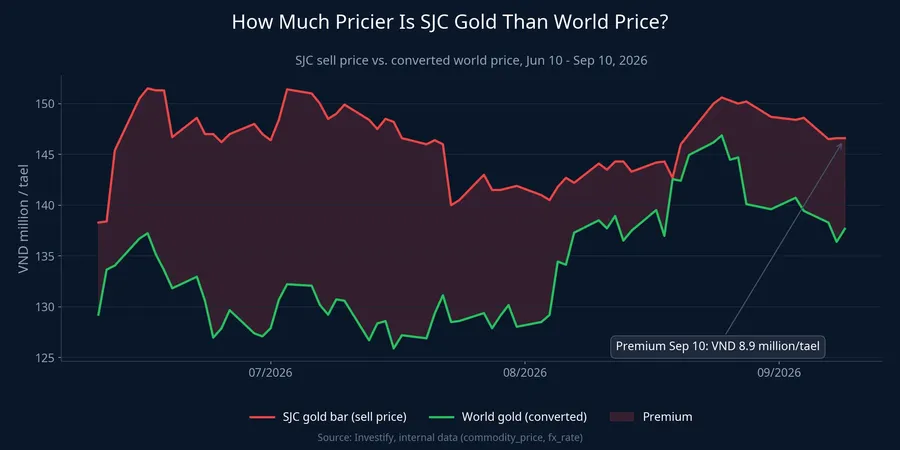
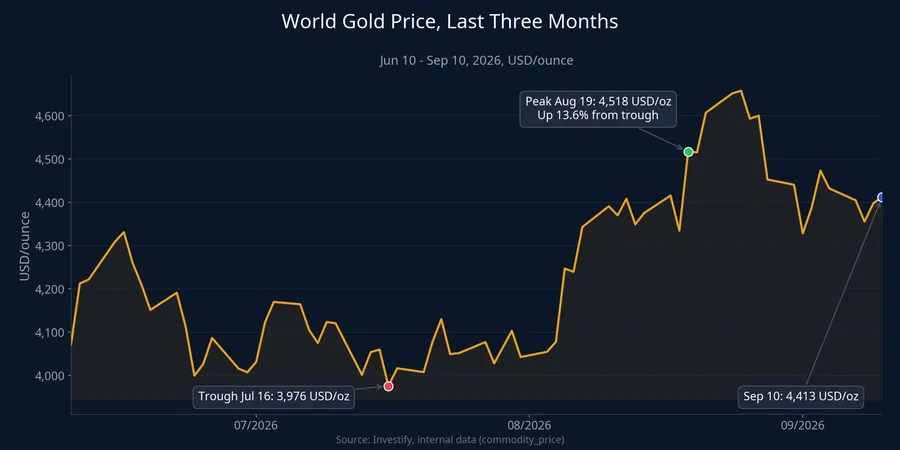
A specific slice shows how this hits your wallet. On July 16, world gold closed at $3,976.18/ounce, that month's low and about 9.9% below the September 10 price. That same day, SJC gold sold for VND 148.2 million/tael, VND 1.6 million higher than today's price. Domestic buyers that day paid more than they would today for the same amount of gold, even though the world market was nearly a tenth cheaper.
The next stretch makes it even clearer. From July 16 to August 19, world gold jumped from $3,976.18 to $4,517.78/ounce, up 13.6%. Over that exact window, SJC's sell price went the other way, from VND 148.2 million to VND 142.7 million/tael, down 3.7%.CafeF For over a month, the two price lines ran in opposite directions, and nearly all of July's VND 22.3 million gap was wiped out.
The VND 22.2 million/tael swing over three months equals about 15% of today's sell price. Set beside the global roadmap for scale: if the exchange rate holds steady, the world price's 22.4% projected gain over the next four quarters translates to roughly VND 30.8 million/tael. The domestic premium alone has already moved more than two-thirds of that distance, in just three months, without the world price going anywhere.
Why the two lines don't move together
The root cause is supply. For 13 years under Decree 24/2012, the state held a monopoly on producing gold bars and importing raw gold, keeping SJC gold and world price running as nearly separate markets. In May 2025, the State Bank of Vietnam pointed to three reasons the domestic price ran as much as VND 14.48 million/tael above world price: limited supply, expectations of further world price gains, and possible speculation by some firms.CafeF
Decree 232/2025/ND-CP, issued August 26, 2025, scrapped the monopoly on gold bar production and raw gold import-export, shifting to a licensing system, and took effect October 10, 2025.Baomoi But actual supply is arriving slower than the paperwork: firms wanting to produce gold bars need minimum charter capital of VND 1,000 billion, commercial banks need over VND 50,000 billion, and applications for raw gold import quotas must be filed before November 15 each year, with the State Bank granting quotas before December 15.Baomoi Between those two procedural dates sit stretches where demand rises but supply can't keep up, and the premium widens.
The exchange rate is the second moving part. Over the past three months, USD/VND fell from 26,340 on June 9 to 25,963.5 on September 9, a 1.43% gain for the dong. A lower exchange rate makes the converted world price cheaper in dong terms, so if the domestic listed price stays flat, the premium widens on its own, without either side actively raising prices.
The final layer sits right on the receipt you sign: the buy-sell spread. On September 10, this gap was VND 3 million/tael, or 2.05% of the sell price. That's currently on the low end compared with the three-month average of VND 3.18 million, and it climbed as high as VND 5 million/tael in early June. You pay this cost the moment you sign, before gold prices have a chance to move in either direction.
How to read the two paths
The sharp narrowing of the premium in the second half of 2026 may only hold for this particular window, not enough to call it a permanent structural shift. SJC gold once closed at a peak of VND 190.9 million/tael on March 2, 2026. Buyers at that peak are now looking at a price 23.2% lower as of September 10. Over that same stretch, world gold fell from $5,322.69 to $4,412.76/ounce, a 17.1% drop. The six-percentage-point gap between those two declines is exactly the domestic premium shrinking, and buyers who bought at the peak absorbed both losses at once.
From this, a reading framework emerges for horizons under a year. Roadmaps from UOB or HSBC decide direction: both lean higher, though by different degrees, and both have been cut at least once this year. But the outcome you actually get from buying SJC gold domestically is decided by two numbers on the board the day you buy: the premium over converted world price, and the buy-sell spread. At today's 6.48% premium plus a 2.05% transaction cost, roughly 8.5% of the sell price needs to be recovered by the world price before you break even.
The two price lines also run on different calendars. The global path is set by Fed meetings and whether rates actually fall the way UOB expects. The domestic path is set by the November 15 deadline for raw gold import quota applications and the December 15 deadline for the State Bank to grant them, the most direct mechanism available for adding SJC gold supply. Those are also the two dates worth watching most for where next year's domestic premium settles.