


On the morning of September 10, Vietnamese outlets reported that FPT Corporation had finalized the purchase of the automotive software design and development unit of Nippon Seiki Europe B.V. in Poland, the European subsidiary of Japanese auto parts maker Nippon Seiki. FPT set up a new legal entity, FPT Poland, in the port city of Gdańsk to take over the operation.
At first glance, this is an M&A story small enough to barely register on a retail investor's radar. But read the transfer terms closely, and the deal shows how a Vietnamese tech company is buying its way into the global automotive supply chain by the shortest route currently available.

A deal much smaller than the headline suggests
The unit being transferred has around 50 staff specializing in embedded automotive software, with more than two decades of operating history. The handover takes effect on October 2, 2026, and both sides did not disclose the deal value. Set against FPT's scale, that headcount barely registers: the group's global automotive software engineering workforce alone already exceeds 5,000 people. The value of this deal, then, doesn't come from the number of people changing hands.
Who is the seller, and what exactly are they selling
Nippon Seiki was founded in 1946 in Nagaoka, Niigata Prefecture, and specializes in instrument clusters and head-up displays, or HUDs. The Poland unit FPT is taking over is precisely where the software for that product line was written. It handles embedded software, HUD software, systems engineering, software architecture, testing and quality assurance for the automotive sector, and doubles as a production hub serving European automotive clients. In other words, FPT isn't buying a generic outsourcing team: it's buying the exact software layer for a product line Nippon Seiki has invested in for two decades.
The key clause: the seller stays on as a customer
This is the detail that sets the deal apart from a large-scale hiring spree. Nippon Seiki confirmed it will continue outsourcing software development work to FPT Poland after the handover, while keeping software development collaboration running across its Japan, Vietnam and Europe sites. In the software services industry, the hardest thing to buy has never been engineers, because engineers can always be hired. What's hard to buy is a live program: a contract that has already cleared capability audits, is already tied to a product line headed for commercial vehicles, and already has an approved budget. The Gdańsk deal transfers all of that in one package, because the seller stays on as the buyer of the work rather than walking away from the relationship entirely.
The relationship between the two companies didn't start this week, either. In July 2023, FPT Software signed an agreement to become Nippon Seiki's end-to-end software development partner, under a division of labor where FPT handled software while Nippon Seiki focused its resources on hardware. Three years later, that arrangement has moved a step further: the software function has shifted to FPT not just contractually, but as a legal entity too.

Why buy outright instead of building from scratch
Automotive software is a segment where market entry is gated by process, not capital. A supplier seeking functional-safety work must meet standards such as ISO 26262 and Automotive SPICE, then get re-vetted by the client for every single program. Each vehicle model runs for years, and a supplier only gets a shot at the initial design stage. Miss that window, and it has to wait for the next generation.
European clients also demand engineering teams based locally in the region, something a delivery model out of Vietnam can't fully substitute. FPT has had a presence in Europe since 2008, with more than 150 corporate clients, and revenue from the region grew 36.5% in the first seven months of 2026. Gdańsk supplies exactly what that growth needs: an automotive engineering hub inside the European Union, with a two-decade track record already built in.

The $1 billion target: still a long way off
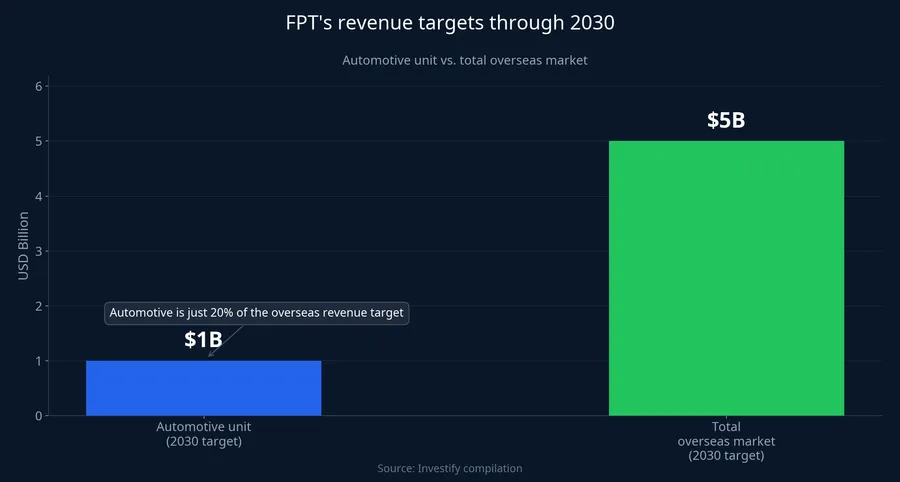
FPT Automotive launched in late 2023, headquartered in Texas, with a $1 billion revenue target by 2030, a fifth of the $5 billion overseas revenue target for 2030 the group has announced. That means FPT expects automotive to become one of the main pillars of its overseas business, not a side bet.
The problem for investors is that there's no direct way to measure progress, since FPT doesn't break out automotive revenue in its financial reports. The closest anchor the group has disclosed is in Japan: in an internal newsletter dated December 10, 2025, FPT said automotive software led its revenue in Japan for 2025, with OEM and Tier-1 suppliers contributing roughly 90% of the unit's sales. Đỗ Văn Khắc, Deputy General Director of FPT Software (Công ty TNHH Phần mềm FPT) and CEO of FPT Japan, called automotive software the "key battlefront driving growth" for 2026.
Same deal, several equally valid readings
The full meaning of this deal shouldn't be pinned to a single motive, because three readings hold up equally well. The defensive reading is that FPT is locking in a large client, preventing the work from shifting to a rival if the Poland unit had changed hands. The talent reading is that hiring experienced automotive software engineers in Europe is slow and expensive, so buying an already-trained team is the faster route. The industry reading is that legacy component suppliers are letting go of their in-house software layers; Automotive World assessed that Nippon Seiki selling off its design unit rather than expanding it shows component suppliers choosing to partner with specialized software firms instead of competing head-on in that space.
The available evidence leans most heavily toward the third reading, since the seller both handed over the team and committed to keep ordering from that same team, the behavior of a company that wants to stop maintaining its own software operation rather than one exiting the product altogether. The other two readings still add plausible motives, but neither explains why the seller would proactively preserve the ordering relationship right after selling.
For FPT shareholders
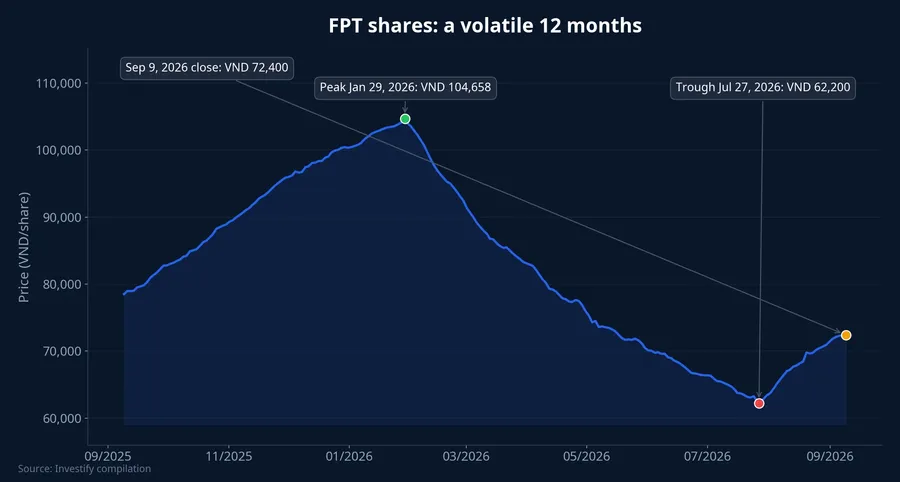
FPT shares closed the September 9 session at VND 72,400, down 22.7% from VND 93,709 at the start of the year. From a peak of VND 104,658 on January 29, the stock slid more than 40% to a trough of VND 62,200 on July 27, then recovered about 16% from that low. The trailing four-quarter P/E sits at roughly 12.3x, below the near-15x five-year average.
The Gdańsk deal doesn't move any number this quarter, and it shouldn't be expected to. What it changes is the quality of the 2030 $1 billion target: from an ambition built on headcount growth to a roadmap that now includes a real client asset in Europe.
On a sub-one-year horizon, what still decides FPT's share price is the growth rate of the Technology segment and the valuation discount versus its own history, not a 50-person entity in Poland. The automotive unit is a long-term growth option, and that option only becomes a valuation argument once investors have a way to measure it.
The signals worth watching are therefore specific. First, whether FPT starts breaking out automotive revenue in coming reporting periods. Second, whether the pace of large new contract wins in overseas markets holds up at the momentum of recent years. Third, whether FPT Poland retains the work volume the seller committed to after the October 2 handover. That is the first real test of the industry reading above.