

On September 9, 2026, platinum closed at USD 1,909.0 per troy ounce, up 3.01% for the session, its highest close since the January peak this year. The same day in London, the World Platinum Investment Council (WPIC) published its Q2 report and flipped its full-year 2026 supply-demand forecast from a 297,000-ounce deficit to a 265,000-ounce surplus.PRNewswire To anyone who just watched the price climb, a surplus headline sounds like a contradiction.
The two facts do not actually conflict. They measure different things on different timescales, and that is exactly where investors are most likely to read them as one signal instead of two.
The supply side: a story two decades in the making
Platinum is not as geographically diversified as gold or copper. By WPIC's own numbers, South Africa accounts for roughly 70% of global mined platinum supply, with most of the rest coming from Russia and Zimbabwe.Startup Fortune When South African mines run into trouble, there is no spare capacity waiting in Australia or Canada to fill the gap.
South Africa's problem is electricity. Per Nedbank CIB research, power now makes up 10-15% of the local mining industry's cost structure, and every 1,000 GWh of rolling blackouts cuts roughly 2% off annual mining output. Eskom, the state power utility, has raised rates for mining customers by about 60% since 2021.Startup Fortune

The effect shows up clearly in the long-run production curve: South African platinum output peaked at 5.3 million ounces in 2006 and has fallen to roughly 3.6 million ounces in 2025, with new projects failing to offset the decline at older mines.Startup Fortune This is a slow-moving story, measured in decades, and it does not reverse in a single quarter.
What the 265,000-ounce surplus actually measures
Read the WPIC statement closely and the picture looks quite different from how most people will interpret the word "surplus." Trevor Raymond, CEO of the World Platinum Investment Council, said plainly that the shift to a surplus forecast is "almost entirely due to investment outflows in the first half of the year, against a backdrop of heightened macroeconomic and geopolitical uncertainty."PRNewswire
The underlying numbers back that up: WPIC forecasts full-year 2026 investment demand at net sales of 83,000 ounces, while industrial demand is projected to grow 5%, enough to offset a 4% decline in automotive demand.PRNewswire The second-largest drag is not industrial at all: it's jewelry, down 15% on high prices and weak domestic consumption in China.
In other words, most of the 265,000-ounce surplus is metal that investors themselves released as prices fell in the first half of the year. It records a sale that already happened, not a sign that industry needs less platinum. In Q2 alone, supply reached 1.906 million ounces against demand of 1.663 million ounces, producing a 244,000-ounce surplus for the quarter.Mining Technology
A 562,000-ounce swing in four months
What's more striking than the direction of the forecast is how fast it flipped. In its Q4 2025 report, WPIC forecast a 240,000-ounce deficit for 2026.Newswire By its May 18, 2026 release, the deficit had widened to 297,000 ounces, with above-ground inventories projected to fall to 1,747,000 ounces by year-end, less than three months of global demand.PRNewswire Four months later, the same organization flipped to a 265,000-ounce surplus.
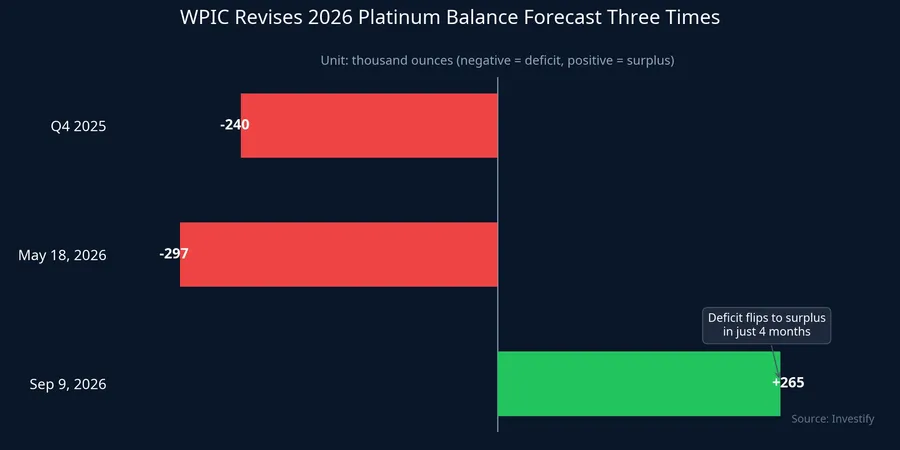
Going from a 297,000-ounce deficit to a 265,000-ounce surplus is a 562,000-ounce swing in four months, on a market where WPIC itself forecast full-year demand of 7.674 million ounces back in May.Startup Fortune The variable driving most of that swing is investor behavior, which can reverse as quickly as it left. Raymond himself left that door open: platinum prices will likely track broader precious-metals sentiment, which could open room for renewed investment demand later in the year, especially if US interest rates rise less than expected or not at all.
Analysts are also split hard on this. Just eight days before WPIC flipped its forecast, Bank of America raised its average 2026 platinum price forecast from USD 1,825 to USD 2,450 per ounce, citing a prolonged supply deficit.Startup Fortune
This rally isn't just a South Africa story
South African supply is not the only explanation for the recent rally. On September 3, platinum rose 3.43% while palladium rose more sharply, up 4.92% to USD 1,441.00 per ounce.Startup Fortune That was a broad rally across precious metals, supported by a weaker dollar and softer-than-expected US jobs data that lowered rate expectations. If South African power costs were the whole story, palladium would have had no reason to outrun platinum in the same session.
The reading best supported by the data is three forces pushing at once: a mining supply base thinned out over many years, electricity costs squeezing South African mine margins, and capital flowing back into precious metals as rate expectations ease. The third force explains why the rally landed exactly in early September; the first two explain why platinum reacted more sharply than a deep, liquid market typically would.
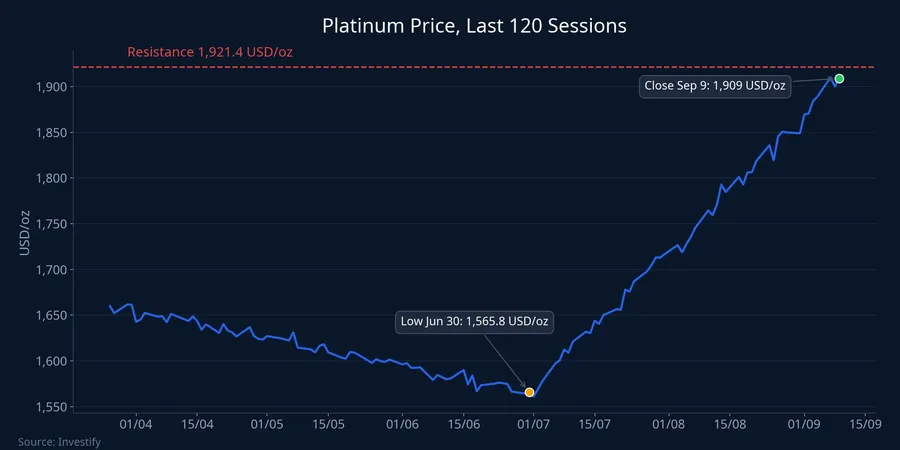
Scale matters here too. The USD 1,909.0 close on September 9 marks a 21.9% recovery from the June 30 closing low of USD 1,565.8, but it still sits about 33.7% below the USD 2,880.4 peak set on January 26, 2026. The USD 1,921.4 level, August's high, is the nearest resistance. This looks like a rebound from oversold territory, not a fresh breakout to new highs.
How Vietnamese investors access this market
Platinum is officially listed on the Vietnam Mercantile Exchange (MXV), pricing off the NYMEX reference. Retail investors do not trade directly with MXV; they access the market through licensed brokerage members, posting margin and trading leveraged contracts.
Leverage is the variable to size up before placing an order. Platinum has just logged two sessions above 3% within five trading days, and this same commodity fell 45.6% from its January peak to its June low. In a thin market, swings run sharp in both directions, and margin amplifies both.
The legal framework for this channel is also tightening. Decree 302/2026/ND-CP, effective September 15, 2026, raises the minimum charter capital to establish a commodity exchange to VND 1,500 billion, sets a VND 5 billion minimum for brokerage members, and establishes a framework for a clearing center with minimum capital of VND 500 billion.Fireant
Signals worth watching
For anyone weighing platinum at current levels, the sensible framework is to separate the two legs and weight them differently.
The supply leg is slow and trustworthy: South African output, Eskom's power costs, above-ground inventories. Even with the 265,000-ounce surplus, WPIC still projects 2026 year-end inventories equivalent to just 3.4 months of global demand, after 2025's deficit was revised up to more than 1.4 million ounces.PRNewswire A 265,000-ounce surplus set against last year's 1.4-million-ounce deficit doesn't refill much.
The capital-flow leg is fast and self-reversing: it has already swung 562,000 ounces in four months, and could swing again if US rate expectations shift. Using this leg as a basis for long-term valuation is where investors are most likely to go wrong.
Three data points will help resolve this story in the months ahead: actual South African mine output against the multi-year decline curve described above, ETF flows following the 83,000-ounce net-sell figure, and how price reacts at the USD 1,921 resistance level. WPIC's Q3 report will show which leg is winning.