

Two numbers dominating conversation on Vietnam's stock market this week sound like they contradict each other. HOSE's market capitalization topped VND 8.84 quadrillion as of August 28, a 7.55% jump in a single month.Thời báo Ngân hàng At the same time, foreign investors have net-sold more than VND 90,704 billion on the same exchange since the start of the year.Thời báo Ngân hàng Side by side, it looks like a paradox: the market ballooning while foreign capital walks out the door. Laid out on a timeline, the picture looks very different. These are two consecutive phases, not a tug-of-war happening at once.
Market cap growth was concentrated in one month
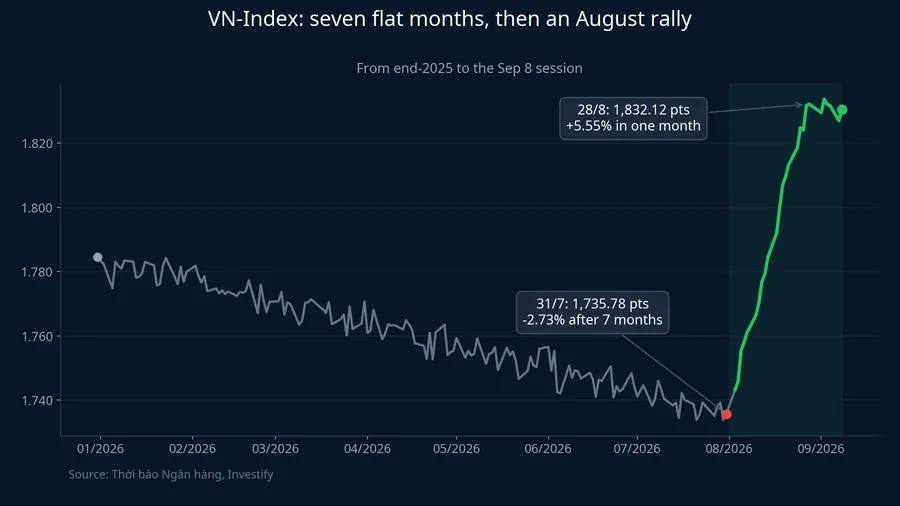
Vietnam's benchmark barely moved for seven months. The VN-Index closed 2025 at 1,784.49 points and ended the July 31 session at 1,735.78 points, down about 2.73% over seven months. That was a period of tight-range consolidation with no clear catalyst to break out.
August flipped the picture entirely. The VN-Index closed August 28 at 1,832.12 points, up 5.55% from the prior month, and HOSE's market cap rose 7.55% in that single month, equivalent to 68.84% of 2025 GDP.Thời báo Ngân hàng
What's notable is that foreign net selling moved in the opposite rhythm. Of the more than VND 90,704 billion net-sold over eight months, August alone accounted for just over VND 1,744 billion.Thời báo Ngân hàng The other seven months carried nearly VND 89,000 billion, averaging roughly VND 12,700 billion a month.
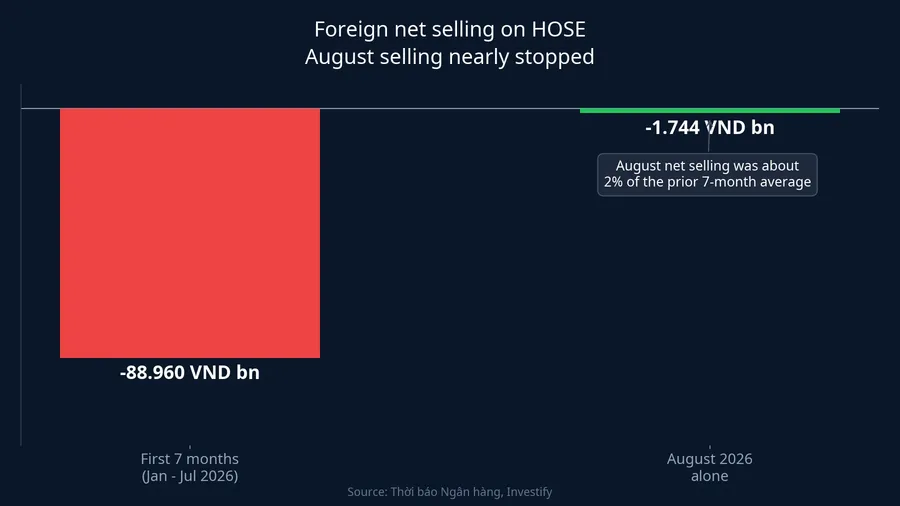
In other words, the period of heaviest foreign selling was exactly the period when the index was falling. And the sharpest expansion in market cap landed exactly in the month foreign selling nearly stopped. The two figures never coexisted at the same moment to contradict each other, they simply describe two different phases of the same market.
The gap comes from share count, not price
There's a small but telling gap in the August data: market cap rose 7.55% while the VN-Index rose only 5.55%. Market cap is price multiplied by shares outstanding, so that two-point gap comes from share count, not price.
August was peak season for stock dividends and capital increases. Vinhomes doubled its charter capital and had its reference price halved starting the August 6 session, so the stock's market cap held at roughly VND 599,682 billion even though the per-share price was cut in half.Thời báo Ngân hàng Every such stock dividend adds to exchange-wide market cap without making existing shareholders proportionally wealthier.
That's why a bigger market cap doesn't automatically mean investors are earning more. As of August 28, HOSE had 52 companies with market caps above USD 1 billion, with VIC alone accounting for more than VND 1.831 quadrillion.Thời báo Ngân hàng Market scale is increasingly concentrated in a narrow group of large-cap names.
The upgrade mechanics: sell once, buy in stages
The bigger picture sits in how FTSE Russell is actually executing Vietnam's upgrade from frontier to secondary emerging market status, effective September 21. Under the published roadmap, Vietnam enters the FTSE Global Equity Index Series across four phases running from September 2026 to September 2027.Dân trí The phase effective September 21 carries just 10% of full weight; subsequent phases raise the cumulative weight to roughly 30%, then 65%, reaching 100% only by September 2027.
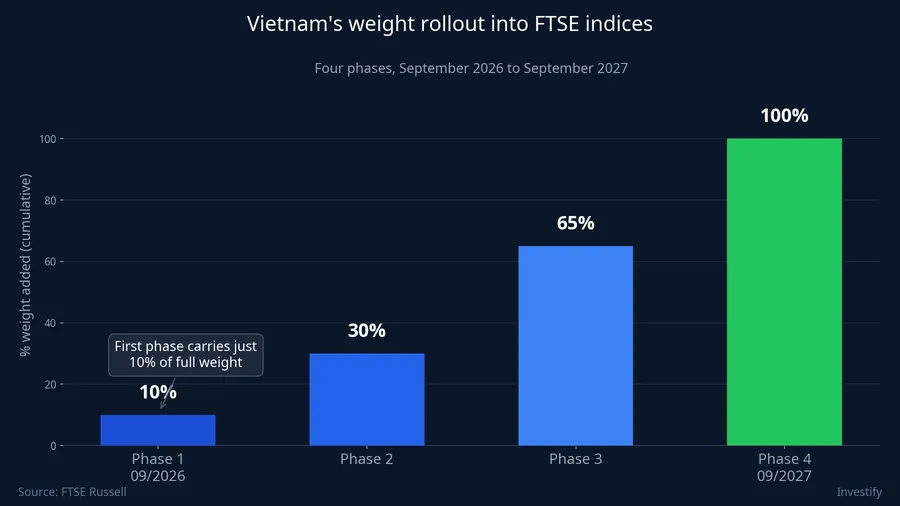
Nguyễn Tiến Dũng, Head of Sector and Equity Research at MB Securities (MBS), points to a technical detail that gets little attention: Vietnam was dropped from the FTSE Frontier index in a single phase, while its inclusion in the global and emerging-market indices is split across four.Dân trí In other words, the mandatory selling from frontier-index funds is compressed into one moment, while the passive buying from emerging-market funds is spread across a full year. For individual investors, that means September 21 isn't a switch that flips capital flows overnight, it's the starting date of a schedule that runs for months.
Valuation doesn't explain the foreign selling
A common explanation is that foreign investors are selling because Vietnamese stocks have become expensive. Valuation data doesn't support that reading. Per SSI Research, the VN-Index's projected 2026 P/E sits around 12.7x, below the 14x average of the past decade.Thời báo Tài chính Việt Nam
Đinh Minh Trí, Director of Individual Client Analysis at Mirae Asset Securities (MAS), says foreign investors' decisions also hinge on exchange rates, global interest rates, market valuation, and corporate earnings outlook.Dân trí For a fund that books profit and loss in USD, the return after currency conversion is what matters, not the gain measured in VND. On top of that, global portfolio rebalancing and client redemption needs at individual funds both generate sell orders that have nothing to do with Vietnam's own outlook.
That explains why selling has concentrated in the largest-cap names, where funds hold their biggest weightings and where positions are easiest to exit. Year to date, VHM has seen more than VND 20,300 billion in net foreign selling and FPT more than VND 15,200 billion, both among the exchange's largest-cap stocks.
The real bottleneck is absorption capacity
Even if capital wants in, absorption capacity remains an open question. Analysts at both MBS and Mirae Asset note that international funds struggle to deploy large sums when leading stocks still have very little foreign room, low free-float ratios, and limited liquidity.

August's data confirms exactly that bottleneck. Average daily trading value on HOSE reached just over VND 17,336 billion, down 2.23% from July, even as the index rallied hard.Thời báo Ngân hàng An index climbing on thinning liquidity is a setup that reverses easily when a large sell order shows up, as it did on September 7 when the VN-Index dropped 31.44 points.
What to watch around September 21
Early signals have already shown up at the individual-stock level. In August, FPT led foreign net buying with more than VND 879.65 billion, followed by DMX, PNJ, VNM, and HPG.Thời báo Ngân hàng Notably, FPT is also the second most net-sold stock year to date. A stock flipping from the top of the sell list to the top of the buy list within the same year is a signal about behavior, not yet a conclusion about a trend.
For individual investors, the sensible window to watch around September 21 spans several weeks, not a single session. A large net-buying session on the exact day the upgrade takes effect is likely to come from passive funds rebalancing their portfolios, a technical trade rather than a directional signal. A more credible signal would be foreign investors sustaining net buying over several consecutive weeks, alongside average daily trading value climbing back above July's level.
Until both conditions show up together, the reasonable default is that the market keeps being driven by domestic flows, with volatility concentrated in large-cap names. On September 8, the VN-Index closed at 1,830.44 points while foreign investors kept net-selling more than VND 350 billion, pushing net selling over the past four sessions above VND 2,300 billion.Dân trí FTSE Russell's one-year schedule has only just begun, and the coming weeks will show whether foreign capital flows are actually turning.