

September 11, 2026 is the final registration date for two separate share issuances at Vietnam International Bank (VIB). Both fall on the same day, draw from the same source of capital, but have opposite economic effects on anyone currently holding the stock.
The first is a bonus share issuance of more than 323 million shares at a 9.5% ratio, distributed to all existing shareholders, worth close to VND 3,234 billion at par value.Vietstock Shareholders holding 200 shares will receive 19 more. VIB's charter capital rises to VND 37,274 billion as a result, up from VND 34,040 billion currently.
The second is nearly 8 million ESOP shares issued at zero cost to 890 staff members, equal to 0.24% of shares outstanding, with a one-year transfer restriction.DNSE The recipient list was finalized back on June 25, 2026. Both issuances draw on undistributed after-tax profit as of December 31, 2025 per audited consolidated financial statements, and both were approved by the State Bank of Vietnam under document No. 5444/NHNN-QLGS dated June 24, 2026.Vietstock
The number that grabs attention is the zero-cost price tag. But the dilution shareholders actually bear doesn't come from the 323-million-share bonus issue, and it doesn't come from "zero cost" the way most people assume either.
Bonus shares: a bookkeeping transfer within equity
A bonus share issuance isn't extra cash the bank hands to shareholders. It's an accounting move that shifts a portion of undistributed after-tax profit into the charter capital line item. Total equity before and after the issuance stays flat at VND 47,838 billion as of June 30, 2026, only the internal mix shifts: retained earnings drop from VND 6,981 billion to roughly VND 3,747 billion, with the difference flowing into charter capital.
Since net assets are unchanged while the share count rises, book value per share falls proportionally, from roughly VND 14,050 to roughly VND 12,810. The exchange reflects that math by cutting the reference price on the ex-right trading date of September 10, by roughly 8.7%. VIB shares closed the September 8 session at VND 15,050, up 1.01%. If the September 9 session holds that price, the reference price on the morning of September 10 will land around VND 13,740.
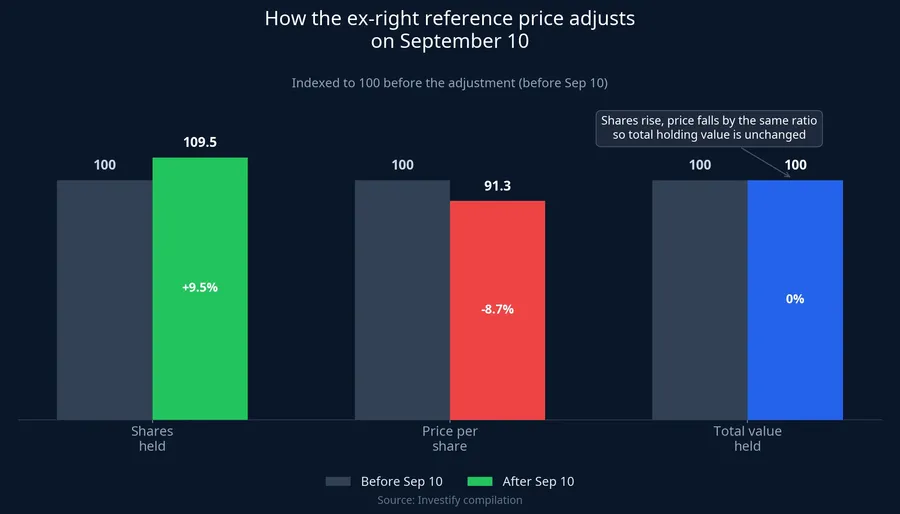
The net effect for anyone holding the stock: share count up 9.5%, price per share down 8.7%, total holding value unchanged, and ownership percentage in the bank unchanged too, since every shareholder is diluted at the identical ratio. Nobody gets richer and nobody gets poorer from this large issuance. The price drop on the morning of September 10 will show up on the board as a red session, but that's the exchange's technical arithmetic, not selling pressure.
ESOP: the only piece that actually takes value from shareholders
The ESOP tranche follows a completely different mechanism. These shares go to employees, not to shareholders, and the reference price on the exchange isn't adjusted for this portion. Shares outstanding rise by 0.24% while the bank's net assets don't grow by a single dong from the transaction, so every existing shareholder's ownership stake is diluted by exactly 0.24%.
Converted to cash at the September 8 market price, the nearly 8 million ESOP shares are worth roughly VND 120 billion, or about VND 135 million per person across the 890 staff receiving the award, before factoring in the one-year transfer lock-up. Against VIB's VND 51,200 billion market capitalization, this transfer is small, but it's a real transfer, unlike the 323-million-share bonus round which only changes the denominator.
Put simply: the large issuance makes noise on the trading board but is value-neutral, while the small one, nearly invisible on the board, is the only tranche that actually shifts ownership from shareholders to employees. Both draw from the same pool, undistributed profit, they just have different destinations.
Why VIB keeps capitalizing its profit
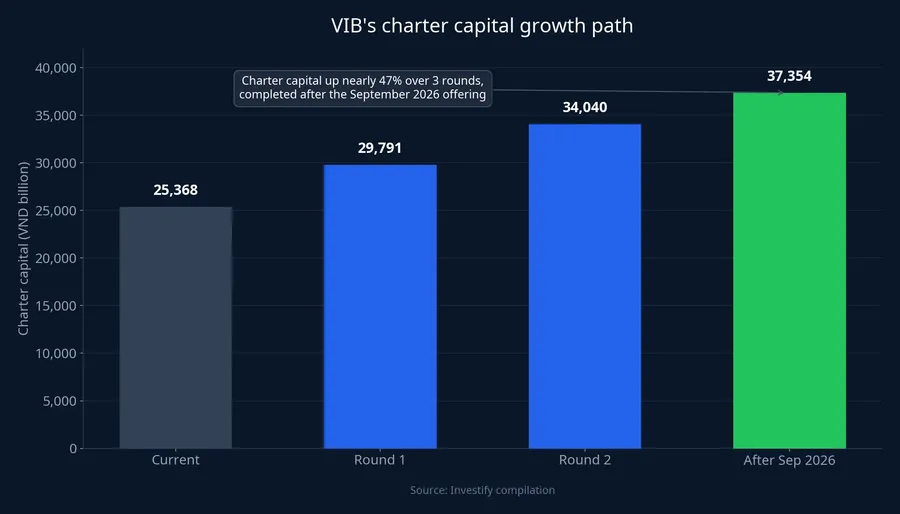
Looking back two years, VIB's charter capital has climbed through three steps: VND 25,368 billion, then VND 29,791 billion after the Q3 2024 capital raise, then VND 34,040 billion after the Q3 2025 round, and roughly VND 37,354 billion after September 11 once the ESOP tranche is included. That's a nearly 47% increase over two years, entirely from internal sources, with shareholders never asked to put in fresh cash.
The driver behind this is credit growth. VIB's outstanding credit exceeded VND 397,000 billion at the end of June 2026, with customer lending alone at VND 381,972 billion, up 4.9%.Thời báo Tài chính Việt Nam The full-year 2026 plan approved at the annual shareholders' meeting targets roughly 15% credit growth and total assets above VND 637,000 billion.VIB As the loan book expands, capital has to expand alongside it to keep safety ratios intact.
VIB isn't remotely strained on this front today. Its capital adequacy ratio (CAR) stood at 17.07% at the end of Q2 2026, holding in a 16.3-17.9% range for over a year, double the 8% regulatory minimum, and the bank completed Basel III under the standardized approach back in December 2025.CafeF Converting retained earnings into charter capital strengthens Tier 1 capital quality, the most durable layer in a bank's safety structure.
VIB hasn't relied solely on retaining profit either: add a cash dividend of VND 900 per share (a 9% ratio, ex-right on May 4, 2026) to the 9.5% bonus shares and 0.24% ESOP, and total distributions for fiscal year 2025 come to roughly 19%.
Where investors should look more closely
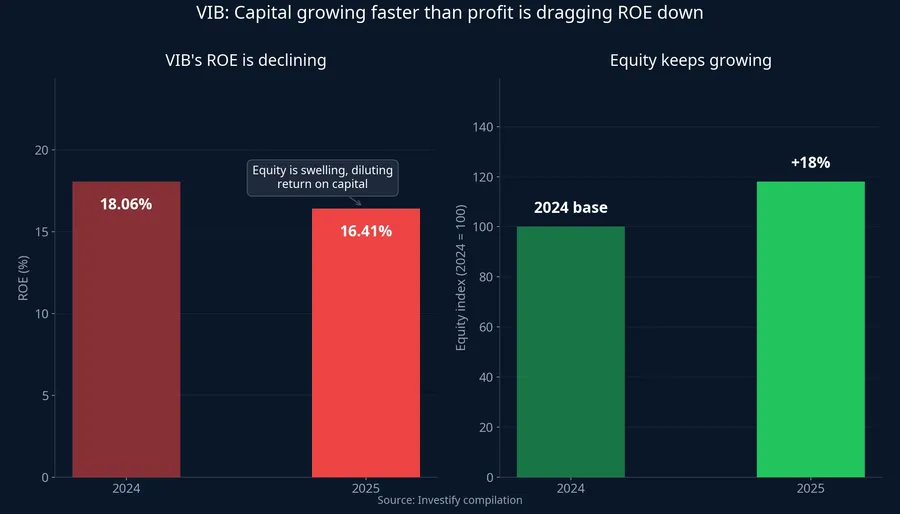
Thicker capital is a good thing, but when the denominator grows faster than the numerator, return on equity falls. This is where VIB's picture shows a crack.
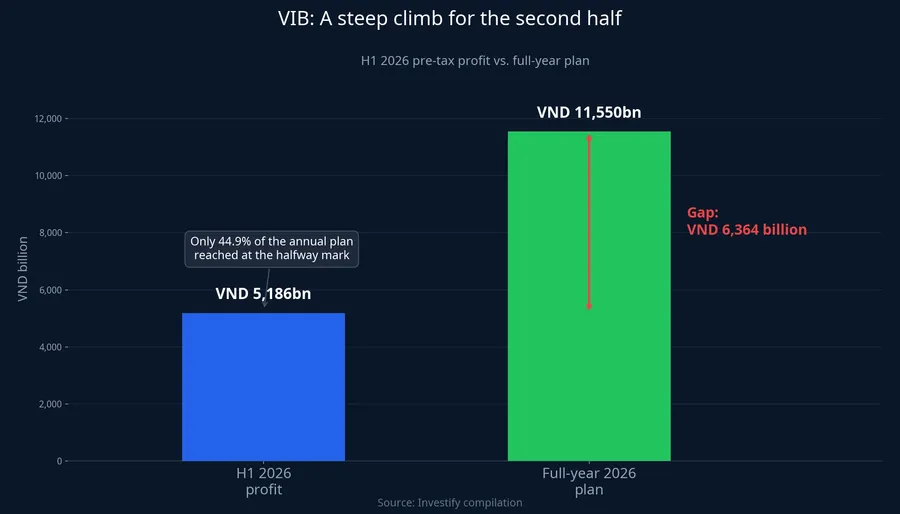
Pre-tax profit for 2025 came to VND 9,105 billion, up only about 1% from 2024. Moving into 2026, H1 profit reached VND 5,186 billion, up 3.4% year-on-year, hitting just 44.9% of the full-year plan of VND 11,550 billion, a target that implies 27% growth for the year as set by shareholders. Q2 2026 alone saw pre-tax profit of VND 2,383 billion, down 8.2% year-on-year as provisioning costs roughly doubled, even as net service income for H1 nearly tripled to VND 3,065 billion.Mekong Asean
The arithmetic consequence has already shown up in ROE: 18.06% in 2024 down to 16.41% in 2025. The cause needs to be pinned down precisely. The bonus share issuance itself doesn't drag ROE down, because it leaves total equity, the denominator of ROE, unchanged. What's dragging ROE down is the bank's habit of retaining most of its profit to build capital while the profit it generates has been essentially flat. The September 11 issuance is a visible symptom of that strategy, not the cause of it.
There's also an alternative reading of the profit slowdown worth weighing fairly. Heavier provisioning could reflect the bank proactively cleaning up its balance sheet rather than deteriorating asset quality, and the bad-debt data supports that reading: the non-performing loan ratio fell from roughly 3.5% in early 2025 to 2.16% by the end of 2025 and to roughly 2.1% by mid-2026. The second reading is that retail credit, VIB's core business, is growing slowly, keeping net interest margin stuck in a 3.0-3.2% range through 2025 and H1 2026. The available data leans toward the second reading, since bad debt has clearly improved while profit still hasn't picked up.
Three dates to remember before the September 10 session
For anyone currently holding VIB shares, three dates matter: September 9 is the last session to buy in and still qualify for the bonus shares; the morning of September 10 will see the reference price cut by roughly 8.7% on technical grounds, not because of bad news; and the bonus shares will land in accounts some time after the record date, depending on the bank's registration and custody processing.
For anyone weighing a purchase, the decision shouldn't hinge on making the record date or missing it: buying before or after September 10 produces the same asset value, only differing in whether you receive it as extra shares or as a lower price. The real question is the bank's earning power in the second half of the year.
The metric worth tracking isn't the dilution ratio, it's the Q3 2026 earnings report. VIB needs roughly VND 6,364 billion of pre-tax profit in the second half to hit its VND 11,550 billion full-year plan, 23% higher than what it delivered in H1. Three signals worth watching: whether retail credit picks back up, whether provisioning costs cool off, and whether net interest margin edges out of the 3.0-3.2% band. If all three stay flat, the more likely scenario is that ROE keeps sliding through 2026, regardless of charter capital on paper now exceeding VND 37,000 billion.
The VN-Index closed the September 8 session at 1,830.44 points, up 0.48%, with banking stocks still the market's main pillar. Within that group, VIB is entering a stretch where its capital base is already thick but its profit engine remains unclear.