
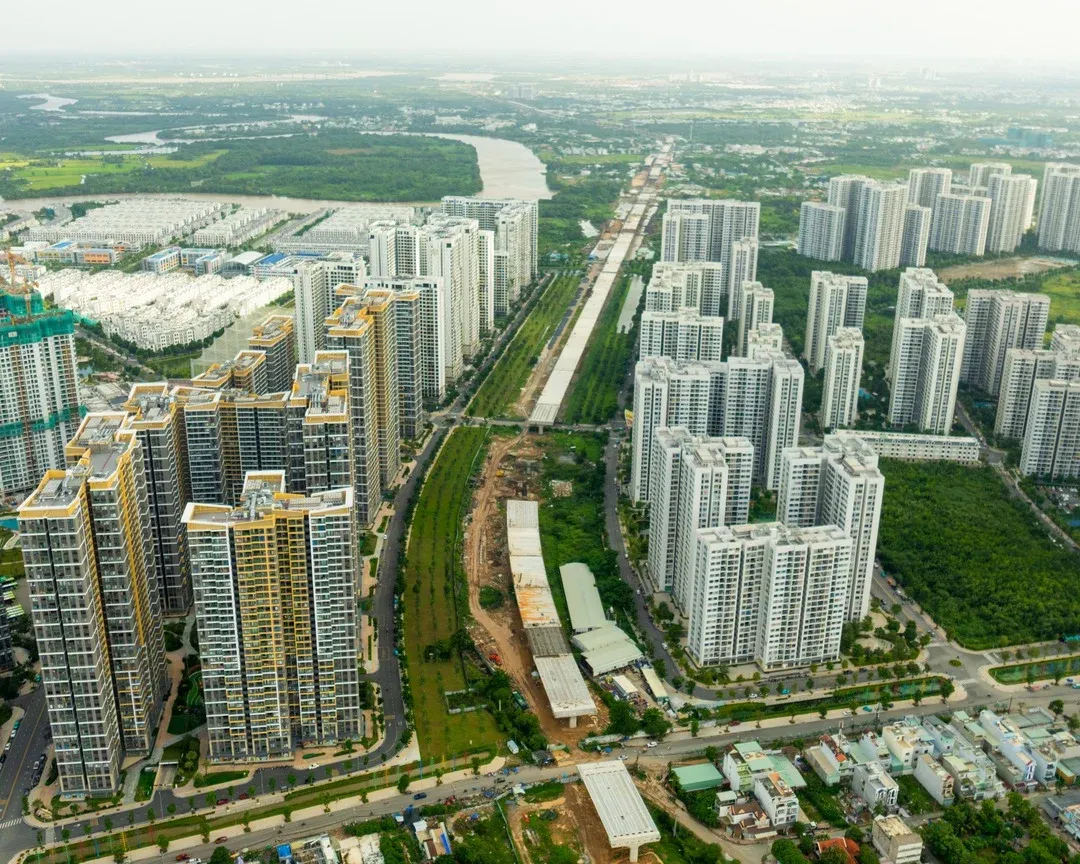

Vinhomes' share price was technically halved back on August 6. What lands in the accounts of 34,021 shareholders on September 9 isn't a fresh round of dilution. It's simply the right to sell shares that were already repriced a month ago. Look at the numbers, and that distinction is the single most important thing to understand about what's being billed as "Vinhomes' largest share issuance ever."
The market has already had 22 trading sessions to reprice the company for the new share count. The only thing that changes on September 9 is that the liquidity of more than 4.1 billion shares gets unlocked. And once you look closely at the ownership structure, the real supply that can actually hit the market turns out to be far smaller than that headline figure.
What's actually happening on September 9
Vinhomes issued 4,107,412,004 new shares as a 2025 stock dividend at a 1:1 ratio to its 34,021 shareholders, meaning every existing share gets one new share.MarketTimes The funding came from retained after-tax profit, not fresh capital raised from investors, so this isn't dilution in the conventional financial sense.
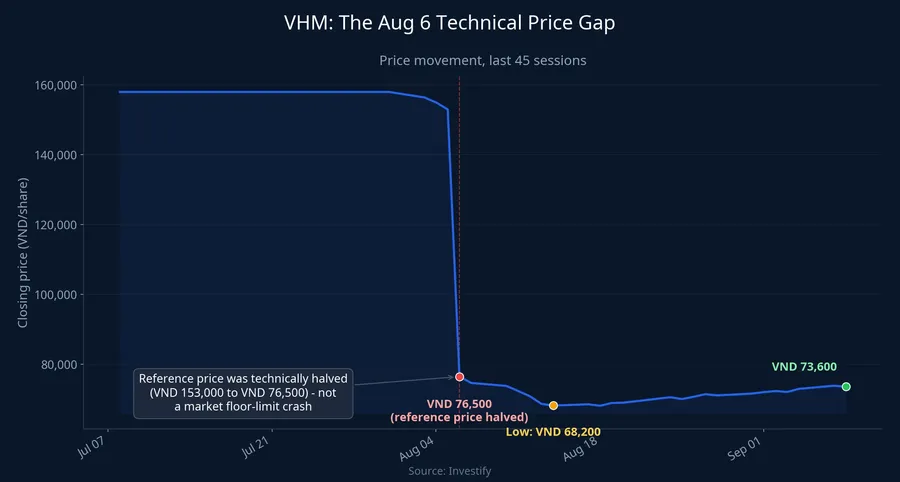
The timeline is nearly complete: the ex-rights date was August 6, the shareholder list closed and the issuance was finalized on August 7, the supplementary listing went through on August 27, and trading rights officially open on September 9.CafeBiz After the issuance, Vinhomes' charter capital rose from more than VND 41,074 billion to over VND 82,148 billion.
The repricing itself is old news. VHM closed at VND 153,000 on August 5. On August 6, the reference price was adjusted down to VND 76,500 and the stock closed at VND 77,100. From that reference point to now, VHM has fallen roughly 3.8%, closing at VND 73,600 on September 8. That's up 23% since the start of 2026.CafeBiz
Vinhomes' market cap now tops VND 600 trillion, the second-largest on the exchange, trailing only its own parent, Vingroup. That's why September 9 isn't just a story for VHM holders. On September 8 alone, VHM shaved 0.86 points off the VN-Index, even as the benchmark still rose 8.80 points to close at 1,830.44.
The real float is much smaller than 4.1 billion shares
The 4.1 billion figure is the headline number. Stock dividends get distributed strictly according to existing ownership stakes, so most of the new shares simply land wherever the old shares already sat. No new pool of shareholders gets created in the process.
As of end-June 2026, Vingroup held 71.70% of Vinhomes' charter capital, after transferring ownership of more than 15.2 million shares to two foreign institutions.Tuổi Trẻ At that ratio, about 2.94 billion of the new shares flow straight back to the parent company, which has not registered to sell. That leaves roughly 1.16 billion shares for every other shareholder combined, less than 30% of the headline figure still being repeated in the press.
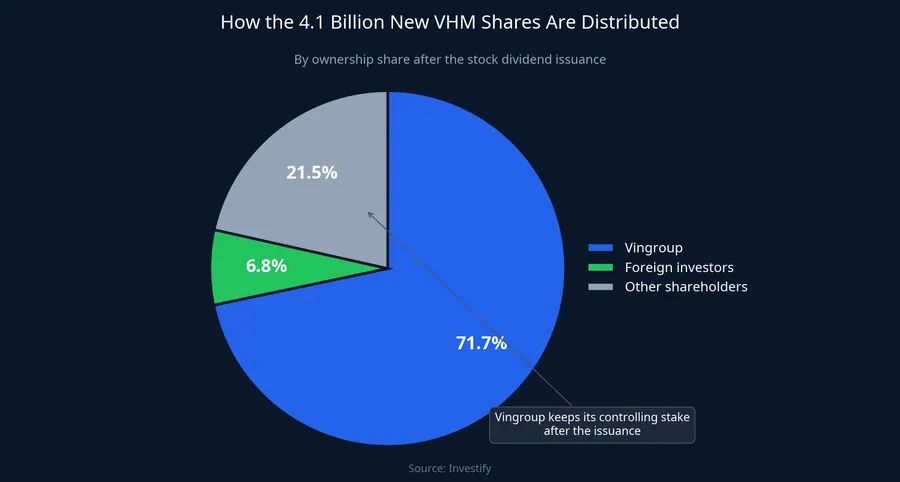
Foreign investors aren't a major supply source either. Foreign ownership of VHM currently sits at only about 6.8%, or under 280 million shares out of the new issuance. The remaining foreign room, measured against the now-doubled share count, has risen to roughly 3.55 billion shares, simply because total shares outstanding doubled while the ownership ratio barely moved.
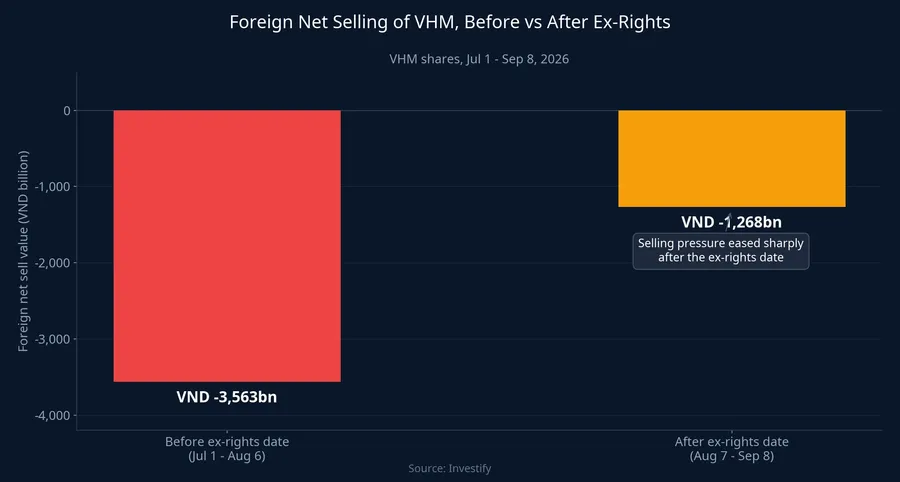
More notably, the bulk of foreign selling already happened before the event, not after. From July 1 to September 8, foreign investors net-sold about VND 4,831 billion of VHM stock, with VND 3,563 billion of that concentrated in the 27 sessions before August 6. The single session of July 28 alone accounted for VND 2,944 billion. Over the last five sessions, foreign flows have turned neutral, hovering around plus or minus VND 130 billion per session.
Two scenarios for September 9 and the days after
The absorption scenario. The trigger here is trading value on September 9 rising clearly above the roughly VND 600 billion per-session baseline of the last ten sessions, while the price still holds the VND 73,000 zone. The mechanism behind this scenario is that real supply hitting the market is small, combined with an operating base strong enough to keep holders in place. In the first half of 2026, Vinhomes posted revenue of VND 116,565 billion and after-tax profit of VND 52,091 billion — 3.4 times and 4.8 times higher than the same period last year, respectively — reaching 87% of its full-year profit target of VND 60,000 billion in just half the year.CafeBiz
If this scenario plays out, the VN-Index loses a significant drag: when the exchange's second-largest stock trades flat or slightly higher even as its float doubles, the benchmark benefits, and the thicker daily trading value for VHM is also the kind of liquidity condition large foreign funds typically need before deploying more capital.
The narrow-exit scenario. The trigger here is trading value spiking to several times the roughly VND 600 billion baseline, the price breaking below the August 14 low of VND 68,200, and foreign investors returning to net selling of several hundred billion dong per session instead of the neutral stance seen last week. The mechanism at play is behavioral, not valuation-driven: among the more than 34,000 shareholders receiving new shares, individual investors tend to sell off the portion that just landed in their account, even though their underlying wealth hasn't actually increased.
For anyone who bought VHM around VND 153,000 before August 6, the two shares they now hold are worth VND 147,200 combined, still a modest paper loss. That's the group most likely to sell once the price approaches breakeven. If that selling is large enough, a sharp VHM decline drags the VN-Index down immediately, and the sentiment typically spreads to other large-cap real estate names and the broader Vingroup family of stocks.
The tell: watch value, not share count
This is the easiest place to misread September 9. From tomorrow, the same amount of money traded will match to twice as many shares, simply because each share is now worth half as much. A matched volume of 15 million units tomorrow is not equivalent to 15 million units from last week. The metric that still means something is trading value in VND terms: the comparison baseline is roughly VND 600 billion per session over the last ten sessions, with the two busiest sessions, September 4 and September 7, reaching around VND 970 billion to VND 1,090 billion.
It's also worth subtracting out what belongs to the broader market before assigning a cause. The slide from VND 77,100 to VND 68,200 during the August 13-14 window wasn't a consequence unique to the share issuance: over those same two sessions, the VN-Index fell 1.54% and then 2.07%, meaning the entire market was under pressure. Supply pressure from the new shares, the broader market pullback, and foreign portfolio rebalancing were three forces acting on VHM's price at once over the past month. The available evidence isn't enough to cleanly separate each force's exact contribution; only when VHM falls meaningfully more than the broader market on a given session can more of that move be attributed to supply.
The longer-term story: leverage, not share count
This issuance doesn't bring a single new dong of capital into Vinhomes, so it doesn't change the company's financial picture. In the first half of the year, Vinhomes' total assets topped VND 1 quadrillion for the first time, real estate inventory rose to roughly VND 227,684 billion, and total borrowings climbed to about VND 215,508 billion from around VND 90,401 billion a year earlier. On August 24, the company approved a plan to issue two private bond tranches worth a combined VND 3,000 billion, with a 24-month tenor and collateral backing. This is the metric long-term investors should track alongside the stock dividend story: Vinhomes' financial leverage is rising far faster than its charter capital is growing on paper.

What to watch in the first week of trading
One session isn't enough to call which scenario wins out. The ownership structure shows real supply is smaller than the headline number suggests, and first-half earnings are strong enough to tilt the balance toward absorption. But profit-taking behavior from individual shareholders remains a hard-to-predict variable. The two numbers worth tracking are trading value against the roughly VND 600 billion baseline and the VND 68,200 price zone; which scenario takes shape should become clearer after the first full week of trading, once the shareholders who want to sell have either finished selling or haven't.