

This week, right after the US Labor Day holiday, Anthropic is expected to release its IPO prospectus, after having confidentially filed an S-1 with the SEC on June 1, 2026.CNBC The public filing will likely reveal the terms of a contract that, until now, has only been described in a few lines of a press release.Fool
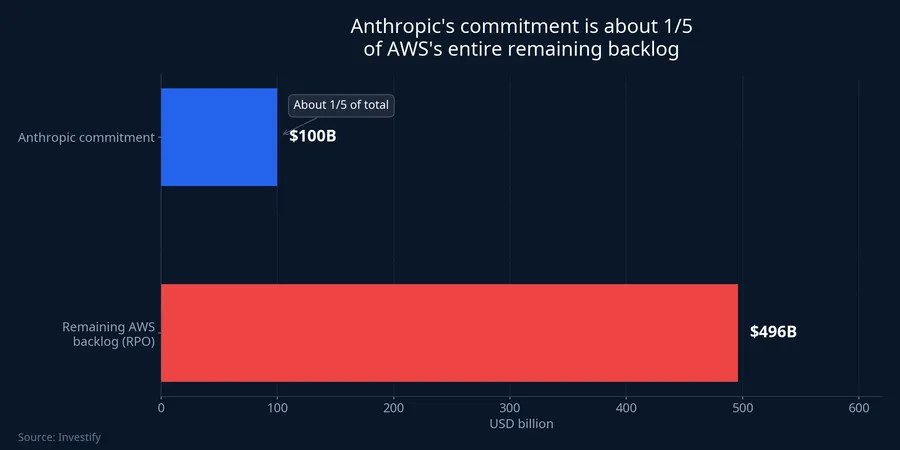
What is that contract? On April 20, 2026, Anthropic committed more than $100 billion over 10 years to Amazon Web Services in exchange for up to 5 gigawatts of compute capacity, running on Amazon's own Trainium and Graviton chips.Anthropic That same day, Amazon put in another $5 billion into Anthropic and committed up to $20 billion more, on top of $8 billion already invested.CNBC
That $100 billion figure is roughly one-fifth of AWS's entire signed, not-yet-fulfilled contract backlog, about $496 billion as of June 2026.Fool A single customer is carrying one-fifth of the order book of the world's largest cloud provider, and that is exactly where this risk story begins.
AI revenue isn't fake
For retail investors holding fund certificates or ETFs weighted toward US tech stocks, the familiar read is: AI demand is real, the spending is just running ahead of demand, so the risk is about pacing, not foundations. That read isn't naive.
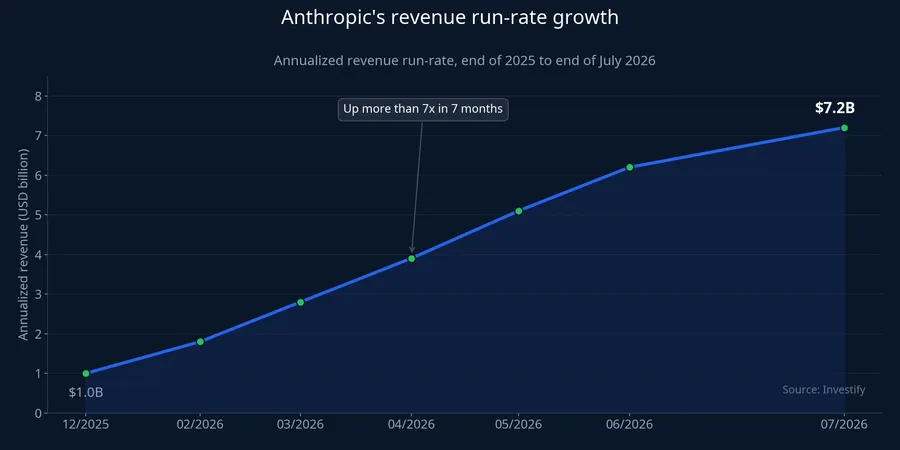
Anthropic's annualized revenue run-rate hit $65 billion by the end of July 2026, up from $47 billion in May and just $9 billion at the end of 2025.CNBC Preliminary Q2 revenue exceeded $11.5 billion, versus $787 million in the same period a year earlier. OpenAI roughly doubled over the same stretch, to about $40 billion. These are real revenue numbers, growing at a pace rarely seen in corporate history.
So the argument that "AI is a bubble because the revenue is fake" is out of step with the data. The real risk sits somewhere else, and it has nothing to do with whether the revenue is real.
Buyer, seller, and creditor: the same handful of names
Look at the list of compute-purchase commitments OpenAI has announced: $250 billion for Microsoft's Azure, $300 billion for Oracle, $138 billion for AWS, $22.4 billion for CoreWeave, and $10 billion for Broadcom. At the same time, Nvidia itself has committed to invest up to $100 billion into OpenAI. Bloomberg mapped the entire web: roughly $46 billion in equity stakes and $879 billion in multi-year purchase commitments circulating among exactly nine names: Microsoft, Oracle, Amazon, Google, Meta, OpenAI, Anthropic, xAI, and CoreWeave. Analysts call this circular financing. The mechanics are simple: a cloud company invests in an AI lab, the lab uses that money to rent infrastructure from the same cloud company, and the cloud company books that spending as its own revenue.

In the Anthropic-Amazon contract, all three roles show up at once: Amazon is a shareholder, an infrastructure supplier, and the designer of the chip Anthropic is required to use. None of this is legally improper, but the question worth asking is: when three roles concentrate in a single counterparty, who actually bears the risk if one link in the chain breaks?
When the chip seller has to guarantee the buyer's debt
The clearest sign of how stretched this structure has become is OpenAI's data center project in Ohio. In July 2026, Nvidia was reportedly considering guaranteeing up to $250 billion of the land-lease and construction costs for the project. Nvidia's stock dropped 5% right after that news broke.
By mid-August, the figure had been cut down: Nvidia is said to be backing about $105 billion in financing, and only for the project's first phase.CNBC The reason cited was investor pushback over Nvidia putting too much of its own balance sheet behind demand for the very chips it sells.
A manufacturer lending money to a customer to buy its own product isn't unusual in the hardware industry. What's unusual is the scale: even after being cut by more than half, the guarantee is still more than double OpenAI's entire current annualized revenue. When a seller stands behind a buyer's debt, that risk doesn't disappear, it just moves from the customer's balance sheet onto the supplier's own.
There's another reading, and it's partly right too
This structure shouldn't be presented as if there's only one explanation. The most persuasive alternative reading is: power and chips are genuinely scarce, so locking in compute capacity for 10 years is smart procurement, not financial engineering.Futurum Group A long-term commitment also lets the supplier build with confidence, much like offtake contracts in the power or gas industries.
That reading explains the purchase side of the contract well. It does not explain the debt-guarantee side. In a normal offtake agreement, the buyer bears the risk if demand falls short. Here, when the seller guarantees the buyer's loan, the risk runs backward onto the seller's own balance sheet. That's a difference in kind, not in degree.
The central banks' bank has already named this risk
The Bank for International Settlements (BIS), the institution often called the bank of central banks, devoted part of its Annual Economic Report 2026, published in late June, to this exact topic.Fortune Three points from the report stand out: the five largest cloud companies, Alphabet, Amazon, Meta, Microsoft, and Oracle, are expected to spend more than $1 trillion on AI infrastructure across 2025 and 2026, exceeding their own profits and free cash flow, forcing some to issue debt.Business Standard Visible financial metrics don't capture the full risk, because off-balance-sheet borrowing structures create a gap between reported debt and actual economic debt. And deals that blend equity, debt, and purchase agreements between suppliers and customers carry the risk that the same underlying asset gets pledged more than once, while terms are often disclosed only sparsely.
How this risk travels into your portfolio
For Vietnamese investors, exposure to this cluster of companies is almost always indirect, through fund certificates or ETFs weighted toward global tech stocks. And this is exactly where you need to read carefully, because most people buy funds to diversify risk, not to add another concentrated position.
On May 15, 2026, Ben Snider, Senior Strategist in Goldman Sachs Research, made a striking quantitative observation: tech stocks contributed 85% of the S&P 500's gain year-to-date at that point, while the rest of the index rose just 3%. Large-cap AI-linked stocks now account for roughly 40% to 45% of the index's total market value.
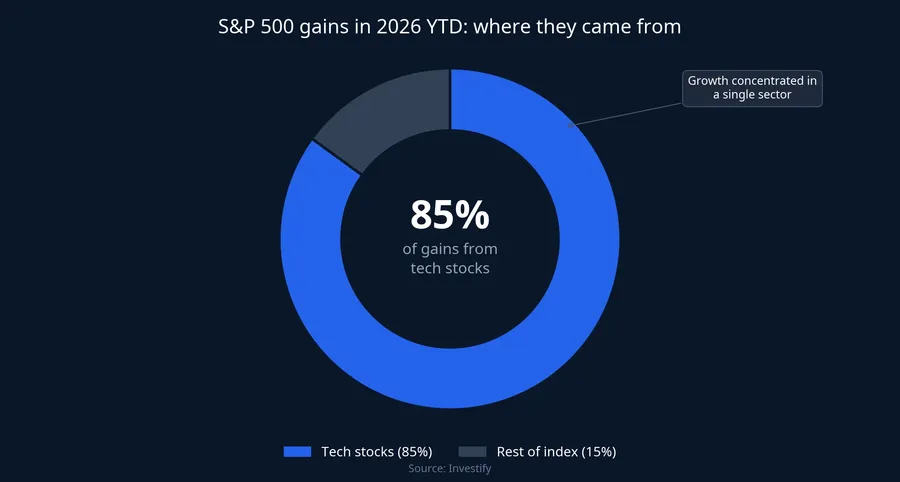
The consequence is concrete. A fund tracking the S&P 500 carries a name that suggests the diversity of 500 companies, but most of its movement is now driven by a handful of names. Worse for diversification purposes, those names aren't independent of each other: Nvidia, Microsoft, Amazon, Alphabet, Oracle, and Broadcom are simultaneously shareholders, customers, and creditors of one another within the same chain of contracts. Holding six tickers in this group doesn't create six separate sources of risk, it creates one single position split into six pieces.
What to watch for
The more accurate picture is this: AI revenue isn't fake, and that's exactly why the old-style bubble argument no longer holds up. The real risk is concentrated counterparty risk, embedded in contract structure rather than in market demand.
For investors considering, or already holding, fund products weighted toward global tech, the sensible approach is to read holdings at the individual-stock level instead of just the fund's name, and to add up total exposure to the six-company cluster above instead of counting how many tickers or funds you hold. A portfolio already heavily weighted toward this group doesn't gain diversification by adding another global tech fund, even if the number of funds held looks larger on paper.
The next signal will arrive within days. When Anthropic's prospectus is published, the three terms worth reading first are: the minimum mandatory annual spend under the AWS contract, the payment schedule, and the conditions for canceling or deferring the commitment. Until now, investors have only known the headline total. This will be the first time the internal structure of a $100-billion-plus AI infrastructure commitment has to sit inside a filing submitted to a regulator, instead of a few lines in a press release.