


On the afternoon of September 7, 2026, two pieces of news landed on Vietnam's financial newswires within hours of each other. The VN-Index closed at 1,821.64 points, down 31.44 points, or 1.70%. At the same time, the Ho Chi Minh City Stock Exchange (HoSE) added five more tickers to its list of stocks ineligible for margin trading, bringing the total to 69.CafeF
The instinctive reaction for anyone trading on margin is to scan that list for the tickers in their own portfolio. That's not a bad instinct, but it only answers half the question. The other half is more worrying, and it isn't written on any list at all.
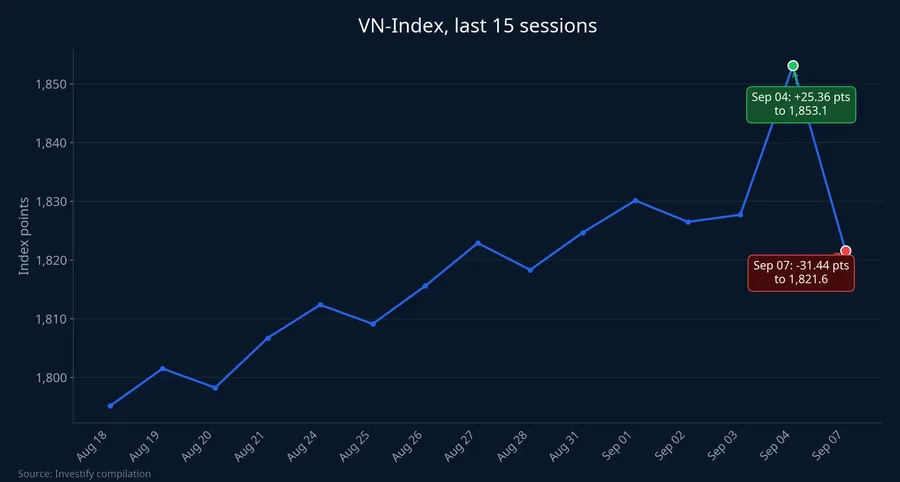
A decline that piled up in the afternoon
The session didn't fall evenly. By the close of the morning session, the index was down just under 14 points.Báo Tin Tức More than half of the day's total decline formed after the lunch break.
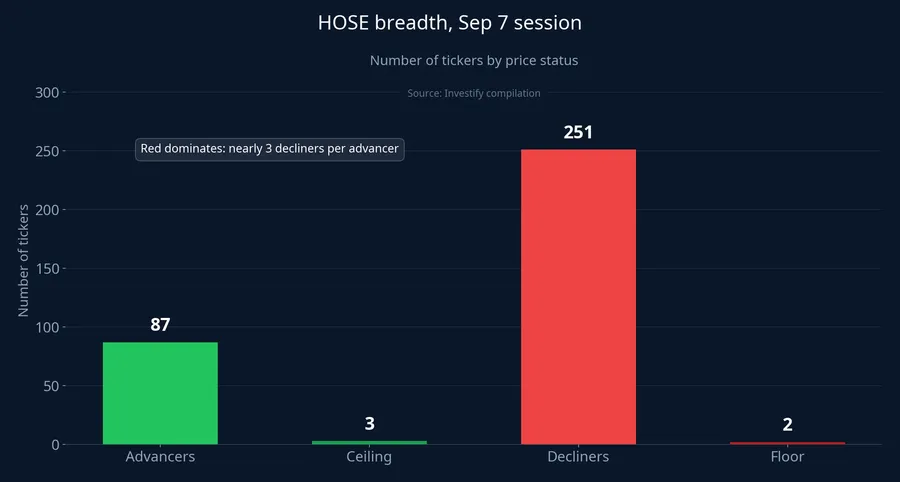
What matters more than the index points is breadth. HOSE recorded 87 advancers against 251 decliners, plus 3 tickers at the ceiling and 2 at the floor, on volume of more than 643.8 million shares. Nearly three losers for every winner points to selling pressure spread across the board rather than concentrated in a handful of sectors. The session also erased almost all the gains from the previous one: on September 4, the VN-Index had risen 25.36 points to 1,853.08. Add both sessions together, and the index still sits below where it started.
Five new names, three different reasons
The five newly added tickers are BCE, GIL, PNC, VNG and VNS. Their reasons for losing margin eligibility differ, and that difference matters to anyone holding the shares.
BCE (Binh Duong Construction and Transport), PNC (Phuong Nam Culture), VNG (Thanh Thanh Cong Tourism) and VNS (Vinasun) were cut because after-tax profit attributable to the parent company's shareholders came in negative on their reviewed H1 2026 consolidated financial statements. GIL (Gilimex) was cut because its H1 review carried a qualified opinion rather than an unqualified one.VnEconomy Those are two different categories of problem: one is about profitability, the other is about the reliability of the financial statement itself.
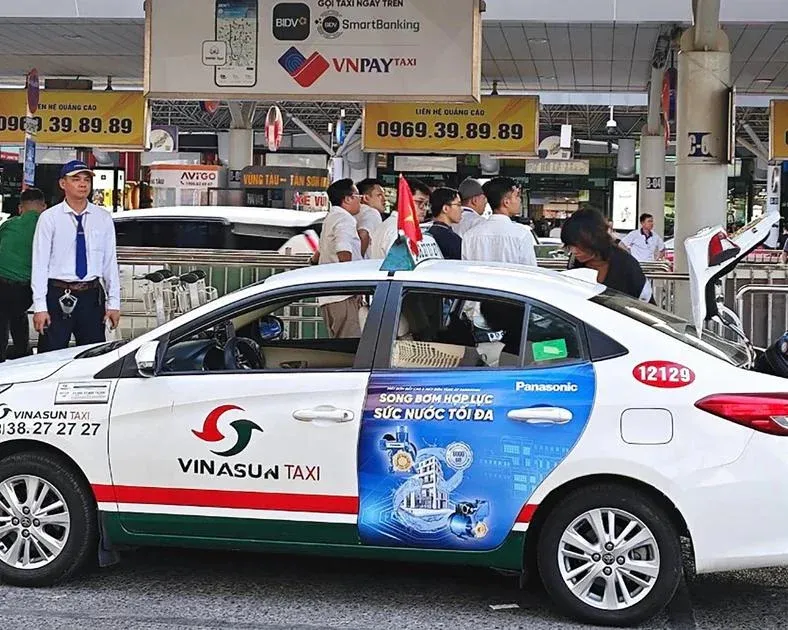
Vinasun's case stands out for how unexpected it was. The taxi operator posted a net loss of nearly VND 14 billion in the first half of 2026, against a VND 24.1 billion profit in the same period last year, on net revenue of VND 419 billion, down 7.1%.CafeF It is the first loss the company has reported since the Covid-19 pandemic.Tuổi Trẻ VNS shares closed the September 7 session at VND 6,250, down 5.30%.
Across the full list of 69 tickers, the largest single group is stocks under a warning designation, at 29 names.CafeF Most of that group reflects issues that already existed rather than anything new this week.
The new names barely register in size
Set against a session that fell 1.70% market-wide, the five newly added tickers carry almost no weight of their own.
On September 7, PNC saw zero shares change hands. VNG traded 1,200 units. BCE traded 31,700 units, VNS traded 35,600 units, and GIL traded 112,200 units. At closing prices, the combined trading value of all five names came to roughly VND 1.2 billion, on a session where the whole HOSE exchange traded more than 643.8 million shares. Combined market capitalization for all five companies is only around VND 2,300 billion. In other words, for the overwhelming majority of retail investors, these five names are almost certainly not in a leveraged portfolio to begin with. Securities firms already limit lending against stocks that trade only a few thousand units a session.
The opposite case is what deserves attention. The list of 69 still includes large, actively traded names. DGC of Duc Giang Chemicals, with a market cap of VND 17,850 billion, lost margin eligibility on April 8, 2026 for filing its audited 2025 financial statements late, and has remained under trading restrictions for months since.Tuổi Trẻ On September 7, the stock still traded more than 1.63 million shares and fell just 0.21%. Losing margin eligibility removes leverage; it does not automatically remove liquidity.
The risk that isn't on any list
For a leveraged account, what determines whether it faces a margin call is the ratio between outstanding debt and the value of collateral, not whether a given ticker appears on the margin-ineligible list. On September 7, collateral value fell across the board because 251 tickers declined together, not just the ones inside those 69 names. A portfolio entirely free of margin-restricted tickers, holding nothing but large-cap names, can still hit a warning threshold after a broad sell-off session like this one.
This is the point many investors miss: the margin-ineligible list answers "can I still borrow against this stock," while the actual margin ratio in the account answers "is my portfolio safe right now." The two questions are independent. A ticker that has never appeared on any warning list can still push an account into margin-call territory, if its weight is large enough and the decline deep enough.

Three things to check before the September 8 session
Read the reason, not just the name. A ticker cut for having been listed less than six months has an entirely different profile from one cut for a negative H1 profit or a qualified audit opinion. The first is a technical rule about listing tenure. The second and third reflect the actual state of the business, and rarely resolve within a quarter or two.
Check the real loan ratio in your account, not just the list. After a session that fell 1.70% with 251 decliners against 87 advancers, the question that matters isn't "is my stock on the list of 69," it's "how many more sessions like this can my portfolio absorb before facing a margin call."
Estimate your exit before you need it. If you're forced to reduce a position, a ticker that trades only a few thousand units a session won't let you sell at the price you want, regardless of whether it's on the margin-ineligible list. Liquidity is something to check while the market is calm, not after you already need to sell.
For a leveraged portfolio coming out of a broad-based decline, a common defensive benchmark is to bring the loan ratio down to a level that can absorb two more sessions like this one without triggering a margin call. The exact number depends on portfolio weighting and the type of stocks held; there's no single figure that fits every account.
The external backdrop hasn't cooled off either. US-Iran tension around the Strait of Hormuz continues to keep oil prices in a wide range, with Brent crude trading around $95 a barrel this week.VTC News Commodity swings typically feed into equity market sentiment with a lag of a few sessions. The list of 69 will keep growing as HoSE issues further notices. But the figure worth watching more closely in the coming sessions isn't the length of that list: it's market breadth. If decliners keep outnumbering advancers on volume above 600 million shares a session, pressure on leveraged accounts will build far faster than the list can grow.