

For years, every Federal Reserve meeting has revolved around one question: how much will they cut, and when. On September 15-16, that question flips. Futures markets are now pricing a Fed rate hike as more likely than a hold, a scenario most Vietnamese retail investors have never lived through.
The Fed's policy rate currently sits at 3.50-3.75% per year, unchanged through several consecutive meetings.Tuoi Tre A 0.25-point hike would push the range to 3.75-4.00%. More notable than the absolute number: the Fed has not raised rates once since July 2023, over three years ago.CNBC
What flipped the odds in a single week
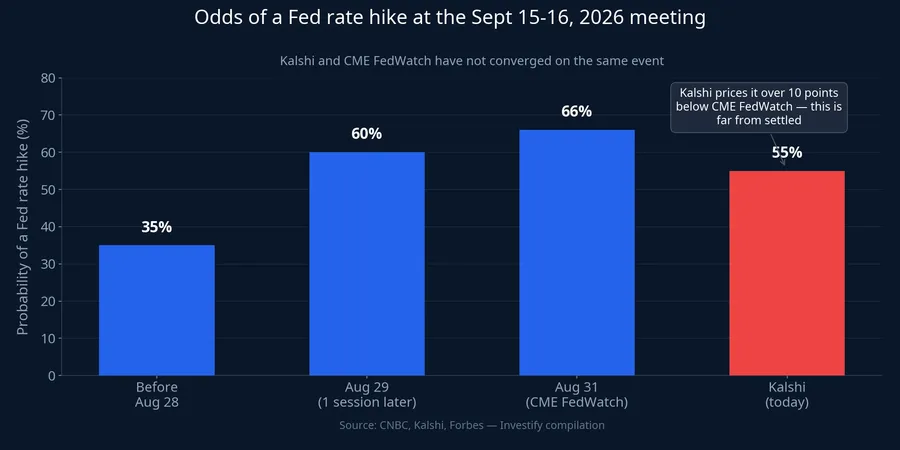
The picture before August 28 was simple: futures markets priced roughly a one-in-three chance of a September hike, with a hold as the default scenario.CNBC The turning point was a speech by Fed Chair Kevin Warsh at the Jackson Hole conference on August 28, 2026. He reaffirmed commitment to the 2% inflation target and said the summer's softer inflation readings "do not show the underlying trend has genuinely improved."CNBC
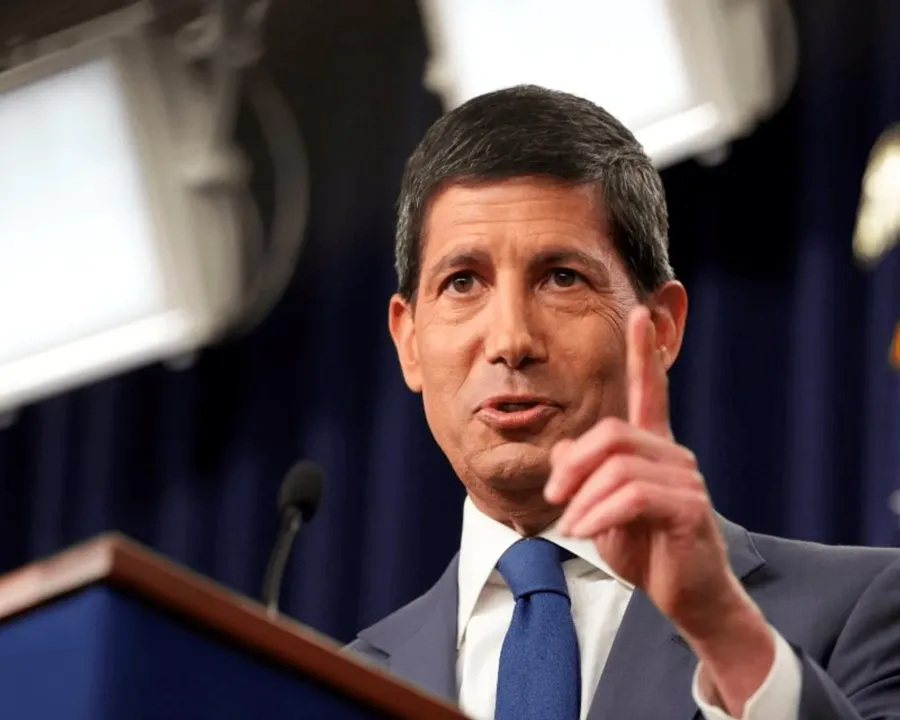
That was a signal the Fed stands ready to act if prices don't cool, not a promise to hike. But markets reacted almost immediately: the odds of a September hike jumped to roughly 60% within a single session,CNBC then to roughly 66% by August 31 per CME FedWatch. The reversal wasn't triggered by a speech alone: US inflation has run above target through 2026, partly because new import tariffs effective late July pushed goods prices up, and the August jobs report released in early September beat forecasts.
The degree of certainty here needs a caveat: two markets tracking the same event are showing two different numbers. CME prices it at roughly 66%, while prediction market Kalshi puts it at only about 55%, with 46% leaning toward a hold.Kalshi A gap of more than 10 percentage points shows this is far from settled.
The last variable before the Fed meets is the US August CPI report, due September 11, just days ahead of the decision. That release, not the meeting date itself, is what will actually move the odds.
What the Fed's decision touches, and what it doesn't
For anyone holding money in Vietnam, the key transmission channels from a Fed decision run through three variables: the dollar index, world gold prices, and the USD/VND exchange rate. On September 4, the DXY closed at 98.97 points (down 0.56%), world gold traded at USD 4,397 per ounce (down 1.70%), and the interbank USD/VND rate stood at VND 26,092.5.
The trouble is that history offers no one-directional rule to lean on. A study of 20 Fed hiking episodes from 1994 to 2023 shows that five sessions later, the DXY rose an average of 0.43% while gold barely moved, down an average of just 0.08%. That average masks enormous dispersion: for gold alone, the range 10 sessions after a decision spanned from down 5.86% to up 8.49%. In other words, correctly guessing what the Fed will do doesn't mean guessing which way gold will move, these are two layers of uncertainty stacked on top of each other.
There's one more layer to weigh. When a decision has already been priced in at 60-66%, the market's reaction afterward tends to be milder than a historical surprise. The bigger risk actually runs the other way: if the Fed holds while markets have leaned heavily toward a hike, that shortfall in expectations is what could trigger sharper volatility in gold and the exchange rate.
Three domestic cash channels, measured by the same yardstick
The practical question for retail investors isn't "what will the Fed do" but "where should my money sit while I wait." The three most common channels can be measured against the same criteria: whether the yield is known upfront, what cost you pay just to enter, and how exposed the channel is to the outcome of a meeting in Washington.
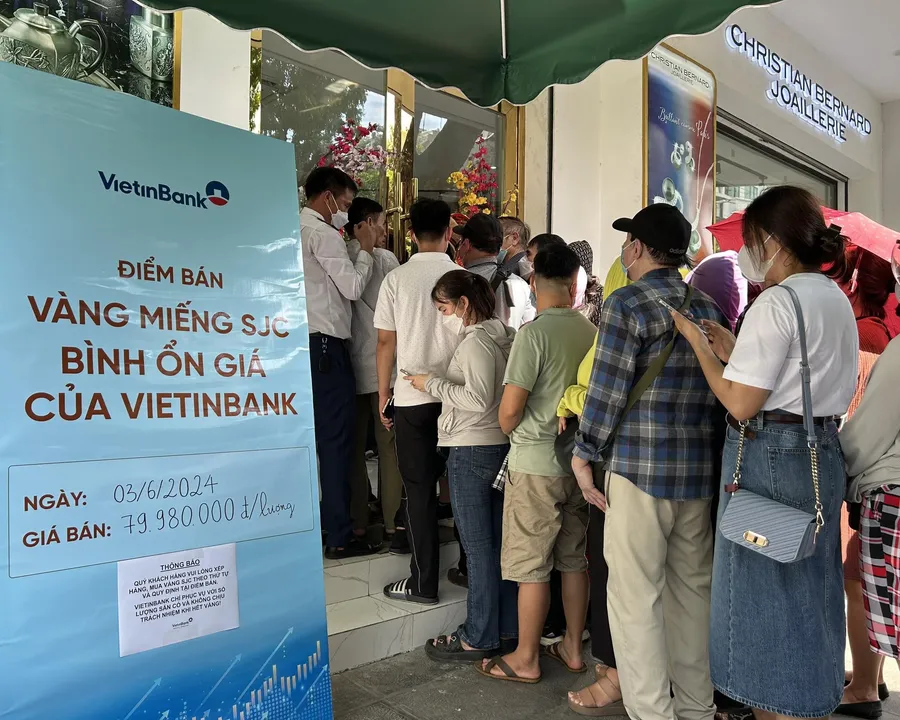
Gold. On September 5, SJC gold bars were quoted at VND 144.6 million to buy and VND 147.6 million to sell per tael, down VND 1 million from the prior session.VietnamNet Converted at world prices and the bank exchange rate, that same tael is worth roughly VND 140.2 million.Bao Lao Cai Two numbers matter here at once: the premium over world price of roughly VND 7.4 million per tael, and the buy-sell spread of VND 3 million per tael. That VND 3 million is a fixed cost paid the moment you buy, regardless of what the Fed decides. Gold has to rise about 2% just for a buyer to break even on the sell side.
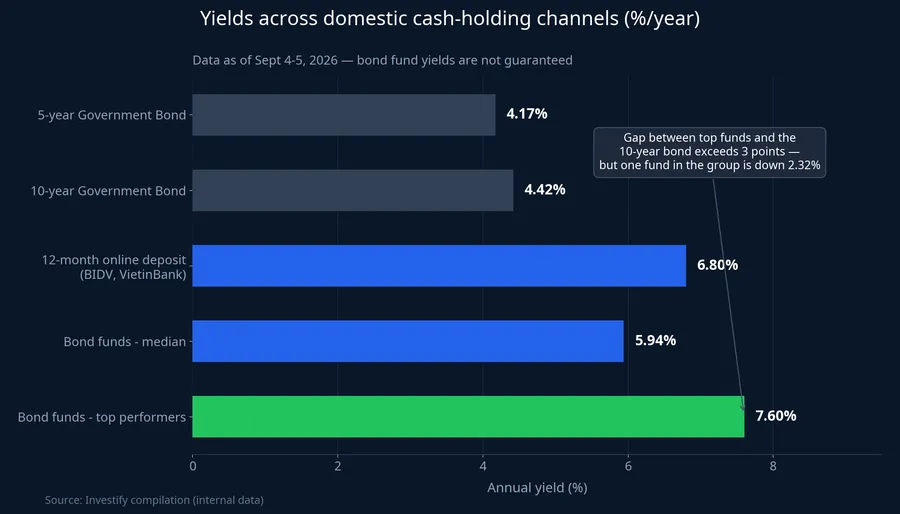
Savings deposits. For 12-month online deposits, BIDV and VietinBank both quote 6.8% per year as of September 4, while Techcombank sits at 6.75%.Kenh14 Easy to miss: back in mid-March, at the same tenor and same online channel, BIDV and VietinBank paid only around 5.2-5.3%. That roughly 1.5-percentage-point increase over half a year happened while the Fed didn't move at all, because it reflects domestic funding demand and liquidity conditions, not US policy.

Bonds and bond funds. Vietnam Government Bond yields sit at 4.17% per year for the 5-year and 4.42% for the 10-year as of September 4, well below deposit rates at comparable tenors. Domestic open-end bond funds post a 12-month median yield of roughly 5.94%, with top performers reaching 7.6%, but that yield isn't guaranteed: one fund in the same group posted a 12-month return of negative 2.32%, driven by credit risk and repricing of corporate bonds.
Lining the three channels up
Ranked by exposure to the September 16 outcome, the order is fairly clear.
Gold is the most exposed. Domestic gold tracks world prices, and world prices respond directly to the dollar and US bond yields. Anyone buying gold right now is accepting two layers of uncertainty while also paying VND 3 million per tael upfront in spread.
Bond funds sit in the middle. This channel isn't hit directly by the Fed, but a rising domestic yield environment lowers the market price of bonds already held, dragging near-term fund returns down.
Deposits and fixed-income products are the least exposed, simply because the yield is locked in at signing. A 12-month deposit opened this week at 6.8% per year pays exactly 6.8% until maturity, whether the Fed hikes, holds, or cuts.
The trade-off deserves to be stated plainly too. Locking in a 12-month rate means giving up any chance to capture a higher rate if domestic funding conditions keep climbing, and withdrawing early forfeits most of the interest earned. For anyone who wants to stay flexible, shorter tenors or fixed-income products that allow flexible withdrawal are the common way to avoid an all-or-nothing choice.
What to watch next
For money needed within a year, the channel with a yield fixed upfront is the reasonable default choice right now, simply because it's the only one of the three that doesn't have to wait on the outcome of a meeting on the other side of the world. The trade-off, as noted, is missing out on further rate increases if domestic liquidity keeps tightening, but that risk isn't large enough to overturn this choice for short-term cash.
For the portion of a portfolio that can absorb volatility, the date to watch isn't September 16, it's September 11, when the US August CPI report lands. If that number runs hotter than forecast, the odds of a hike will firm up further and pressure on gold and the exchange rate will build with it. If it cools, the hold scenario comes back into play, and that's exactly when a shortfall in expectations becomes the bigger source of volatility for anyone who bet on a hike.