
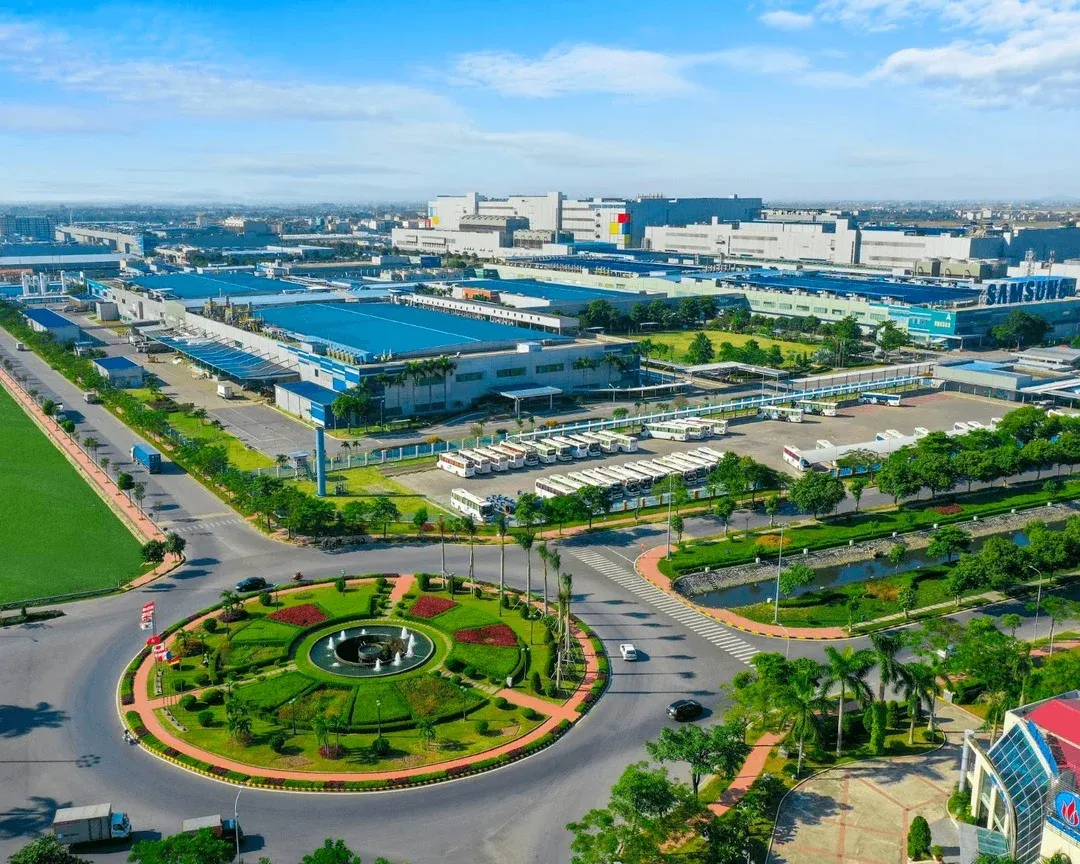

In the first half of 2026, Thai Nguyen unexpectedly topped the country in newly registered manufacturing FDI, pulling in roughly USD 5.77 billion across 17 projects, more than half of all new manufacturing FDI registered nationwide during the period, according to a Savills Vietnam analysis published September 5.MarketTimes This is a midland province in the northern mountains with a population of roughly 1.69 million after merging with Bac Kan in July 2025. That population size clearly does not explain why more than half of all foreign capital going into new factories nationwide chose this exact spot.
The picture only comes into focus once you look at how that USD 5.77 billion figure was actually assembled. And the answer is not a wave of new investors arriving at once. It is two decisions from the same conglomerate in the same year.
Two projects carry almost the entire number
Of that USD 5.77 billion, a USD 4.08 billion project from Samsung Semiconductor Asia Holdings and a USD 1.28 billion project from Samsung Electro-Mechanics Vietnam together add up to USD 5.36 billion, roughly 93% of the total.MarketTimes The remaining 15 projects split about USD 410 million between them, averaging less than USD 30 million each. In other words, what put Thai Nguyen at the top of the ranking was not broad-based investor appeal. It was the sheer size of exactly two names.
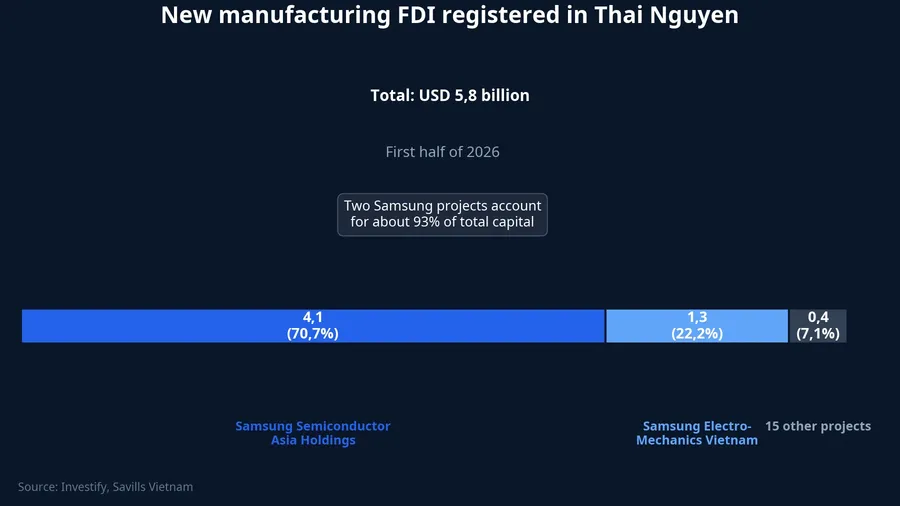
Thai Nguyen's provincial government offers a different, broader count over a longer window: through the end of July 2026, total FDI attraction rose by more than USD 8 billion, including 20 newly licensed projects registering over USD 5.7 billion, while the province's cumulative total as of July 31 stood at 249 FDI projects worth more than USD 19 billion in registered capital.Nhan Dan The two counts differ in scope, but they point to the same conclusion: few projects, each one very large.
Three provinces, three different kinds of capital
Foreign capital is moving through very different channels depending on the locality, and the difference is not in the total amount but in the type of capital. Bac Ninh, which merged with Bac Giang in July 2025, recorded 111 new manufacturing projects, the highest in the country.MarketTimes That is an ecosystem model, with many small and mid-sized suppliers clustering around a handful of anchor factories.
Hanoi is going in a completely different direction. In the first eight months of the year, total FDI in the capital reached more than USD 3.7 billion, of which newly licensed capital was only just over USD 572 million across 450 projects, while capital contributions and share purchases accounted for more than USD 2.6 billion.Nhan Dan That means roughly 70% of foreign capital flowing into Hanoi is being used to buy stakes in existing businesses, not to build new factories. The average newly licensed project here is worth about USD 1.3 million, less than one two-hundredth the average size of a new manufacturing project in Thai Nguyen.
Ho Chi Minh City still holds the largest total: as of August 25, registered capital exceeded USD 10 billion, equivalent to 91.5% of the annual plan.CafeF But that figure combines all three channels: newly licensed, additional, and share-purchase capital. Looking only at newly registered manufacturing capital, the race has clearly shifted north: the northern region attracted about USD 8.63 billion, 80.5% of the national total in the first half, with computers, electronics and optical products drawing more than USD 7.03 billion from just 65 projects, up 614% year-on-year.MarketTimes

The national picture is tilting the same way. In the first eight months, total registered FDI into Vietnam reached USD 40.63 billion, up 55.4%; newly licensed capital alone reached USD 21.72 billion across 2,771 projects, up 9.4% in project count but up 96.8% in capital.Bao Van Hoa Project count barely moved while capital nearly doubled, meaning the average project size is inflating nationwide. Thai Nguyen is simply the most extreme version of that broader trend.
The same structure that drives growth also creates risk
This level of concentration has a clear downside. The first risk is cyclicality: the province's capital is overwhelmingly concentrated in electronics and semiconductors, an industry with wide swings tied to global equipment demand, so when the cycle turns down, both disbursement progress and the province's export revenue come under pressure at the same time, since there is no second industry large enough to offset it.
The second risk lies in the parent company's own decisions. A single project accounting for more than 70% of the province's new manufacturing capital means Samsung's global capital-allocation schedule carries more weight than any incentive policy the province can offer. And the point most easily overlooked, the third risk, is that registered capital is not yet capital that has actually flowed into the economy.
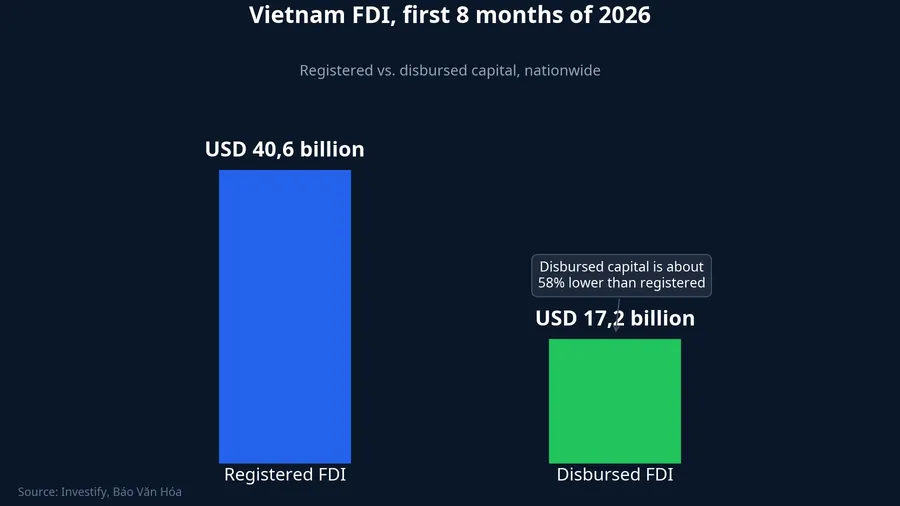
Nationwide, disbursed capital over eight months reached USD 17.25 billion, up 12% and the highest for the period in five years, against a base of USD 40.63 billion registered.Bao Van Hoa In Ho Chi Minh City, the FDI sector's disbursement rate reached 66.4% of registered capital, and authorities pointed directly to land handover and leasing procedures as the bottleneck after licenses are issued.CafeF In Hanoi, cumulative disbursed capital stood at just over USD 1.3 billion against USD 3.7 billion registered.Nhan Dan The gap between capital committed on paper and money that actually flows into the economy is a persistent feature, and Thai Nguyen, carrying two mega-projects, needs to be watched on precisely this metric.
Which listed companies sit in the affected zone
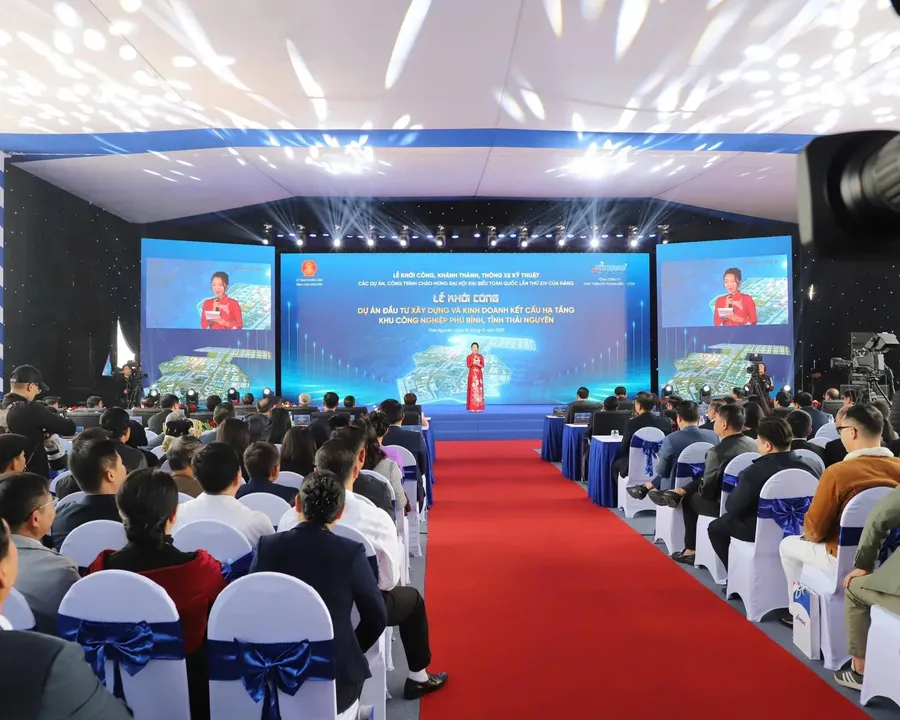
For individual investors, the most direct way in is industrial park infrastructure around the Yen Binh, Pho Yen and Phu Binh corridor. Kinh Bac (KBC) has the clearest presence here, with its 675-hectare Phu Binh Industrial Park, worth roughly VND 11,500 billion in total investment, which broke ground in December 2025 and connects directly to the Capital Region's Ring Road 5 and National Highway 37.CafeF KBC shares closed the September 4 session at VND 27,100.
Alongside KBC, ASG operates warehouse facilities in the Yen Binh Industrial Park (Thai Nguyen) and Yen Phong Industrial Park (Bac Ninh), closing the same session at VND 16,300. IDV is a pure Vinh Phuc play through its Khai Quang and Song Lo II industrial parks, closing at VND 21,100. All three are tied to leasing infrastructure rather than the Samsung capital itself, so movements in rental prices and regional occupancy are the more relevant indicators of this group's revenue.
The backdrop for the whole group is a leasing market that is slowing down, not accelerating. Per CBRE, published August 20, the average asking rent for northern industrial land in Q2 2026 was USD 137.7 per square meter per lease term, up 2.7% year-on-year, while regional occupancy fell to 64%, down 2.7 percentage points, as more than 1,200 hectares of new supply from six industrial parks in Hai Phong, Bac Ninh and Ninh Binh entered the market within just six months.MarketTimes
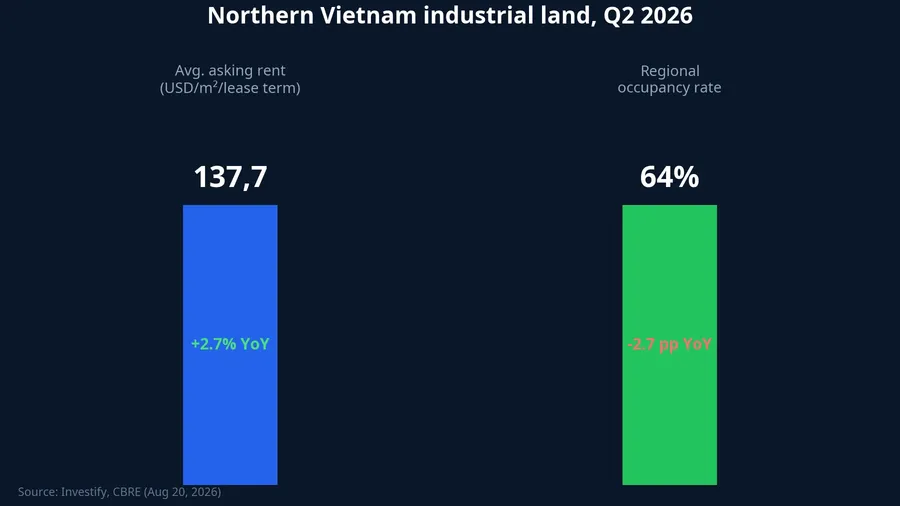
In the top-tier segment, occupancy still reached 81.3% after six months with more than 217 hectares absorbed, the highest since Q1 2024.FireAnt The two figures are not contradictory: clean land with completed legal procedures in the core zones is still leasing quickly, while the region-wide vacancy average is being dragged down by new supply that has not yet been absorbed.
What to watch
The right framework for this stage is to track land-handover progress rather than the registered-capital headline. Registered capital is a commitment on paper; an industrial park developer's revenue only materializes once land is actually handed over and booked. Kinh Bac already illustrated that gap clearly: Q1 2026 revenue fell sharply due to low handover volume, even as its backlog of contracts awaiting recognition remained substantial.
Three signals worth watching in the coming quarters: site-clearance and land-handover progress at Phu Binh, absorption of northern industrial land as more than a thousand hectares of new supply continues entering the market, and the actual disbursement pace of the two Samsung projects. If all three signals move upward together, the Thai Nguyen story shifts from registered capital to real cash flow, and the industrial park infrastructure stocks tied to it would have grounds to benefit directly. If only the registered-capital headline keeps climbing while those three signals stay flat, it remains a prettier ranking rather than a business cycle that has actually taken shape.