

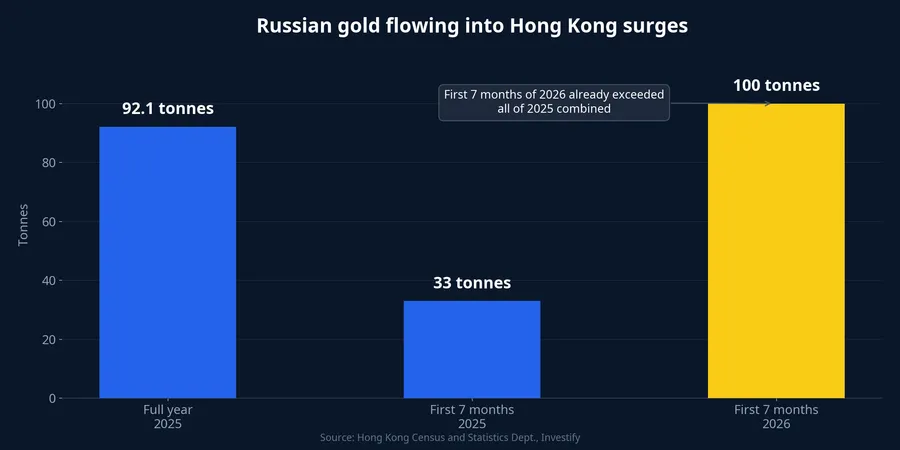
In March 2022, the London Bullion Market Association (LBMA) struck six Russian refiners off its accredited list. Four years later, the consequences of that decision are still reshaping the map of global gold flows: according to Hong Kong trade data cited by Markettimes on September 6, 2026, gold imports from Russia into the territory reached nearly 100 tonnes in the first seven months of 2026 alone, almost triple the same period last year and already exceeding the full-year 2025 total.Markettimes
The bigger picture behind that number touches something few Vietnamese gold buyers ever think about: what decides where a gold bar can be sold, and at what price, is not the metal itself.
The paper decides the price, not the metal
Gold is a homogeneous metal. A 999.9-fine bar cast in Krasnoyarsk and one of the same purity cast in Zurich are physically identical. But the international gold market does not trade bare metal: it trades bars carrying LBMA Good Delivery certification, proof that the bar was cast by a refiner on the accredited list.

That certification carries weight because the London market accounts for roughly 70% of global nominal trading volume and holds the world's largest physical gold reserves, over 8,500 tonnes in its vaults.FireantVietstock On March 7, 2022, the LBMA suspended six Russian refiners with immediate effect, following sanctions from the US, UK and EU.LBMA Bars cast before that date kept their Good Delivery status; anything cast after did not. The metal itself never changed. Only the paperwork attached to it did, and that was enough to sever all of Russia's new gold output from Western trading channels.
Why the flow has to stop over in Hong Kong
Once London shut its door, Russian gold needed a market that did not treat the LBMA standard as mandatory. Dubai was the first stop. But once the UAE tightened its rules after being placed on a global anti-money-laundering watchlist, the route shifted again: by late 2023, Hong Kong had overtaken Dubai as the biggest hub for Russian gold trading.SCMP
Gold does not flow straight into mainland China even though that is where it is ultimately consumed, and the reason is quota. Mainland China manages gold imports through quotas granted to a designated group of banks, while Hong Kong imposes no restriction on Russian gold at all. According to Debajit Saha, Lead Metals Analyst at London Stock Exchange Group (LSEG), Chinese buyers can park gold in Hong Kong first, then move it into the mainland once quota room opens up. Hong Kong therefore functions as a waiting room, not a final destination.

Who is absorbing it on the other end
This flow only survives if demand on the other side is large enough to absorb it, and in China that demand comes from two structurally different layers. The first is the People's Bank of China, which bought roughly 20 tonnes of gold in July 2026 alone — its largest monthly purchase since October 2023 — extending a net-buying streak to 21 consecutive months and pushing reserves past 76 million ounces.VietnamPlusNgười Quan Sát Notably, this buyer moves counter-cyclically, accumulating harder during price pullbacks.
The second layer is civilian demand, and it is this layer that actually determines the scale of the flow: China's private sector consumed roughly 985 tonnes of gold in 2024, while domestic mine output was only about 377 tonnes.Markettimes That gap of more than 600 tonnes a year has to be filled by imports, which is why Russian gold found a foothold there, not because China has any particular political appetite for that specific supply.
Same metal, two prices
The clearest consequence of this market split is price. According to the chairman of the Hong Kong Gold Exchange, traders from Russia and the Middle East have been selling physical gold there at a 15-20% discount to the international price since early April 2026.CafeF That discount is not purely "the price of sanctions": the same chairman said the direct trigger was the US-Israel conflict with Iran, which pushed traders to relocate stock from Dubai to Hong Kong and accept quick, discounted sales for cash. Sanctions created the underlying condition for a two-price market to exist; the geopolitical shock is what triggered that specific sell-off. Both layers of causation point to the same conclusion: gold is no longer a single-price asset globally.
Infrastructure for this second trading channel is also being built. The Shanghai Gold Exchange opened its first vault outside the mainland, in Hong Kong, enabling direct conversion between yuan and gold, and by July 2026 Hong Kong began trial operation of a centralized gold clearing system. In essence, that is a version of the London model, but built inside the yuan ecosystem.Báo Mới

Which side of the split Vietnam sits on
This is the part that touches Vietnamese gold buyers' wallets directly, and the answer is fairly clear-cut: Vietnam is wired into the Western channel, not the Hong Kong-China one. Under Decree 232/2025, which amends Decree 24/2012, the State Bank of Vietnam grants annual quotas and case-by-case licenses to enterprises and commercial banks for importing raw gold, based on monetary policy goals and supply-demand conditions at any given time.Báo Chính phủ That means gold flowing into Vietnam follows an administrative quota, not the cheapest price available internationally: discounted gold in Hong Kong has no route into a domestic jewelry shop.
The numbers make that gap concrete. World gold on September 4 closed around $4,397.41 per troy ounce; converted at that day's exchange rate of VND 26,092.5/USD, that works out to roughly VND 138.4 million per tael. SJC gold bars, meanwhile, sold for VND 147.6 million per tael on September 5, while SJC 99.99% rings sold for VND 146.1 million. The gap versus converted world price runs about VND 9.2 million per tael for bars and VND 7.7 million for rings.
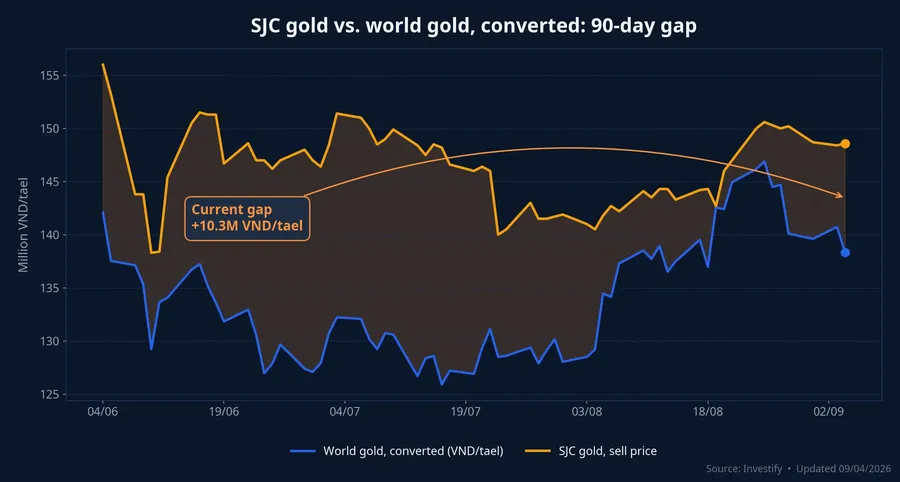
That gap comes from domestic supply locked behind a licensing mechanism, not from any global gold shortage. The world currently has enough surplus gold that some sellers are cutting prices 15-20%, yet Vietnamese buyers still pay the London price plus a domestic premium on top. The East-West fragmentation of the gold market does not shrink that premium, because the two markets barely connect through the official import channel.
What to watch next
In the short run, gold prices still swing on Fed rate expectations, and that has not changed. But a second layer is forming underneath it: official demand from Asian central banks keeps buying steadily regardless of whether prices rise or fall, building a firmer floor under gold in the medium term than existed before 2022.
The signal worth watching is not tomorrow's gold price: it is how complete Hong Kong's gold clearing system becomes. As long as that system stays in trial mode, London remains the sole price reference and domestic gold prices keep tracking that familiar anchor. If the system becomes fully operational and establishes its own yuan-denominated reference price, the world gold market will formally have two prices running at once instead of a single London benchmark. Until then, the roughly ten-million-dong gap per tael in Vietnam is still set by import quotas, not by global gold supply and demand.