
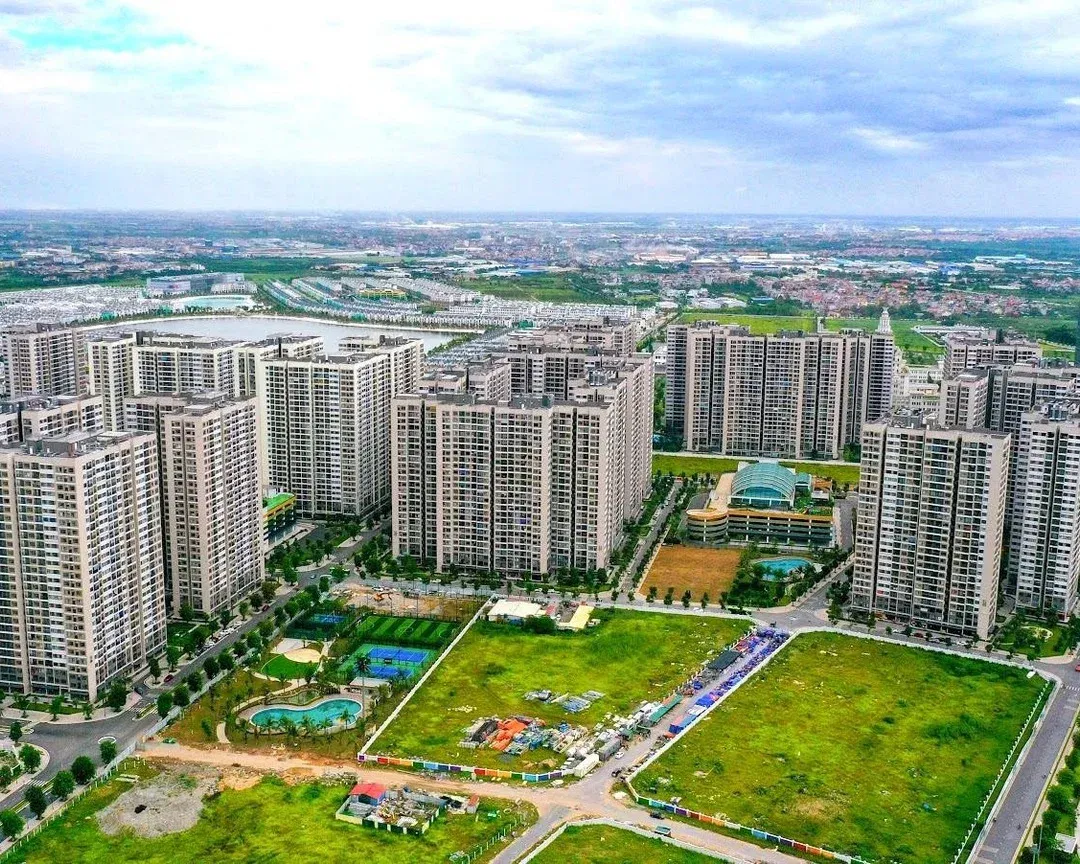

A 54-square-meter, two-bedroom apartment in western Hanoi was listed for nearly VND 5 billion late last year. The owner now accepts around VND 3.7 billion, and is still open to negotiating further.CafeF That's a VND 1.3 billion cut, more than a quarter of the unit's value. A buyer from Từ Liêm toured the building floor by floor, asked detailed questions about handover timing, then went home without putting down a deposit.
This is not an isolated case. It's a miniature of a market where prices are falling but sales are falling faster still. The question worth asking isn't "is the price low enough yet." It's who is hiding the real cost of waiting.
The 71.5% figure everyone is misreading as apartments
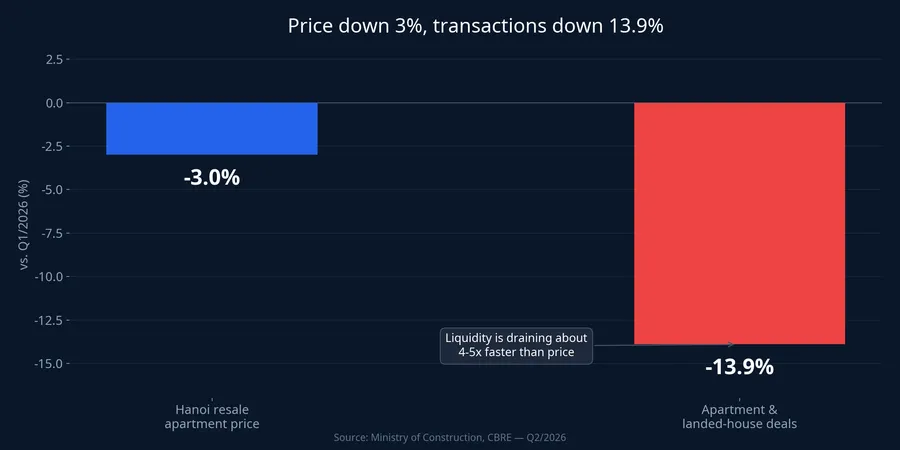
The Ministry of Construction's Q2/2026 report recorded about 100,005 successful real estate transactions nationwide, 71.5% of Q1/2026 and 63.7% of the same period in 2025.CafeF That figure has been cited across the press with the conclusion that apartments lost nearly 30% of their liquidity. That's the wrong layer of data: apartments and standalone houses recorded just 26,567 transactions but that's 86.1% of Q1, while land plots are the segment actually dragging the whole market down, at 73,438 transactions, only 67.4% of Q1.CafeF The market-wide 28.5% decline is mostly land plots; the actual housing segment fell only 13.9%.
Correcting the number doesn't make the paradox go away. It sharpens it. Resale apartment prices in Hanoi fell nearly 3% quarter over quarter, the first pullback since late 2022;Fireant in Ho Chi Minh City, secondary prices commonly dropped 2-6% by quarter.MarketTimes Price down about 3%, transactions down 13.9%: liquidity is draining roughly four to five times faster than price is falling, and that's the piece the familiar logic of "lower price brings buyers in" cannot explain.
Two anchors that refuse to meet
On the seller side, staying power is still thick. A Batdongsan.com.vn survey found 83% of sellers are still selling above cost, with 42% selling more than 10% above cost.Fireant Đồng Quang Cảnh, Senior Business Manager at Batdongsan.com.vn, describes the current state as one without widespread fire sales or capitulation; the biggest friction is buyers bidding too low while sellers still expect high prices. In other words, most people listing today haven't taken a loss. They're only giving up some of the gain they expected in 2024-2025, and someone who hasn't lost money has no reason to sell in a hurry.
On the buyer side, the anchor points the other way. Per One Mount Group, the share of customers with clear intent to buy real estate fell from 55% in 2025 to just 36% in Q1/2026, with only 17% planning to buy within six months.Nguoiquansat Demand hasn't disappeared, it's been deferred: 97% of current renters still want to buy a home eventually,Baomoi and 67% of buyers searching in the first half of this year were looking for a home to live in, not an investment.Baomoi
End users are far more patient than speculators because they aren't under pressure to recycle capital. Nguyễn Văn Đính, Vice Chairman of the Vietnam Real Estate Association and Chairman of the Vietnam Association of Realtors, calls this a shift from fear of missing out to fear of choosing wrong: sellers are anchored to the old peak, buyers are anchored to a floor that hasn't arrived yet, and transactions get stuck in between.

What the report doesn't say: financing costs are what's keeping both anchors still
The expectation gap explains why the two sides don't meet, but it doesn't explain why that gap isn't narrowing over time the way it did in previous cycles. The answer is the cost of capital. Per the Vietnam Association of Realtors, prevailing home loan rates run 13-15% a year, while first-period fixed rates sit around only 9-10%.CafeF Lê Thị Huyền Trang, CEO of JLL Vietnam, says interest-rate pressure is the primary reason the market has cooled, since the risk of a floating rate once the teaser period ends leads many buyers to delay their decision.
Apply those numbers to the VND 3.7 billion apartment from the opening and the real risk becomes visible: borrow 50% of the value, or VND 1.85 billion, and at a fixed 9.5% a year, interest alone runs about VND 14.6 million a month; once the teaser ends and the rate floats to 14%, that jumps to roughly VND 21.6 million a month, before principal. This is an illustrative calculation built from the two prevailing rates above, not a worst-case scenario.
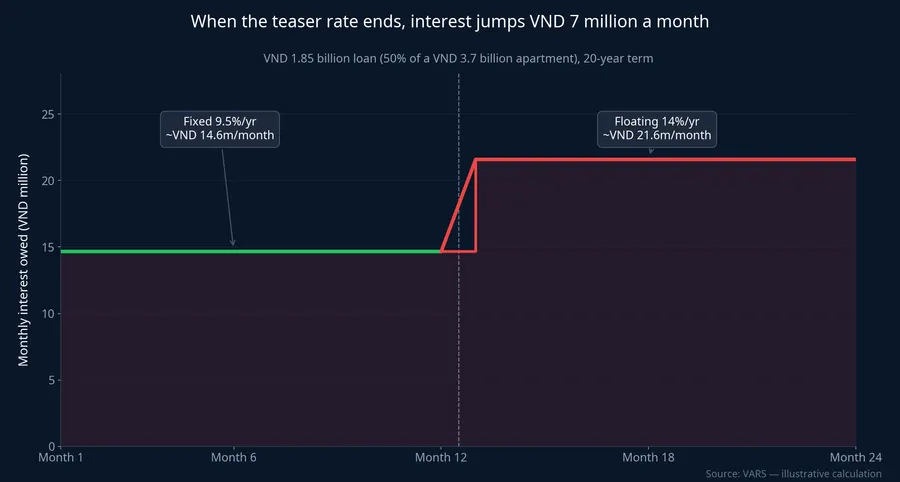
That VND 7 million monthly gap shows up right as a buyer is still adjusting to the initial repayment. The VND 1.3 billion price cut from the opening is real, but it gets eaten up by financing cost over a 20-year loan; buyers aren't misreading the listing price, they're reading a second bill the listing never shows. To be clear, rates aren't the only driver: new supply surged in Q2, skewed toward mid-to-high-end product that misses actual buying power, and that amplifies the problem. But that supply mismatch has been present for several quarters while liquidity still held up, whereas the jump in financing cost is this year's new variable, so the evidence tilts toward interest rates as the dominant cause.
Anchoring price is a seller's right, but that right isn't free
While both sides stand still, inventory keeps piling up: real estate inventory in Q2/2026 topped 39,000 units and plots nationwide, with apartments alone up 22.2% from Q1.MarketTimes That's unsold stock sitting at the project level, and every quarter it sits there is another quarter of financing cost running against the developer.
Developers aren't cutting listed prices. They're holding the price board and compensating with extended payment schedules and rate subsidies instead, because cutting the listed price would hit the value of collateral and the confidence of buyers who already bought in.Baomoi The "on paper" primary-market price barely moves as a result, while the real secondary-market price has already fallen. Buyers see that gap and read it as a signal the correction has only just begun: sellers wait to avoid selling cheap, buyers wait to avoid buying expensive, and every month that passes reinforces both sides' conviction that they're the ones waiting correctly.

What's worth watching, instead of asking whether price has bottomed
For buyers, the relevant decision framework in this environment doesn't hinge on "has price bottomed," because the listing price isn't the variable locking up the market. The more useful signal is home loan rates falling back below 10% a year, the level brokers themselves call the market's breaking point;Nguoiquansat next is secondary transaction volume rising for several consecutive quarters, not a handful of scattered bargain deals; last is apartment inventory ceasing to expand.
For anyone with sufficient cash flow buying to live in, this quarter's setup tilts more toward buyers than 2024-2025 did, with more stock on offer and sellers more willing to negotiate. The usual defensive threshold still applies: monthly debt service under 40% of income, leverage no more than 50% of asset value, calculated at the floating rate rather than the first-year teaser rate — exactly the risk the VND 3.7 billion apartment from the opening illustrates.
For sellers, the number to watch is 22.2%. Rising inventory means more listings competing directly with theirs every quarter, while the pool of qualified buyers keeps narrowing. Anchoring price is a right that belongs to whoever owns the asset, but that right carries an opportunity cost, and that cost keeps rising with every quarter liquidity stays thin.
The Ministry of Construction's Q3/2026 data is expected around October. If apartment transactions keep shrinking while secondary prices only edge down a few more percentage points, this standoff will extend into a third straight quarter, and highly leveraged sellers are the more likely side to run out of patience first.