
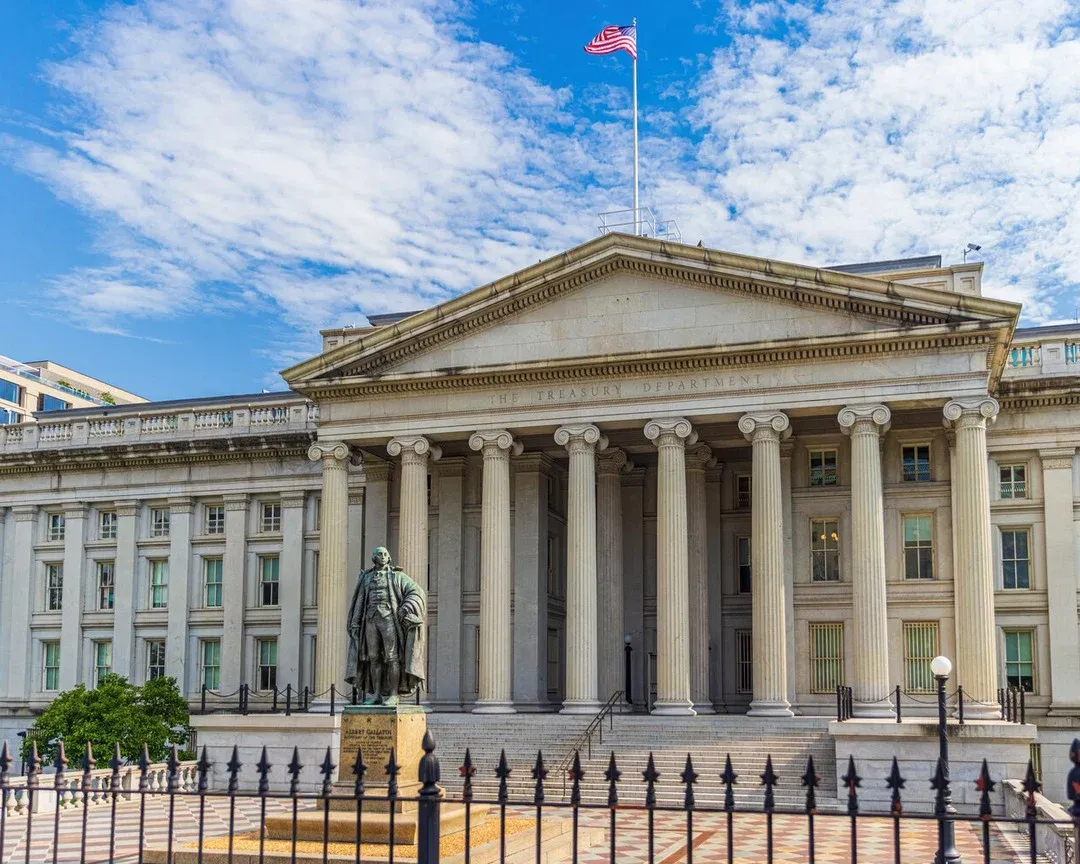

Most retail investors carry a default hierarchy of safety in their heads: savings deposits are the safest, government bonds come next, then corporate bonds and stocks. US Treasuries get an even higher pedestal, labeled the "risk-free asset" in finance textbooks and every valuation model.
That ranking isn't wrong. The US government has never missed an interest payment, and a country borrowing in its own currency can't technically be forced into default. Vietnamese government bonds sit in a similar position. If "risk" means the chance of not getting paid, government bonds really are close to zero risk. But that definition only covers half of what can happen to your money. The other half was just underlined, in a hard-to-ignore way, by the largest owner of government bonds on the planet.
Norway's $2.3 trillion fund wants less of the US Treasury market
On September 1, 2026, Norges Bank Investment Management (NBIM), which manages Norway's roughly $2.3 trillion sovereign wealth fund, sent a formal proposal to Norway's Ministry of Finance. The letter, published September 4, was co-signed by Norges Bank Governor Ida Wolden Bache and NBIM CEO Nicolai Tangen.CNBCNBIM
The core ask: cut government bonds' share of the fund's fixed-income benchmark from 70% to 50%, with US Treasuries within that government bucket falling from 34.1% to 21.9%.BNN Bloomberg In dollar terms, the fund held about $215 billion in US Treasuries as of end-June 2026, meaning the proposed cut is roughly $80 billion if approved.CNBC The capital freed up would shift into US corporate bonds, raised from 16.2% to 27.6% of the benchmark, plus mortgage-backed securities (MBS) added for the first time.Yahoo Finance
It's worth stressing this is still just a proposal awaiting a response from Norway's Ministry of Finance. NBIM has said that if approved, the rebalancing would happen gradually to limit market impact, and no sell orders have been placed this week.

Why cut now: the bigger picture isn't a default warning
It's tempting to read this as a warning shot about America's finances, but capital moves of this size usually reflect several forces at once rather than a single cause.
Three readings are worth weighing: fiscal concern (US public debt sits at 128.7% of GDP in 2026, with the IMF projecting 143.4% by 2030, and 30-year Treasury yields have climbed to roughly 5.25%Federal Reserve); a reach for higher yield in corporate bonds and MBS, a trade-off a pension fund with a multi-decade horizon can afford; and pure portfolio mechanics, with the fund wanting its bond sleeve to do a better job dampening equity volatility.
The evidence leans toward the latter two. The letter itself cites diversification and improved returns as the rationale, while affirming that a 50% government-bond weighting still provides enough liquidity during market stress. More tellingly, the two signatories argue that MBS tends to move opposite to stocks during crises, making it capable of dampening volatility in a way closer to government bonds than corporate credit.Yahoo Finance That's a portfolio-construction argument, not a statement about America's ability to pay.
In other words, NBIM isn't stepping back from Treasuries because it fears not getting paid. It's stepping back because it believes the yield no longer compensates for the risk holders still carry. And that risk, not default risk, is the real lesson for individual investors.
The principal always gets repaid, the problem is when you need to sell
Bonds pay a fixed stream of cash flows. When market yields rise, that fixed stream gets discounted at a higher rate, so the bond's market price falls. The longer the maturity, the harder the price drops for even a small uptick in yield.

The clearest illustration comes straight from the US market. TLT, the ETF holding US Treasuries with 20+ years to maturity, lost about 50% of its value from its August 2020 peak to its October 2023 trough. Someone who bought at the exact 2020 peak is still down more than 40% today, even after collecting every single coupon payment. Not one bond in the fund's portfolio ever missed a payment.247wallst
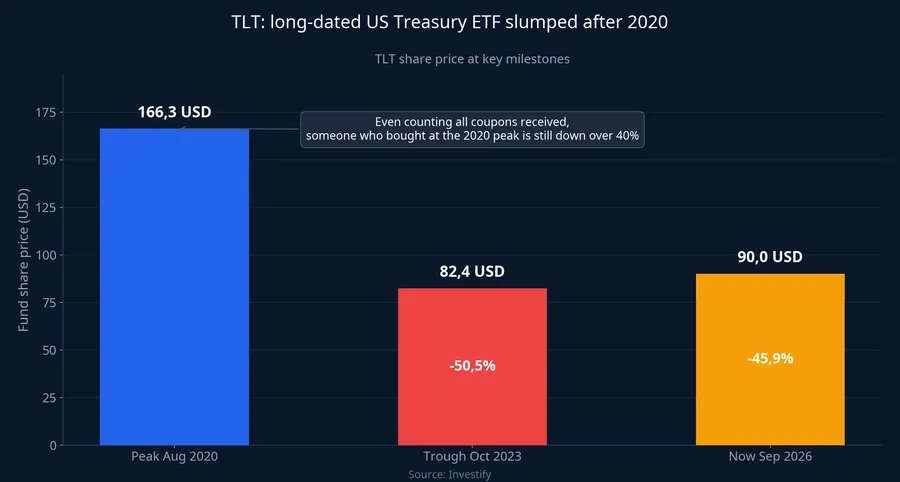
Both things are true at once: the US government paid in full, and holders still lost nearly half their account value. The safety of a government bond is about getting full face value back at maturity, not about the portfolio's value at any point in between. Hold to maturity, and the swings in between cost you nothing. Sell before maturity because you have to, and those swings become a real loss.
That's the line between default risk and interest rate risk: government bonds are nearly immune to the first and fully exposed to the second, while corporate bonds carry both, plus their own issuer-specific credit risk on top.
What Vietnam's yield curve is telling local investors
Vietnamese retail investors can buy government bonds on the secondary market through a brokerage account, since these bonds are listed on the HNX. The mechanics of gains and losses from selling early are identical to what's described above.
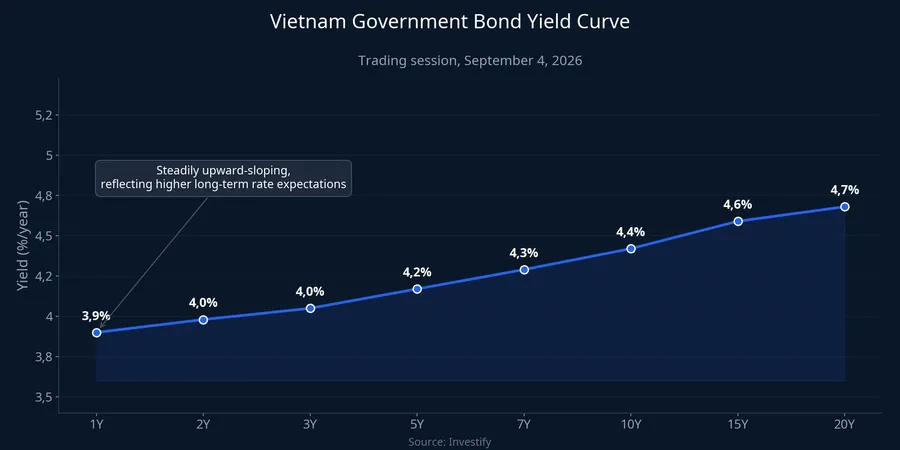
What stands out is the current level of yields. In the September 4, 2026 session, Vietnam's government bond yield curve slopes steadily upward, from 3.90% at the 1-year tenor to 4.68% at 20 years.
That same day, online 12-month VND deposit rates ranged from 5.6% to 6.8% depending on the bank, with Agribank and BIDV both at 6.8%. The result runs counter to intuition: a 12-month deposit is currently paying roughly 2 percentage points more than a 20-year government bond, while the depositor takes on zero price volatility and can simply roll the money over after a year.
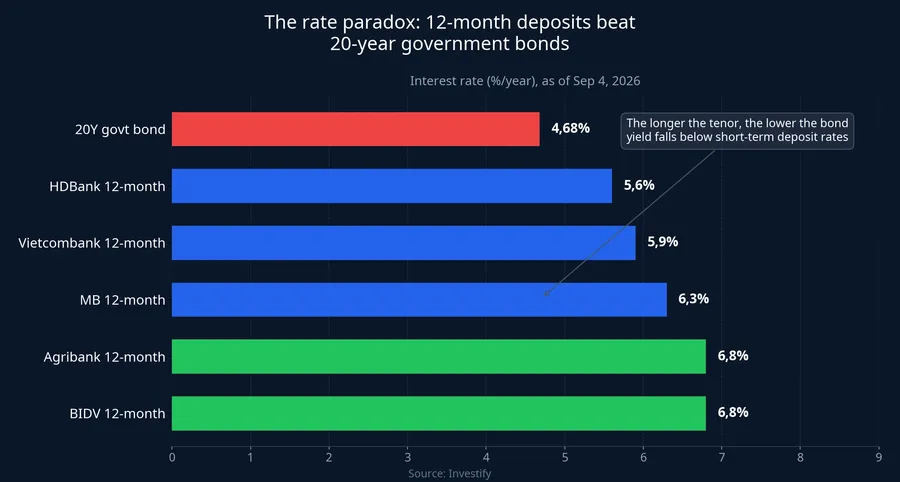
This gap isn't unique to Vietnam. It reflects the credit and liquidity premium banks have to pay depositors, a premium government bonds don't need to offer. But for whoever is holding the cash, the bottom-line number is still the bottom-line number, regardless of the reasoning behind it.
Vietnam's public debt sits at 31.8% of GDP in 2026, far below developed-economy levels, so fiscal pressure isn't what local investors should worry about first. The bigger concern, echoing NBIM's own lesson, is tenor.
A decision framework for Vietnamese investors
For individual investors here, three implications follow fairly directly.
First, choose your tenor based on when you'll actually need the money, not the yield printed on the rate sheet. A long tenor is only safe if you're certain you can hold to maturity.
Second, at today's rate levels, a 12-month deposit is the reasonable default for capital that needs certainty within a year, simply because it pays more than government bonds across the entire curve without carrying any price risk.
Third, long-dated government bonds are only worth considering if you hold a clear view that rates will fall in the coming years, since capital appreciation is then the actual reason to hold them. Betting on the direction of interest rates is an active investment decision, not a default safe choice.
The signal to watch going forward is Norway's Ministry of Finance's formal response to this proposal. If approved, it would mark the first time one of the world's largest government bond buyers has officially downgraded its allocation to an asset class the market still calls risk-free. That is worth close attention from anyone currently holding long-dated bonds.