
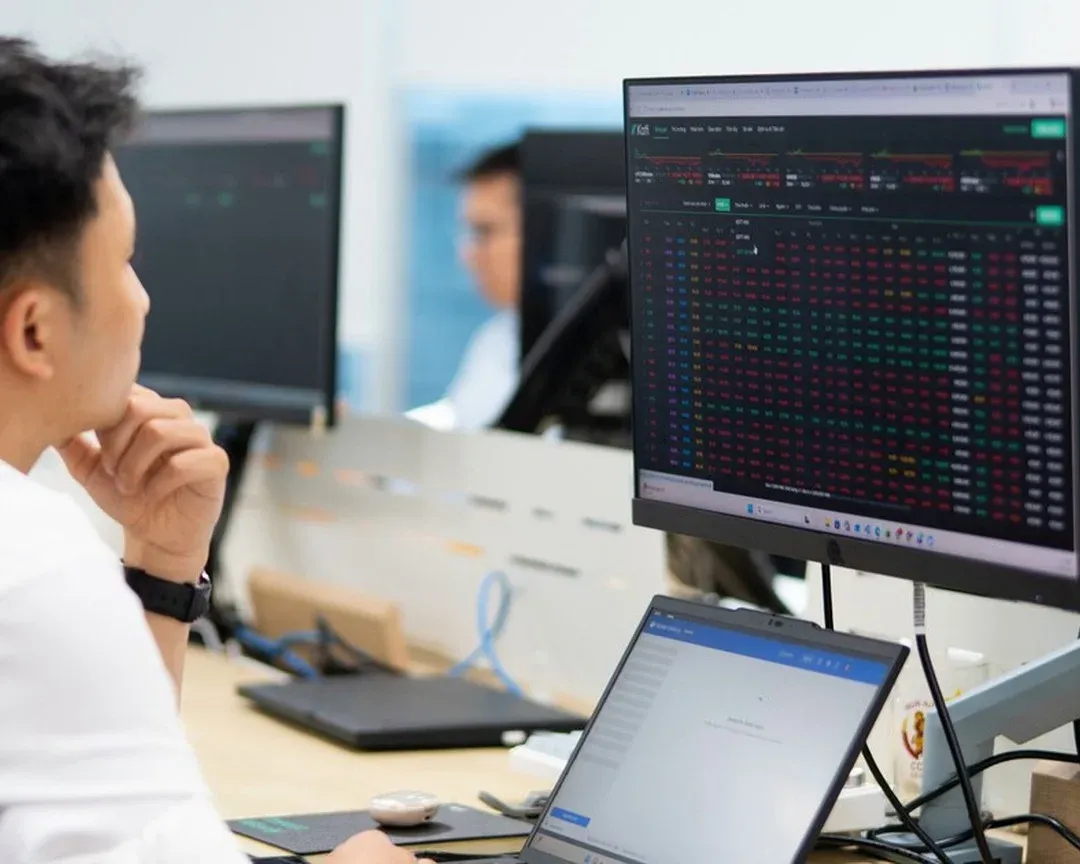

The Vietnam Exchange (VNX) has issued tightened surveillance rules for stock trading during FTSE Russell index rebalancing periods, under Decision 76/QĐ-HĐTV dated August 28, 2026.NguoiQuanSat The rules take effect immediately and apply to stocks listed on HOSE. What stands out isn't their breadth. It's how narrow they are.
According to Tuổi Trẻ, the rules carve out a dedicated watch group for accounts that move the closing price of the session immediately before the index becomes effective.Tuổi Trẻ For this September cycle, that's Friday, September 18. Not the whole month, not even the whole rebalancing week. One single session. The question worth asking is why a regulator would build an entire surveillance track around just one trading day.
Why That Session, and Why Those Fifteen Minutes
Vietnam is being reclassified by FTSE Russell from frontier market to secondary emerging market, effective from the start of trading on September 21, 2026. The new index basket starts running from that moment, and index-tracking funds are obligated to rebalance their portfolios to match the new weights.
A tracking fund is judged by its tracking error: the gap between the price it actually pays and the price the index records. To close that gap, a fund has to buy at the exact closing price of the last session before the effective date, which is September 18. HOSE's closing price is set during the closing call auction, running from 2:30pm to 2:45pm.
The defining feature of these orders is that they don't negotiate. A passive fund doesn't buy because a stock looks cheap; it buys because the index rulebook forces it to, with a volume already calculated, at a price point already fixed in advance. ACB Securities (ACBS) forecasts that Friday's session could see positive net foreign inflows, particularly during the closing auction.CafeF When the market knows for certain that someone has to buy, which stocks, roughly how much, and exactly when, those fifteen minutes become the single most valuable window of the month for anyone looking to push a price. That's why the rules dedicate an entire criteria group to it.

Three Phases, Three Different Risks
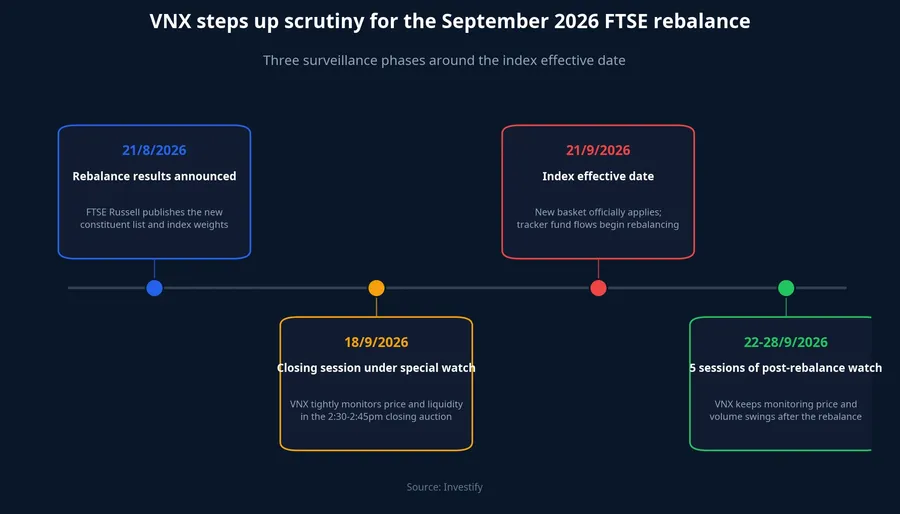
The enhanced surveillance track is split into three phases, and each one targets a different suspicious behavior rather than blanket monitoring.
Phase one runs from the session before FTSE Russell locks in its input data to the session before results are announced. This is the window where review results already exist but haven't gone public. The risk here is inside information: whoever learns which stocks are entering the basket early can front-run the rest of the market.
Phase two spans from the announcement date to the session before the new basket takes effect. The market currently sits in the middle of this phase: the list was announced August 21, and the effective date is September 21. The risk shifts here to prices being pushed up gradually across sessions to front-run the mandatory buying, then capped off with a push on the September 18 close.
Phase three starts on the index's effective date and runs for five more sessions. Once funds finish buying, the mandatory buying pressure disappears from the board. This is when pre-positioned shares can be sold off, and when prices are most likely to give back earlier gains.
HOSE is the direct supervisor, tracking trading activity of individual accounts and account groups showing signs of moving price or liquidity. HOSE can require member securities firms to provide information to clarify suspicious trades, and must report suspicious cases to the State Securities Commission and VNX.
The Risk Is Predictability, Not the Size of the Money
This is where most people get it wrong. Many picture a rebalancing period as a flood of foreign capital big enough to lift the whole market. The real numbers are far more modest.
The first tranche only counts 10% of each stock's investable weight; the rest is split across three more tranches in March, June, and September 2027. ACBS estimates passive funds could net-buy roughly VND 5,588 billion (about USD 216 million) across 27 Vietnamese stocks, with VIC expected to draw the most at around VND 2,092 billion, VHM around VND 659 billion, and HPG around VND 340 billion.CafeF
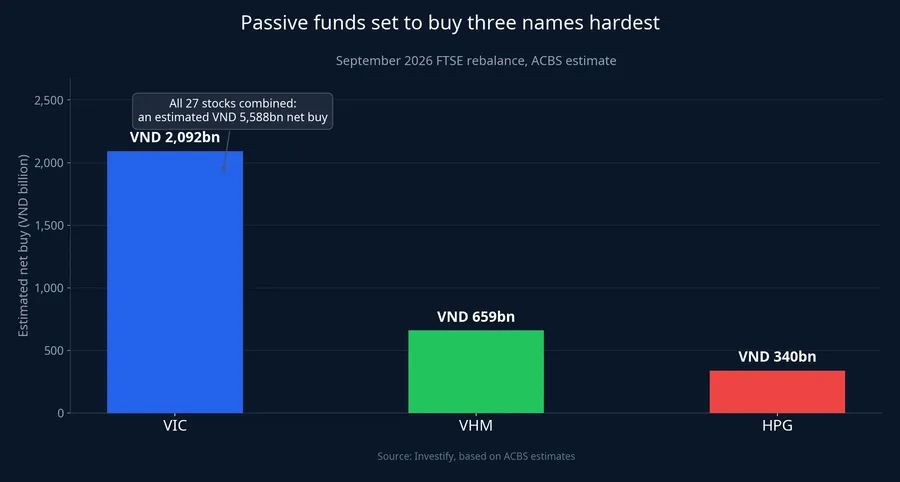
Put side by side, the real scale becomes clear. On September 3, VIC alone traded 7.68 million shares at a closing price of VND 244,500, worth nearly VND 1,880 billion in an ordinary session. The single largest purchase foreign funds are expected to make for the entire rebalancing round barely exceeds one normal day's trading value in that same stock. For scale, the largest fund tracking this index group, Vanguard Total International Stock Index Fund, manages roughly USD 646.2 billion.
So the risk doesn't come from the size of the money. It comes from every parameter being announced in advance: the stock list, the trading date, the exact matching window, even the estimated volume. A small amount of money that's certain to show up at a precise time creates a stronger incentive to game the system than a large amount that's hard to predict. That's exactly the part most brokerage reports skip when they lead with the headline total.
Entering the Basket Is Not a Guaranteed Ticket Up
Data from the past two weeks makes this clear. FTSE Russell's list, published August 21, added 27 Vietnamese stocks to the FTSE Global All Cap index, including three large-cap names, VCB, VIC, and VHM, and three mid-cap names, BID, HPG, and VPB.Dân Trí
From the August 21 close to the September 3 close, these six stocks moved in six different directions: VIC rose 19.3%, from VND 205,000 to VND 244,500; VPB gained 4.9%; VHM gained 2.4%; while HPG fell 0.5%, VCB fell 0.7%, and BID fell 1.2%. Over the same window, the VN-Index moved from 1,768.12 to 1,827.72 points.
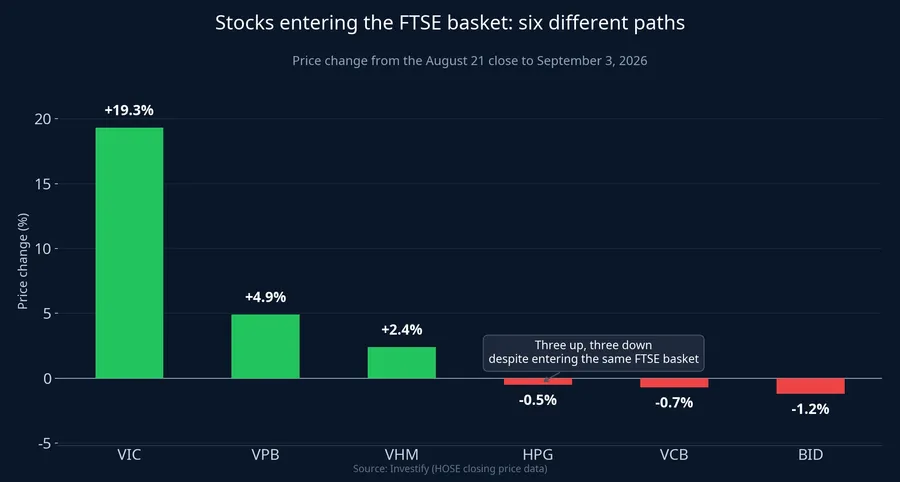
It's worth being clear that VIC's gain can't be attributed entirely to entering the index. The Vingroup stock group has its own storyline running through this period, and domestic money accounts for most of the liquidity, so the exact contribution of each factor can't be cleanly separated. What the data shows more clearly is the reverse case: if being on the FTSE list were enough on its own to push a price up, three of the six largest names wouldn't have fallen after the announcement. Entering the index is a real event, but it isn't the only explanation, and it's certainly no guarantee of direction.
The Penalties Are Already Steep Enough to Deter
For market manipulation, the State Securities Commission has applied a fairly consistent maximum fine of VND 1.5 billion for individuals, plus a trading ban of two to three years. In February 2026, an individual who used 19 accounts to manipulate PAS shares was fined VND 1.5 billion and banned from trading for two years.NguoiQuanSat In August 2026, a case involving MTG shares that ran for over a year and a half drew the same VND 1.5 billion fine plus a three-year ban.NguoiQuanSat
At a larger scale, the 2015 Penal Code, as amended in 2017, carries two directly relevant offenses: Article 210 on using inside information to trade securities, and Article 211 on market manipulation. The current administrative penalty framework sits in Decree 156/2020, most recently amended by Decree 306/2025, effective from January 9, 2026. These fines and bans aren't symbolic figures. What remains is the ability to catch violations in time, which is exactly what this new surveillance track is trying to solve.
How Individual Investors Should Read the Signal
These rules don't add any new trading restriction for ordinary investors. But they change how the board should be read over the next three weeks, in three specific ways.
First, price swings during the September 18 closing auction should be treated as mechanical, not a genuine supply-and-demand signal. A stock jumping in the final fifteen minutes that day reflects an index fund's buying obligation, not anything about the company's business outlook.
Second, the first five sessions after September 21 are the zone most likely to reverse, since mandatory buying pressure has ended by then. This window deserves closer attention than usual, especially for anyone who bought in around the rebalancing date.
Third, for insiders, major shareholders, and related parties, pre- and post-trade disclosure obligations during this period need to be followed more strictly than usual, since every account showing signs of price impact sits inside the dedicated watch group.
The date to mark isn't September 21. It's the afternoon of September 18. That's the only session in the entire rebalancing cycle where the regulator has carved out a dedicated surveillance criteria group, and the only one where the closing price carries meaning well beyond an ordinary quote. Foreign trading data and price action in the final week of September will be the next benchmark for judging how effectively this surveillance track actually works.