

On September 4, 2026, HDBank announced a plan to issue public bonds worth up to VND 20,000 billion.CafeF The number getting the most attention is the projected 9.2% annual rate for year one, which sounds, next to today's 12-month savings rates, like a deposit account with a few extra points bolted on. But read the plan closely and 9.2% turns out to be a window that stays open for exactly 12 months. Because the target buyers this time are retail investors rather than professional securities investors, the mechanics behind that number are worth reading before committing any money.
The popular assumption isn't unreasonable
Before picking the structure apart, it's worth crediting the part of "big bank bond, so it's safe" that actually holds up.
HDBank is at the strongest point in its operating history. In the first half of 2026, the bank reported pre-tax profit of VND 13,202 billion, up 31% year-on-year, with total assets past VND 1.045 quadrillion and ROE at 25.4%, among the highest in the sector.Tin Nhanh Chung Khoan HDB shares closed the September 4 session at VND 27,200, for a market cap of VND 136.1 trillion.
On top of that, a public offering is a tighter channel than a private placement: the filing has to clear the State Securities Commission and comes with a publicly disclosed prospectus, unlike the private corporate bond lots that shattered trust back in 2022. In other words, the risk in this product doesn't come from the issuer's financial health. It comes from the structure of the bond itself, which is the part getting the least attention.
9.2% isn't the rate for year seven
The bonds run 7 or 8 years, but the 9.2% rate applies only to year one. From year two onward, the rate resets under a formula: a reference rate plus a spread, where the reference rate is the average 12-month deposit rate at VietinBank, BIDV, Vietcombank and Agribank, and the spread is capped at 3.30 percentage points a year.
Read that formula backward and it reveals what the 9.2% headline obscures. What investors are actually buying isn't a 9.2% rate; it's a spread over the savings rate at the four state-owned banks, capped at 3.3 points a year. The closest everyday comparison: holding this bond is like rolling over a 12-month Big 4 deposit continuously for 7 to 8 years, with at most 3.3 extra points stacked on top each year. Whatever direction Big 4 deposit rates move, the bond's coupon moves in roughly the same direction by roughly the same amount.
Big 4 online 12-month deposit rates currently sit around 6.8% a year.CafeF If that level drifted back down to the 4.5% range seen around 2021, the bond's coupon would drift to roughly 7.8%, not stay parked at 9.2%. To be fair, the floating mechanism protects buyers in the other direction too: if deposit rates rise, the coupon rises with them, rather than being locked at a fixed level for eight years. Floating isn't the problem. The problem is that 9.2% is being read as a promise, when it's really just the output of a formula at this particular moment.
What that 3.3-point spread is paid for
If the upside is capped at 3.3 points, the next question is what buyers are giving up in return. This is the part the news coverage mentions least, and the part that determines whether this bond actually fits someone's money.
Savings deposits are covered by Deposit Insurance of Vietnam up to VND 350 million per person per credit institution, a limit just raised from VND 125 million, effective July 13, 2026.DIV These bonds are not covered. A dong deposited into savings and a dong put into this bond, at the same bank, sit in two entirely different legal positions.
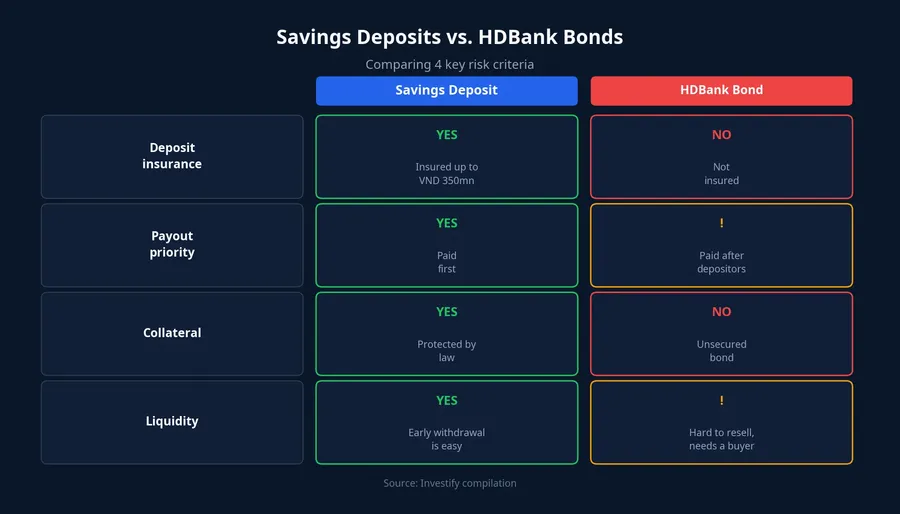
Beyond insurance, this is a subordinated bond that qualifies as Tier 2 capital. In the payout order if the bank runs into trouble, bondholders rank behind depositors and ordinary creditors, ahead only of shareholders. Tier 2 capital is designed to be a loss-absorbing buffer for the bank, and that is exactly why it pays more than a deposit — not out of generosity.
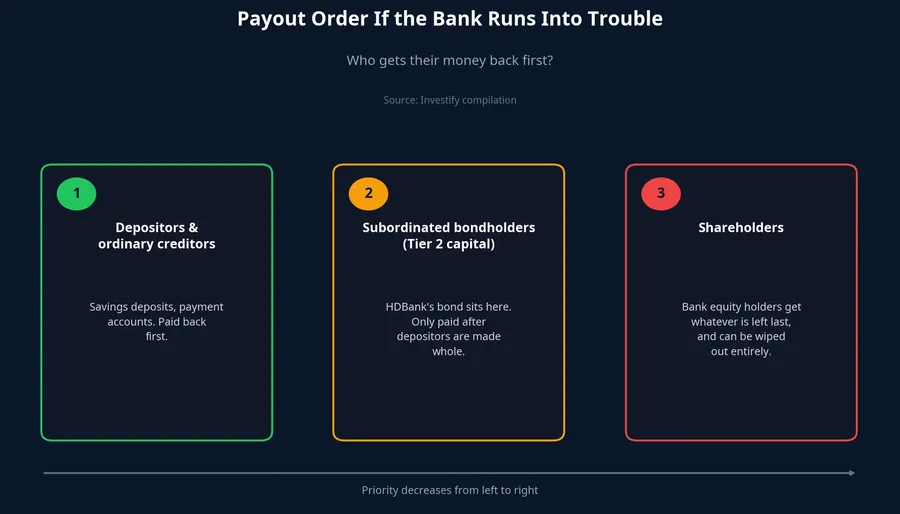
The bonds are also non-convertible, carry no warrants, and have no collateral; the investment rests entirely on the bank's ability to repay. On liquidity, a savings deposit can be withdrawn early at the cost of forfeited interest, while an investor wanting out of a 7-to-8-year bond early has to find a buyer on the secondary market, at a price that depends on prevailing rates at the time and can fall below face value.
At a face value of VND 100,000 per bond, the capital barrier to entry is close to zero. That's a sharp contrast with past privately placed bank bonds, which typically carried face values in the hundreds of millions to billions of dong and were open only to professional investors.MarketTimes Access has gotten easier. The product's complexity has not.
Why a well-capitalized bank borrows long anyway
A 16.16% CAR under Basel II is double the 8% minimum required by the State Bank of Vietnam.CafeF A bank that well-capitalized isn't raising VND 20,000 billion in Tier 2 capital because it needs the money to survive.
A few explanations are equally plausible: capital for growth, given that HDBank's total assets grew 12.3% in just half a year and the bank has set a pre-tax profit target of VND 30,100 billion for 2026,Bao Chinh Phu meaning strong loan-book expansion that eats into the capital adequacy ratio with every dong lent; Tier 2 capital being cheaper than equity, since bond issuance doesn't dilute existing shareholders; or simply locking in long-term funding while rates are still low.
The available data leans toward the first two explanations: asset size is expanding fast, and a 30% dividend payout plan suggests the bank has no intention of retaining earnings to shore up capital. The third explanation is a supporting factor at best, not the primary driver.
One detail on the issuer's side is worth tracking in parallel, and it's the part easiest to miss when looking only at the interest rate. HDBank's consolidated bad debt ratio rose from 2.44% to 2.79% in the first half of the year, while bad debt coverage fell from 54.8% to 50.0%.Bao Moi That's not alarming for a bank with 25.4% ROE, but anyone lending for eight years should be watching the trend, not just a single reading.
An allocation framework, not a buy call
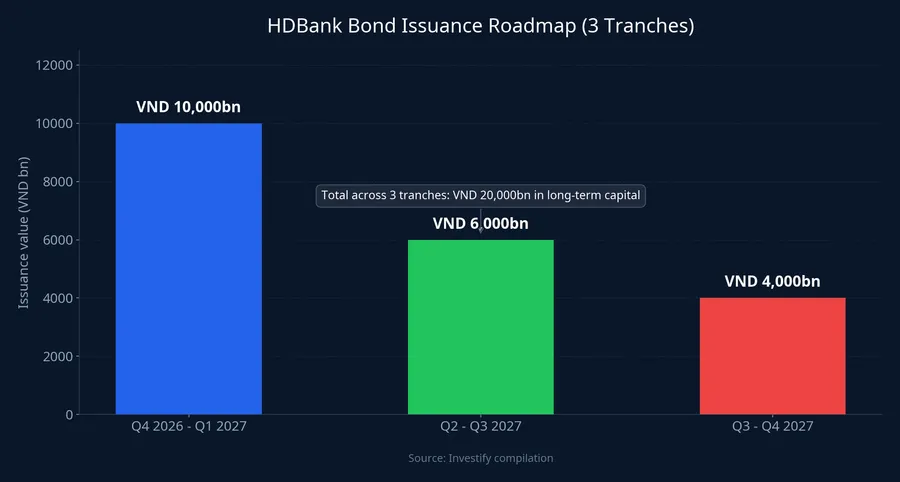
The issuance plan is split into 3 tranches, two bond codes each: VND 10,000 billion between Q4 2026 and Q1 2027, VND 6,000 billion between Q2 and Q3 2027, and VND 4,000 billion between Q3 and Q4 2027. Under the plan's own scenario, if HDBank raises the full VND 20,000 billion at the 8-year tenor and 9.2% rate, its total principal-and-interest obligation reaches VND 33,800 billion.
The line "this bond pays 9.2%, almost 1.5x a savings deposit" is therefore a misreading of the product's structure. The more accurate reading: this is a Tier 2 capital instrument that pays investors a spread capped at 3.3 percentage points over Big 4 savings rates, in exchange for giving up deposit insurance, ranking behind depositors in the payout order, holding no collateral, and locking up capital for 7 to 8 years.
That points to a simple allocation framework, depending on what kind of money is actually on the table. For money that might be needed within a few years, or that still sits under the VND 350 million insurance cap, a savings deposit remains the more sensible default: a 3.3-point spread doesn't compensate for losing both liquidity and the safety net. For money that is genuinely long-term, already well past the insurance cap, and able to sit untouched for nearly a decade, that spread is a risk premium worth considering, as long as the buyer understands they are lending the bank a layer of loss-absorbing capital, not parking cash in a high-yield savings account.
What ultimately determines the answer is the official prospectus, which will spell out terms this initial plan hasn't: the issuer's early call rights, the actual spread applied to each bond code, and how the reference rate gets calculated at each interest period. Those three terms will decide the real number buyers receive over the remaining seven years, far more than the 9.2% figure making headlines today.