

Before dawn on September 3 Vietnam time, Broadcom and Snowflake reported earnings less than an hour apart. Both beat analyst estimates on the quarter that had just closed. But in after-hours trading that followed, Broadcom shares fell 5% while Snowflake shares jumped 22.37% to $374.25, breaking above their 52-week high.CNBC
The 27-point gap between those two price reactions didn't come from the quarter that had just closed. It came from guidance for the quarter ahead. Both companies happened to miss or beat that expectation by exactly the same amount: $230 million, just in opposite directions.

Broadcom: a record quarter still wasn't enough
Broadcom's fiscal Q3 2026, which ended August 2, 2026, was the strongest quarter in the company's history. Per its official release, consolidated revenue hit $29.6 billion, up 86% year over year. AI semiconductor revenue reached $16.7 billion, up 221% year over year. Adjusted operating profit came in at $20.1 billion, up 92%, and free cash flow hit $13.7 billion, or 46% of revenue.PRNewswire Adjusted EPS came in at $3.32, above the roughly $3.22 analysts expected. CEO Hock Tan said demand for the company's custom AI chips and networking gear "remains very strong."
The problem sat in the guidance. Broadcom pointed to fourth-quarter revenue of roughly $34.8 billion, up 93% year over year, with AI semiconductor revenue alone expected at $21.7 billion, up 236%. That sounds strong. But analysts had modeled $35.03 billion. The shortfall was just $230 million, or 0.7% of the forecast. On a market cap of roughly $1.74 trillion heading into the report, that 0.7% was enough to knock 5% off the stock.CompaniesMarketCap
Snowflake: raised guidance, priced four times higher
Snowflake sells data-platform software and is far smaller than Broadcom. Per its fiscal Q2 2027 filing with the SEC, the quarter ended July 31, 2026 brought in total revenue of $1.55 billion (up 35%), product revenue of $1.49 billion (up 37%, the third straight quarter of accelerating growth), and a net revenue retention rate of 126%. Adjusted EPS came in at $0.62, versus the $0.45 analysts expected. Adjusted operating margin rose to 15%, from 11% a year earlier.

The number that changed market sentiment sat at the very end of the release. Snowflake raised its full-year fiscal 2027 product revenue guidance to $6.07 billion, up from $5.84 billion, lifting expected full-year growth from 31% to 36%. Management credited two AI products: CoCo surpassed 9,100 accounts, adding more than 2,000 in a single quarter, while CoWork expanded to 5,800 accounts. CFO Brian Robins said the company is growing faster while also expanding margins.
The same $230 million, two opposite directions
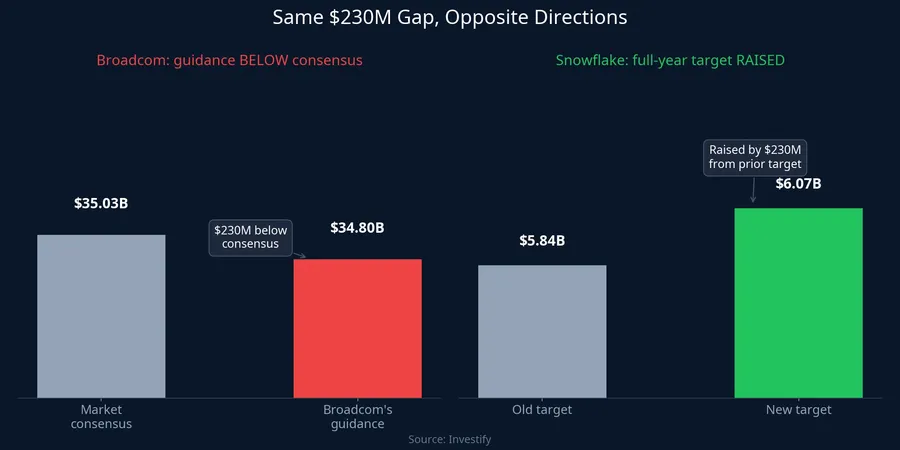
Snowflake's upward revision, $6.07 billion minus $5.84 billion, comes out to exactly $230 million. Broadcom's shortfall versus consensus, $35.03 billion minus $34.80 billion, is also exactly $230 million.
The two numbers aren't on the same scale, and that distinction matters. Broadcom's is a one-quarter guidance gap. Snowflake's is a full fiscal-year upward revision. As a share of the base figure, Broadcom's shortfall is just 0.7% of the forecast, while Snowflake's increase is 3.9% of its prior full-year target.
The key point, then, isn't the size of the number. It's the direction. Broadcom's expected next-quarter growth rate is 93%, roughly two and a half times Snowflake's expected 37-38%. The company growing faster is the one that got sold off.
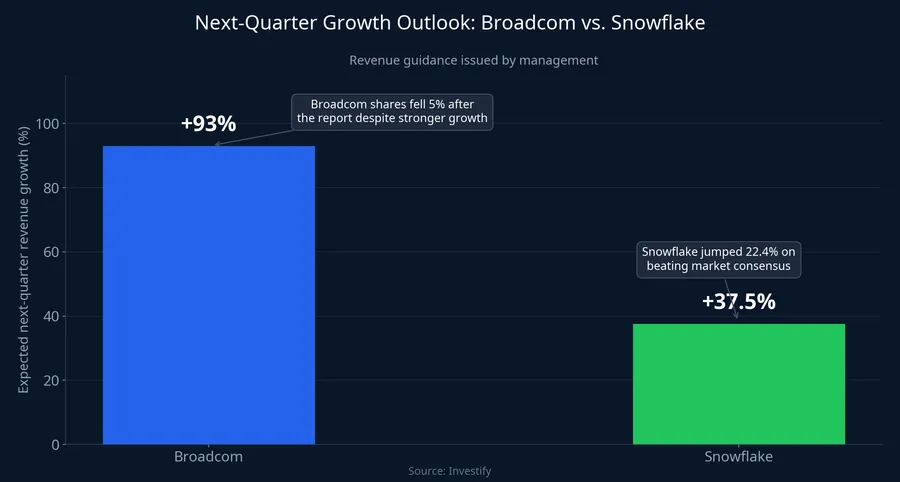
The most sensible read: the stock price already had a growth expectation baked in, and what got re-priced was only the gap between the new number and that expectation. Broadcom's 93% growth rate was already in the price. Snowflake raising its full-year plan wasn't.
Is there another explanation?
The guidance gap isn't the only story. Broadcom walked into its report with a market cap near $1.74 trillion and the most closely watched position among AI stocks, so much of the optimism was arguably already paid for. Snowflake, by contrast, had fallen 4.26% during that day's regular session, giving it a lower base for comparison.ProactiveInvestors The quality of Snowflake's growth also matters: three straight quarters of accelerating product revenue growth, paired with raised margin guidance, is evidence of expanding demand rather than a single good quarter.
Even so, the evidence still leans toward the first explanation. Both companies beat expectations on the quarter that had already closed, so the closed quarter doesn't explain the divergence. The only thing that pointed in opposite directions between the two releases was the direction of guidance.
This also isn't the first time Broadcom has been treated this way. In early June 2026, Broadcom fell 15.4% and lost more than $300 billion in market cap in a single session, even though its quarterly revenue guidance of $29.4 billion beat the $28.2 billion consensus.MarketTimes The reason: management held its 2027 AI chip revenue outlook at $100 billion, while investors were hoping for an upward revision. On the flip side, in late May 2026 Snowflake jumped more than 36.5% in a single session after beating estimates and raising guidance.Fili This time around, Broadcom said it now sees a path to roughly $115 billion in AI semiconductor revenue in fiscal 2027 and roughly $230 billion in fiscal 2028.Yahoo Finance But that outlook still wasn't enough to offset a $230 million shortfall in the nearest quarter.
What should Vietnamese investors watch instead?
Vietnam's mechanics differ technically. Listed domestic companies rarely update guidance quarter by quarter the way US companies do. The only forward-looking number investors get is the annual plan approved at the shareholder meeting, and that plan typically stays fixed all year. So the equivalent of "guidance" in these two US stories is completion progress against the annual plan, plus whether that plan ever gets revised.
FPT is an easy comparison. Its 2026 shareholder meeting approved a plan for VND 58,580 billion in revenue and VND 11,629 billion in pre-tax profit, up 15.8% and 15% respectively.CafeF Through the first half of the year, FPT posted VND 26,269 billion in revenue and VND 5,714 billion in pre-tax profit, up 12.6% and 18.1% year over year.CafeF That works out to 44.8% of the annual revenue target and 49.1% of the profit target completed at the halfway mark.
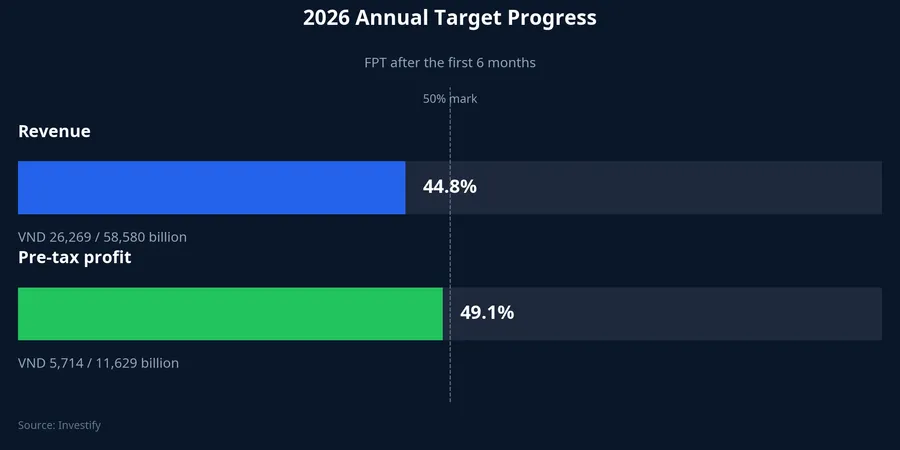
An 18.1% growth rate sounds strong. But 49.1% profit-plan completion after six months is the number that actually answers how much acceleration the second half needs. FPT shares closed their most recent session on August 28 at VND 73,200, implying a market cap of roughly VND 124.7 trillion.
A reading framework for the coming Q3 season
Starting from the night of September 2, there's a framework that works for both US and Vietnamese stocks. Before reading any report, know what number the market is actually waiting for: for US stocks, that's analyst consensus; for Vietnamese stocks, it's the annual plan and quarterly completion progress. Without that reference point, every number in a report is meaningless: an 86% increase could be bad news, and a 37% increase could be good news.
Once a report is out, the part worth reading most carefully is the last line, not the first table. For US companies, that's next-quarter guidance. For Vietnamese companies, it's any resolution revising the annual plan, if one exists.
Vietnam's Q3 earnings season for listed companies begins in mid-October. For companies running behind their annual plan after nine months, the question worth watching isn't how fast Q3 growth was. It's whether management announces a plan revision, and in which direction.