
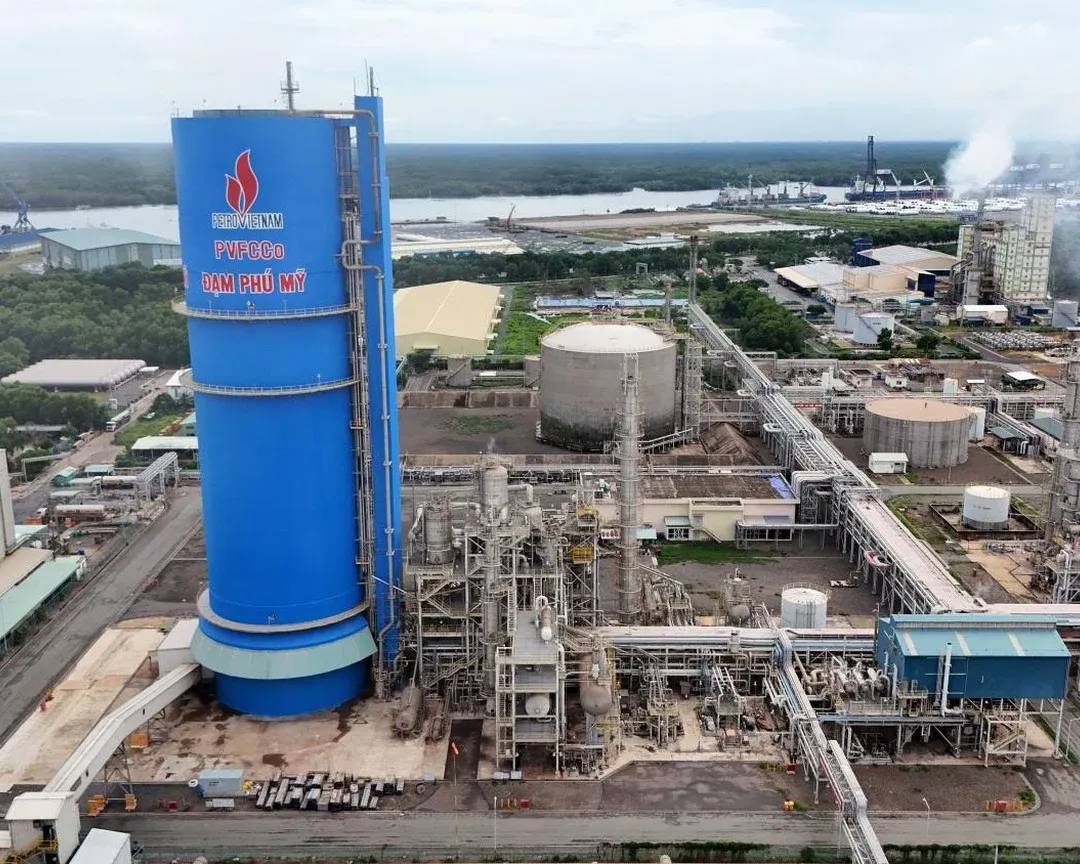

On the morning of September 3, the market passed around a very flattering number: PetroVietnam Fertilizer and Chemicals Corporation (PVFCCo, ticker DPM) says it hit 192% of its full-year profit plan in just six months.Tin nhanh Chứng khoán DPM shares reacted immediately in the morning session, up 4.55% to VND 23,000, while the VN-Index slipped 0.57% to 1,821.61 points, with 216 losers overwhelming 97 gainers.
The natural reflex when reading 192% is to assume the company is having a blowout year, running at nearly double its target. That reflex isn't wrong in direction: DPM genuinely had a strong first half. But 192% doesn't measure what most readers think it measures, and that's worth separating from the real result before drawing conclusions.
The results are genuinely good, no argument there
Before dissecting the plan-completion ratio, credit where due: DPM's first-half growth is real, measured on a yardstick that has nothing to do with any plan. Revenue reached VND 12,609 billion, up 33.8% year-on-year. Pre-tax profit hit VND 1,630.6 billion, up 116.1%. Net profit reached VND 1,326.4 billion, up 112.5%, while the net margin expanded from 6.6% to 10.5%.Tin nhanh Chứng khoán
More telling than any percentage is the absolute comparison: in the first half of this year alone, DPM earned more pre-tax profit than all of 2025 combined, when the full-year figure landed at VND 1,352.6 billion. The real question isn't whether DPM had a good half — it did — but what the 192% figure adds on top of the 116.1% growth number already sitting on the table.
The denominator was set low before the division even happened
The answer lies in how the 2026 plan was built. The plan DPM presented to shareholders in late March called for consolidated revenue of VND 17,600 billion, pre-tax profit of VND 850 billion, and net profit of VND 680 billion. Measured against 2025's actual results, the pre-tax and net profit targets were set 37% and 38% lower respectively, even as revenue was pitched about 3% higher.CafeF
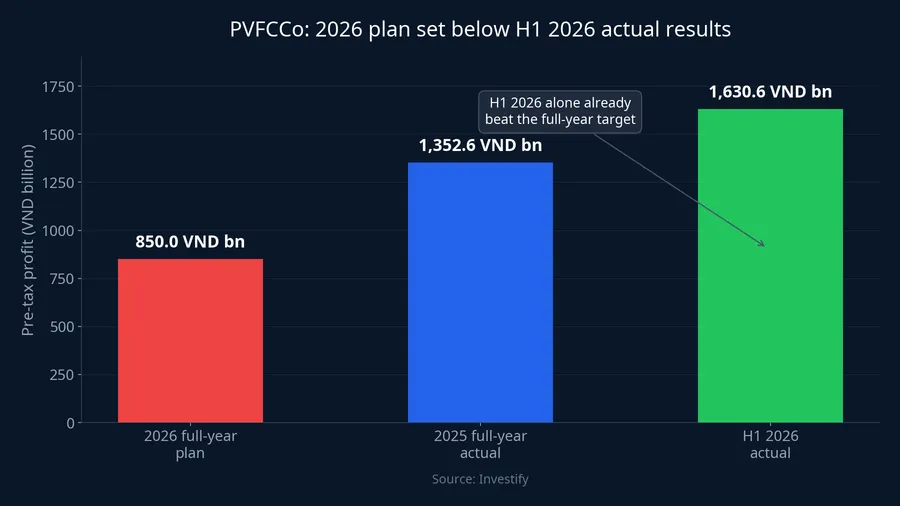
A plan built on "revenue up, profit down" is a plan built on the assumption that margins would thin out, not that volumes would shrink. That's exactly where the 192% figure gives itself away. After six months, DPM's revenue reached only about 72% of the annual plan, right on pace for the halfway mark, while pre-tax profit had already reached 191.8% of the annual plan.Tin nhanh Chứng khoán The gap between 72% and 192% didn't come from selling more than expected: it came from selling prices and realized margins running far above the assumptions baked into the plan.
In other words, 192% measures the distance between reality and a conservative forecast, not growth itself. The growth figure is still 116.1%, and that number is strong enough on its own without borrowing anything from the plan.
A planning habit, not a one-off surprise
DPM's annual shareholder meeting convened on the morning of April 23, 2026 and approved the VND 850 billion pre-tax profit target for the year. At that same meeting, management reported estimated Q1 results of VND 515 billion in pre-tax profit — 61% of the annual plan — and also reported 2025 full-year results of VND 1,352.6 billion in pre-tax profit, equal to 330% of the 2025 plan.Người Đưa Tin Shareholders voted on a full-year target that the first three months had already nearly two-thirds completed, right after closing the previous year at 330% of plan.
A company that repeats this pattern of overshooting year after year is displaying a conservative planning habit, not a surprise breakout in any single year.
The whole sector cut plans the same way, but results diverged
If plan-completion ratios measured genuine business strength, peers that cut targets by a similar margin should post similar results. The evidence says otherwise.
Ca Mau Fertilizer (DCM) set its 2026 pre-tax profit plan at VND 1,320 billion, about 40% below 2025 actuals, and it too beat its full-year plan within six months.Vietstock Binh Dien Fertilizer (BFC) set its target 38.5% below 2025 actuals — almost identical to DPM's cut — yet after six months had only reached about 78.7% of plan.Vietstock
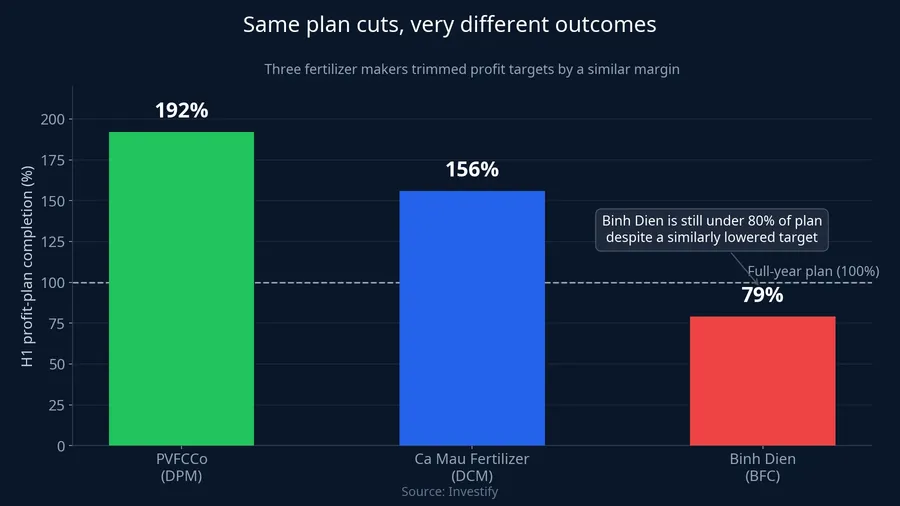
Three companies, the same style of lowballing targets, three very different outcomes. What separates them isn't plan quality: it's who stood in the right direction of the urea export price cycle. DPM and DCM produce urea and benefit directly from the price swing. BFC mainly makes NPK blends for the domestic market, so rising input costs became a burden rather than a tailwind.
The real driver is a price line the company doesn't control
World urea prices closed 2025 at USD 386.50 per tonne. After the Strait of Hormuz disruption, prices climbed to a peak of USD 720.25 per tonne on April 15, 2026, then fell to a trough of USD 359 per tonne on June 18. The H1 average landed around USD 520.8 per tonne, far above any level a plan drafted in March could reasonably have assumed.
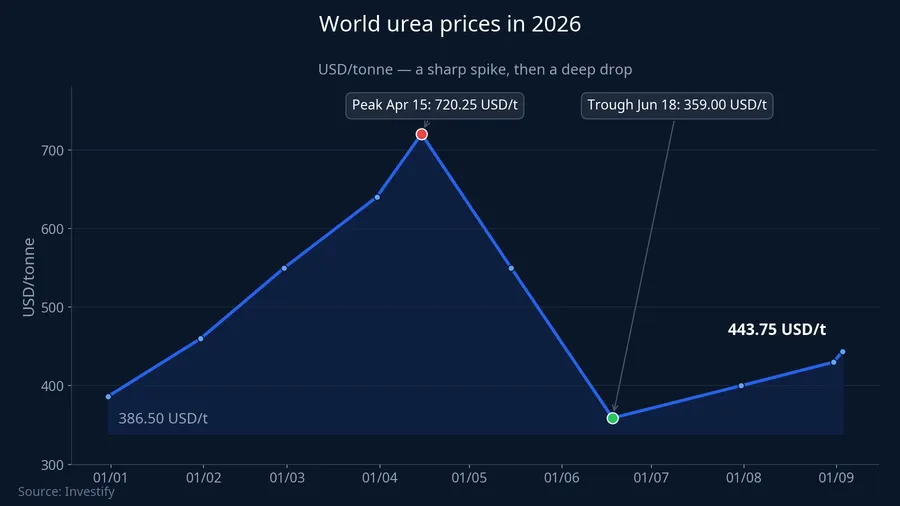
The entirety of DPM's outsized profit sits on that price line, a variable the company neither creates nor controls. The plant ran at similar capacity, with planned output still around 900,000 tonnes of urea, but every tonne sold brought in far more money.Người Đưa Tin
The morning of September 3 illustrates exactly this. DPM rose 4.55%, but DCM also gained 4.05% to VND 32,100 in the same session, despite having no comparable earnings headline of its own. World urea prices had climbed from USD 383.50 per tonne on August 17 to USD 443.75 per tonne on September 2. The most reasonable read on this morning's move is capital flowing into the whole fertilizer group on the back of the price cycle, not a reaction to the 192% headline specifically. That headline may well have amplified DPM's move, but if it were the main driver, DCM wouldn't have risen almost as much.

On the shareholder side, DPM has finalized a 15% cash dividend for 2025, equal to more than VND 1,019 billion on charter capital of nearly VND 6,800 billion.Vietstock That payout tracks the actual profit cycle, and that's worth noting: what shareholders receive is anchored to realized results, not to the plan-completion ratio.
How to read "beat the plan" headlines going forward
From now through the rest of earnings season, investors will keep encountering headlines shaped like "completed X% of the annual plan." Three numbers are worth lining up side by side before drawing any conclusion: this year's plan versus last year's actual result, revenue completion versus profit completion, and the company's own completion ratio the year before.
If the target was set below last year's result, a high completion ratio is baked into the plan itself and isn't necessarily a surprise: for DPM, that's VND 850 billion against VND 1,352.6 billion. If revenue tracks on schedule while profit spikes, the gap comes from margin assumptions rather than sales volume: for DPM, that's 72% against 192%. And if a company beats its plan by a wide margin every single year, that ratio reflects a planning convention, not fresh news: for DPM in 2025, that ratio was 330%.
Running DPM through these three filters, the conclusion is clear: the company is in a genuinely strong profit cycle, but that cycle is dictated by urea prices, and the 192% figure is simply the accounting byproduct of a plan built on unfavorable assumptions.
What to watch for the second half
If DPM is priced off its plan-completion ratio, the current share price already reflects most of the good news. If it's priced off the urea cycle instead, what actually determines this stock is the price level for the second half, and that level looks nothing like the first half.
Mirae Asset forecasts second-half urea prices around USD 400-450 per tonne, roughly 25% below the H1 average.FireAnt At the same time, input gas prices remain around USD 11.23/mmBTU and haven't fallen proportionally, squeezing margins for urea producers in Q3.MarketTimes
On the other side of the ledger, import demand from Brazil starting in September and Vietnam's 2026-2027 Winter-Spring crop season should support Q4, and urea prices are unlikely to fall back to 2025's low levels.Vietstock So Q2's profit level probably won't repeat in Q3, and that doesn't contradict the full-year 2026 result still comfortably beating the VND 850 billion plan. Both things are true at once.
Two indicators worth watching into Q4: the spread between the urea selling price and the gas input cost, and domestic buying strength heading into the Winter-Spring planting season. That's where DPM's 2026 result and valuation will actually be decided, not in the plan figure shareholders voted on back in April.