


On August 21, 2026, FTSE Russell published the results of its September semi-annual review for the FTSE GEIS Asia-Pacific index family, adding 27 Vietnamese stocks to the FTSE All-Cap basket, six of which also entered the FTSE All-World index.Dân trí The formal rebalancing trade happens after the close on Friday, September 18, and the new portfolio takes effect at the open on Monday, September 21.
For individual investors, this is a date worth circling. But across financial media this past week, three separate capital-flow figures have been blurred into one: the total program size, the portion specific to bank stocks, and the amount that actually lands on September 18. These three numbers differ by 6-7x. Conflating any one of them sets up the wrong expectations for what September actually brings.
Why banks took 8 of the 27 slots
Per FTSE Russell's notice, 117 Vietnamese stocks met the index family's baseline criteria, but only 27 satisfied every screening requirement.Dân trí FTSE's filter does not rank by raw market cap; it ranks by investable market cap, meaning full market cap discounted by the free-float ratio and remaining foreign-ownership room. Banks clear that filter more easily than other sectors because they combine large market caps with the deepest liquidity on the exchange.
The result: 8 bank tickers made the cut: VCB, BID, VPB, HDB, SHB, STB, SSB, and MSB. VCB, BID, and VPB were added to FTSE All-World simultaneously, meaning they're tracked by more global index funds than the other five. The standout this cycle is VPB: per Yuanta Securities Vietnam, it's the most positive surprise because it wasn't on the list of 23 stocks expected to qualify under FTSE's April 2026 update, and HDB also saw its odds upgraded from that earlier list.Dân trí
Where the money comes from, and through which channel
This passive capital isn't some foreign investor deciding they like Vietnamese bank stocks. It's index funds whose charters legally require them to hold whatever the reference index holds, at the exact weight the index assigns. That holds regardless of what the fund manager thinks about valuation.
ACB Securities (ACBS) compiled the 17 largest passive funds tracking FTSE GEIS. Topping the list is the Vanguard Total International Stock Index Fund, with $646.2 billion in assets, benchmarked to the FTSE Global All Cap ex US index.Dân trí In other words, the money flowing into Vietnamese bank stocks this month arrives through exactly one channel: foreign index fund certificates. No single order is a bet on VPB or STB specifically.
Three numbers being treated as one
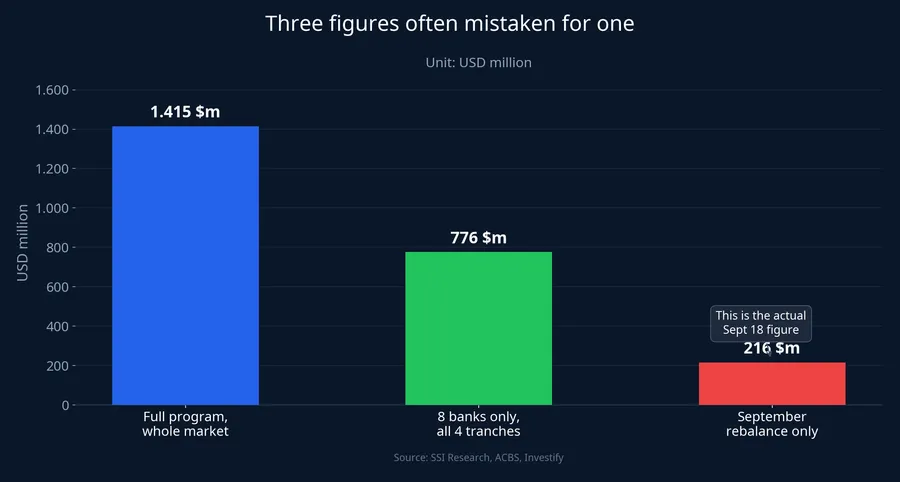
This is where individual investors most often get it wrong, since all three figures get lumped together in headlines as "FTSE capital flow."
The first figure is the full program size. The upgrade is projected to draw roughly $1.33-1.5 billion from passive funds, split across 4 tranches from September 2026 to September 2027, weighted 10%, 20%, 35%, and 35%.Dân trí The second figure is the portion specific to the 8 bank stocks, also covering the entire program: SSI Research estimates inflows into these 8 banks at nearly $800 million under its bull-case scenario, led by VPB at almost $188 million (roughly VND 4,690 billion), followed by VCB, STB, and HDB, while the remaining four smaller names each receive $45-50 million.Dân trí This is still the figure for all 4 tranches over 12 months, not what flows in during September alone.
The third figure is the actual one for September 18. ACBS estimates that during the September 2026 rebalancing window, all 27 Vietnamese stocks combined will see net buying of roughly VND 5,588 billion, or about $216 million.Dân trí Set against actual trading volume, that's a meaningful sum but not enough to move the market on its own: the 8 bank stocks alone traded roughly VND 3,758 billion in the August 28 session, the last session before the holiday break. The entire September rebalance purchase, spread across 27 stocks, barely exceeds one and a half trading sessions' worth of volume in the bank group alone.
The reverse flow that gets less attention
In this same September review, Vietnam was removed from the FTSE Frontier Index in a single step, according to FTSE Russell's own FAQ document on the market reclassification.LSEG These two flows aren't matched in pace: frontier-index funds must sell their entire Vietnam allocation in one motion, while emerging-market funds are only buying the first 10% tranche as of September 21. ACBS's net-buying estimate of VND 5,588 billion already accounts for both directions, but an investor who only reads the standalone $800 million bank figure won't see the sell side, and risks overestimating actual near-term net buying pressure.
How far ahead has price already moved
Over the 5 sessions from FTSE's August 21 announcement to the August 28 close, gains within the bank group diverged sharply. SSB rose 11.76%, VPB rose 8.17%, while VCB gained just 1.69%, STB gained 1.07%, and BID was essentially flat, down 0.14%. The benchmark VN-Index rose 3.62% over the same window.
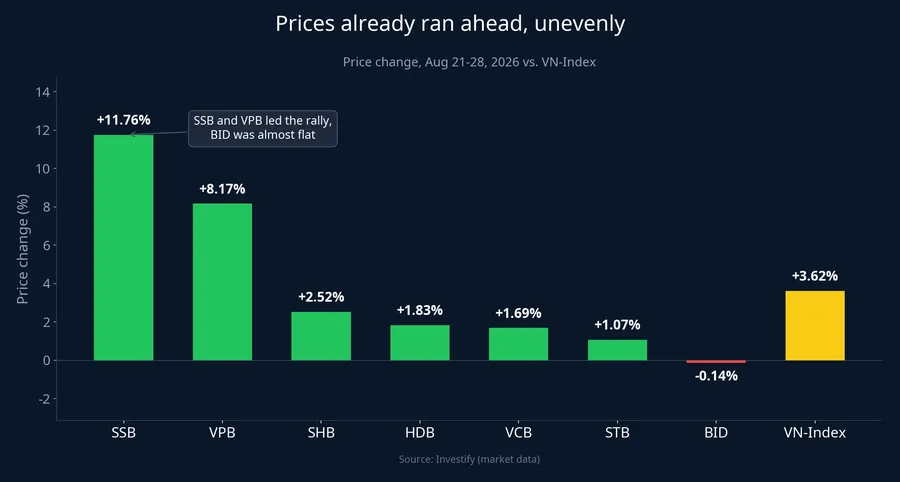
VPB's rally shouldn't be attributed entirely to the FTSE news. Over the same period, the bank has been executing a charter capital increase from over VND 79,300 billion to over VND 106,200 billion, and foreign investors reversed into consecutive net buying after VPB entered both indices.CafeF These three factors overlap, making it hard to isolate each one's contribution. What's certain is that the market has already priced in part of the expectation before passive money actually arrives, and that pricing-in is uneven across tickers.
Where Vietnam's domestic fund industry stands
Vietnam currently has 43 fund management companies running 142 securities investment funds, with combined assets under management of over VND 846,000 billion as of end-June 2026, equivalent to just around 6% of GDP.Người Quan Sát That ratio stands above 31% in Thailand, above 56% in Malaysia, and at 84% in South Korea.Stockbiz
Notably, that nearly $800 million doesn't flow through the domestic fund industry at all: no local fund currently tracks FTSE All-Cap or FTSE Emerging Markets, so the entire passive flow lands directly in foreign index funds' accounts. The closest indirect option for domestic investors is listed VN30-tracking ETFs such as E1VFVN30 (Dragon Capital) or FUEKIV30 (KIM). One clear caveat: VN30 is not the FTSE basket. The two overlap on most of the bank names but at different weights, so this is a way to track the leading group, not a way to replicate the FTSE flow itself.
For the domestic fund industry, the upgrade matters more indirectly and over a longer horizon: a higher-rated market gives pension funds, insurance funds, and foreign institutional investors more grounds to actively allocate into local funds. That's a multi-year process, not something that happens on September 18.
What to watch, and on what timeline
Between now and September 4, the basket can still change, so don't treat the August 21 list as final. Only from September 7 onward should the list be treated as fixed for planning purposes.
On September 18, closing-auction liquidity is likely to spike sharply for basket stocks, since index funds typically execute orders at the closing price to track the index precisely. Price moves within that single session reflect rebalancing mechanics, not a new trend signal. From September 21 onward, the figure worth checking is actual net foreign buying against ACBS's VND 5,588 billion estimate. A large gap in either direction is itself informative, since it shows whether the accompanying active capital is running stronger or weaker than expected.
A reasonable default framework for individual investors right now: treat the upgrade as a catalyst spread across several quarters for the bank group, not a one-session trading window. For portfolios already carrying a high bank-stock weighting that has profited well since early August, holding that weighting until actual net-buying data arrives after September 21 is a lower-risk choice than chasing the price into the rebalancing session. For investors with no position yet, the three remaining tranches through 2027 account for 90% of the program's total flow, so the door doesn't close on September 21.