
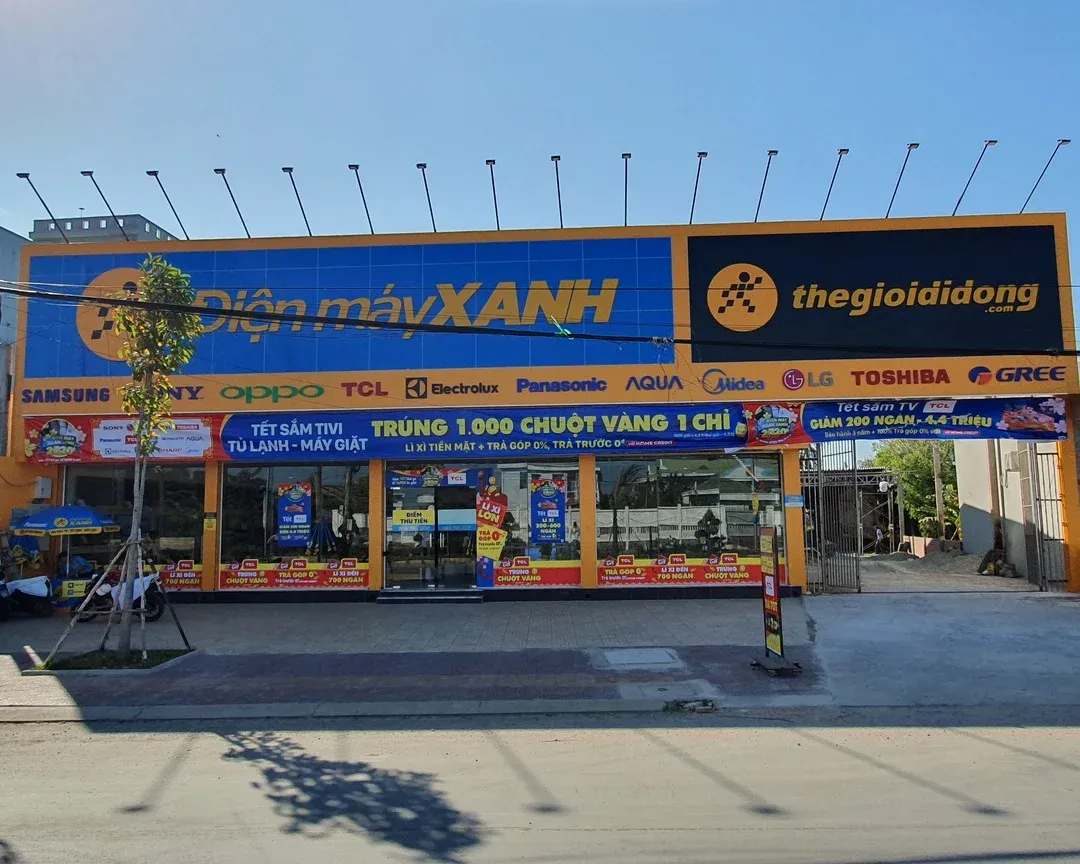

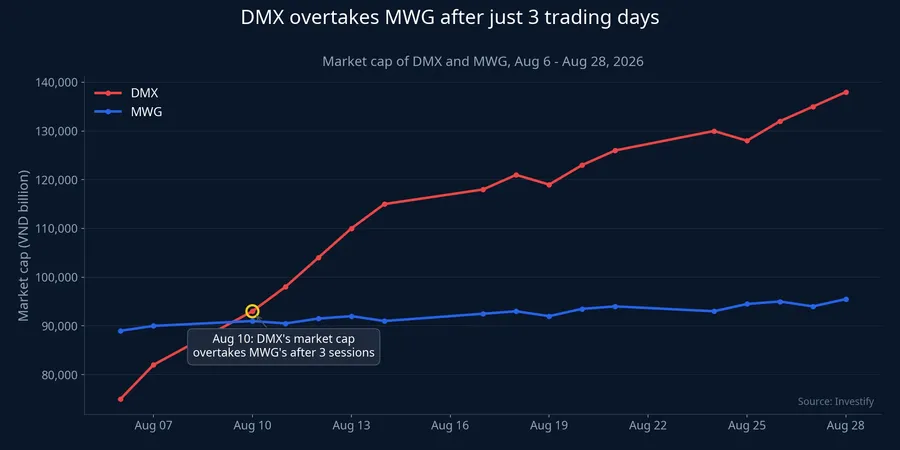
On August 10, 2026, shares of Dien May Xanh (DMX) closed at VND 88,100, pushing the retailer's market cap to roughly VND 112,000 billion.24hMoney At the same moment, parent company Mobile World Group (MWG) was worth only about VND 108,000 billion. The twist: MWG still owns nearly 86% of Dien May Xanh itself.
That's not a data error. It's a direct consequence of how Vietnam's club of billion-dollar-plus companies has grown over the past year, not just through genuinely new businesses, but through splitting existing companies into multiple listed tickers.
New members of the billion-dollar club, mostly already there
Per market cap data as of August 28, 2026, Vietnam's stock market has 63 companies valued above USD 1 billion, worth more than VND 8.5 quadrillion combined.CafeF Over roughly the past year, the group has welcomed a fresh batch of names: Vinpearl, Techcom Securities (TCBS), Dien May Xanh, VPBank Securities, VPS Securities and LPBank Securities.
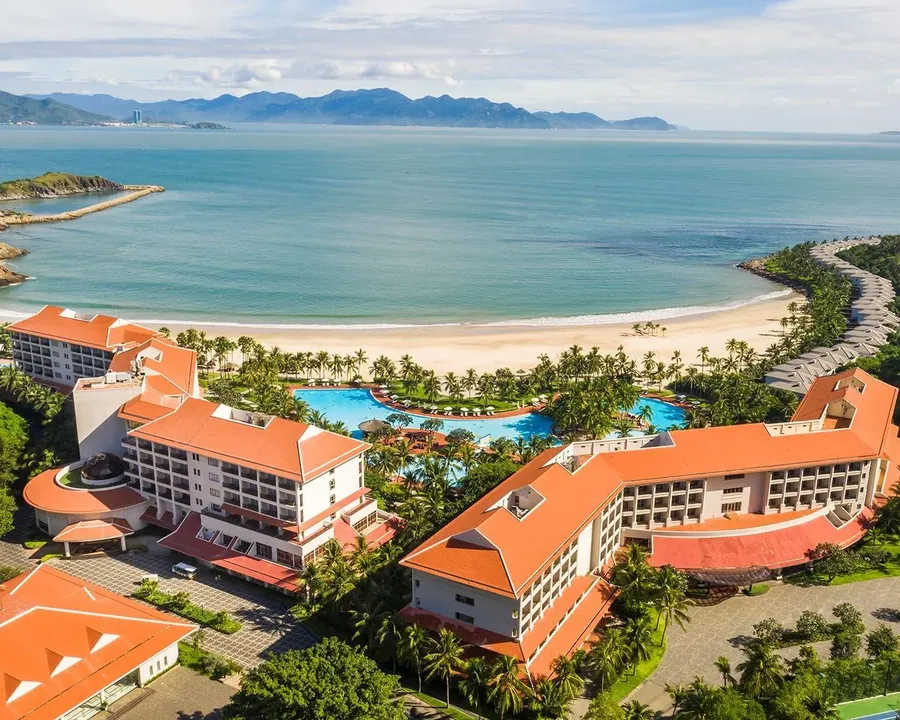
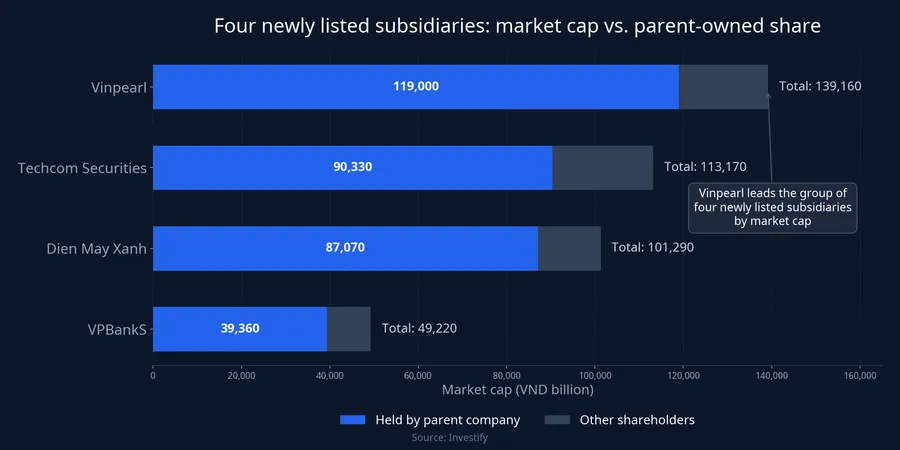
Look at the ownership structure, though, and four of these newcomers turn out to be subsidiaries of companies already listed. Vinpearl (VPL) began trading on HOSE on May 13, 2025 with a market cap of VND 139,160 billion; Vingroup owns 85.51%.Znews Techcom Securities listed on October 21, 2025 at VND 113,170 billion; Techcombank owns 79.82%.Dan Tri Dien May Xanh debuted on August 6, 2026 at VND 101,290 billion, with MWG holding 85.96%, down from 98.955% before its first share sale.Bao Moi VPBank Securities listed on December 11, 2025 at VND 49,220 billion, with VPBank owning roughly 80%.Bao Chinh Phu
The remaining two names have no listed parent. VPS Securities has a dispersed ownership structure with no bank behind it, despite a name easily confused with VPBank.ASEAN Securities LPBank Securities is much the same: after its share offering, its five largest shareholders are all individuals, with no LPBank entity among them.Tin Nhanh Chung Khoan
Why the group's total is double-counted
Those four subsidiaries carry a combined market cap of VND 402,840 billion. Multiply each by its parent's ownership stake, and the value attributable to already-listed parent companies comes to roughly VND 335,800 billion, or 83.3% of the four subsidiaries' combined cap. When the market adds up all 63 billion-dollar companies, that VND 335,800 billion gets counted twice: once under the subsidiary's ticker, once again inside the parent's own market cap.
This is an inherent feature of any market with listed parent-subsidiary structures, not a statistical error. What's changed is the scale: in roughly a year, the overlap has grown by nearly VND 336,000 billion.
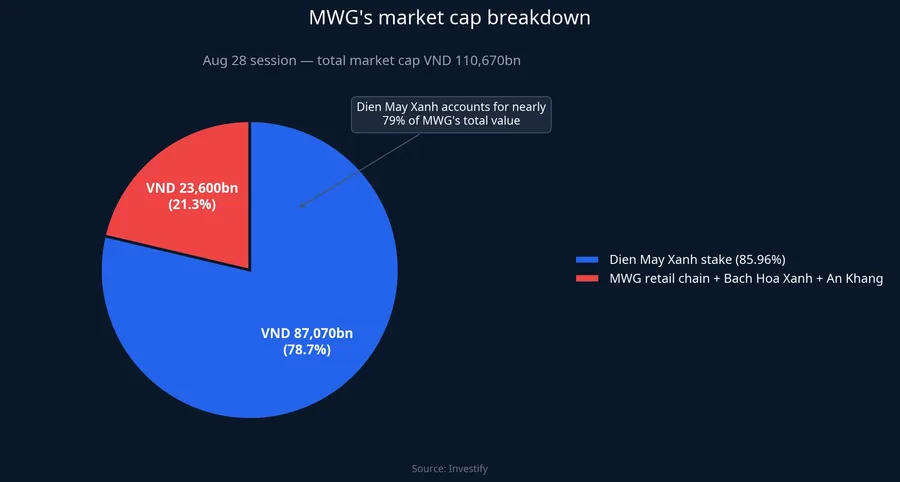
The most extreme case is MWG. Its market cap in the August 28 session was VND 110,700 billion, while its stake in Dien May Xanh alone was worth VND 87,070 billion. A crude subtraction implies the market is paying only about VND 23,600 billion for everything else in the group: the core Mobile World retail chain, Bach Hoa Xanh, An Khang, and its overseas joint ventures.
For Techcombank, its stake in the securities subsidiary is worth VND 90,330 billion, equal to 38.2% of the bank's own VND 236,700 billion market cap. For VPBank, the equivalent ratio is 17.8%. For Vingroup, given the conglomerate's sheer size, the Vinpearl stake accounts for just 6.5% of its VND 1.82 quadrillion market cap.
Three ways to read MWG's VND 23,600 billion, and what the data favors
What's left of MWG after subtracting Dien May Xanh has at least three plausible explanations, and the honest answer doesn't pick just one.
The first is a parent-company discount: markets globally tend to value a holding company below the sum of its parts, because parent shareholders don't control the subsidiary's cash flow directly. The second is a free float that's simply too thin on the subsidiary side. After stripping out what the parent holds, all four newcomers combined have only about VND 67,090 billion of shares genuinely available to trade, just 16.7% of their nominal market cap. For Dien May Xanh alone, free float is roughly VND 14,220 billion. The third explanation is that the market is genuinely undervaluing what's left of MWG's core chains.
Liquidity data leans toward the first two. In the August 28 session, DMX traded 234,300 shares worth about VND 18.7 billion, while MWG traded 3,473,200 shares worth about VND 260 billion, a nearly 14-fold gap. A price set by that little trading volume hasn't yet been tested by real supply and demand.
What's driving the subsidiary spin-offs: securities firms need capital
The dominant force behind this wave of subsidiary listings is a capital squeeze at Vietnam's securities firms. Under current rules, a securities company's margin loan balance cannot exceed twice its equity. By the end of June 2026, industrywide margin balances topped VND 446,000 billion, with several firms pressing close to that ceiling: HCM at 195.4%, MBS at 177.6%, Mirae Asset at 167.9%.VnEconomy
To lend more, a securities firm needs more equity. Its parent bank can't inject unlimited capital because the bank itself has to maintain its own safety ratios, which makes a public share sale the fastest way to raise funds. VPBank Securities raised roughly VND 12,700 billion, lifting its charter capital from VND 15,000 billion to VND 18,750 billion, and told shareholders at its annual meeting it now has more than VND 30,000 billion of additional lending room.Nha Dau Tu Every dong of new equity opens up two dong of lending capacity.
Two secondary forces add to the push: the expectation that markets will price a standalone securities firm more richly than the same business buried inside a bank's consolidated results, and a timing window, with the whole group racing to list ahead of and during Vietnam's market-upgrade cycle, when foreign capital inflows are expected to return.
Does spinning off a subsidiary unlock value for the parent
That's a question the price data has partly answered already, and the answer isn't consistent across cases.
Vingroup is the clearest case. VIC's share price rose from VND 19,950 on February 12, 2025 to VND 39,800 on the very day Vinpearl listed, May 13, 2025, then climbed further to VND 58,750 sixty sessions later, up 47.6% from the listing-day level. The other three cases show no such pattern. Techcombank fell 10.6% in the 15 sessions after its subsidiary's listing and was still about 5.5% below the listing-day level sixty sessions on. VPBank declined steadily both before and after, ending 9.4% lower sixty sessions later. MWG lost about 15% over the two and a half months before Dien May Xanh's listing, then recovered 6.6% in the following 15 sessions.
It would be a stretch to attribute all of these moves purely to the subsidiary listings; late 2025 and mid-2026 both saw other forces weighing on the banking and retail sectors. What the data shows most clearly is that a value-unlocking effect doesn't automatically appear just because a subsidiary goes public.
Three adjustments for reading billion-dollar-club market cap
For investors, three adjustments make sense at this point.
When comparing the size of the billion-dollar club year over year, the headline total is no longer a direct measure of new value created. The increase needs to be split in two: the portion from genuinely new companies, and the portion from an existing company being carved into multiple tickers.
When valuing a parent company after its subsidiary lists, the cleanest approach is to net out the ownership stake. MWG's market cap minus the value of its 85.96% stake in Dien May Xanh is what the market is actually paying for the rest of the group.
When looking at the newcomers themselves, check liquidity before market cap. A ticker with a VND 100,000 billion market cap that trades only tens of billions of dong per session is being priced by a very small pool of buyers and sellers, a price that hasn't been tested by real supply and demand.
The signal worth watching over the coming quarters is free float across this group. If parent companies sell down more shares, or new share issuances thicken the tradable float, these subsidiaries' current prices will meet real supply for the first time. That's when investors will find out how durable their billion-dollar valuations really are.