


There's a reading that has been popular on investing forums this August: brokerage proprietary desks are the market's best-informed, fastest-reacting players, so when they net-sell heavily while the index climbs, retail investors should treat it as a warning sign and stop chasing the rally.
Looking at the numbers, that reading isn't baseless. Proprietary desks net-sold VND 1,917.3 billion on HOSE in August, a full reversal from net buying of VND 886.7 billion in July. Of the 410 tickers with proprietary trading activity, 79 saw net selling and 57 saw net buying. In the three sessions before the National Day holiday alone, desks net-sold more than VND 2,000 billion, concentrated in VPB and MCH.Dân Trí
But break the total down by ticker and by trading channel, and the picture changes.
Almost half the selling traces to one newly-listed stock
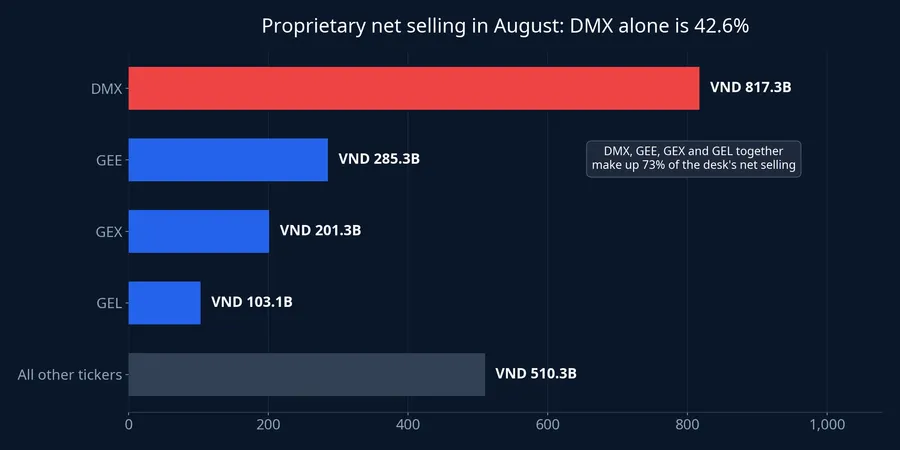
The most heavily net-sold ticker by proprietary desks in August was DMX, Dien May Xanh Investment JSC, at VND 817.3 billion: 42.6% of the entire net-selling value from proprietary trading on HOSE that month.
What matters is that DMX only listed on August 6. The company brought over 166 million shares onto HOSE and began trading that day.Tuổi Trẻ On just its second trading session, August 7, matched and negotiated volume for DMX jumped to 9,061,700 units, nearly five times the listing-day session. Of that, proprietary net selling through the negotiated channel on August 7 alone was VND 657.7 billion.
Large negotiated-block trades right after a listing typically reflect position transfers between institutions rather than a reaction to price action. In other words, almost half of the proprietary desks' "selling pressure" in August came from handing off a block of freshly-listed shares, not from a decision to cut equity exposure over market concerns.

Add the GELEX group and the concentration becomes even clearer. GEE was net-sold VND 285.3 billion, GEX VND 201.3 billion, and GEL VND 103.1 billion. Together, DMX, GEE, GEX and GEL add up to VND 1,407 billion: 73% of the entire desk's net selling value.
This isn't unique to August. The proprietary desks' aggregate net-selling figure is almost always dominated by a handful of large positions closed out in a short window, usually tied to a specific event like a new listing or a portfolio restructuring within a related corporate group. Reading it as a sentiment gauge for the entire institutional investor base assigns the number a meaning it doesn't actually carry.
What they bought says more than what they sold
In August, proprietary desks were still net buyers in two sectors: banking, at VND 195.1 billion, and real estate, at VND 192.5 billion. These were also the only two sectors to see meaningful inflows, while 12 of 19 sectors saw net selling.
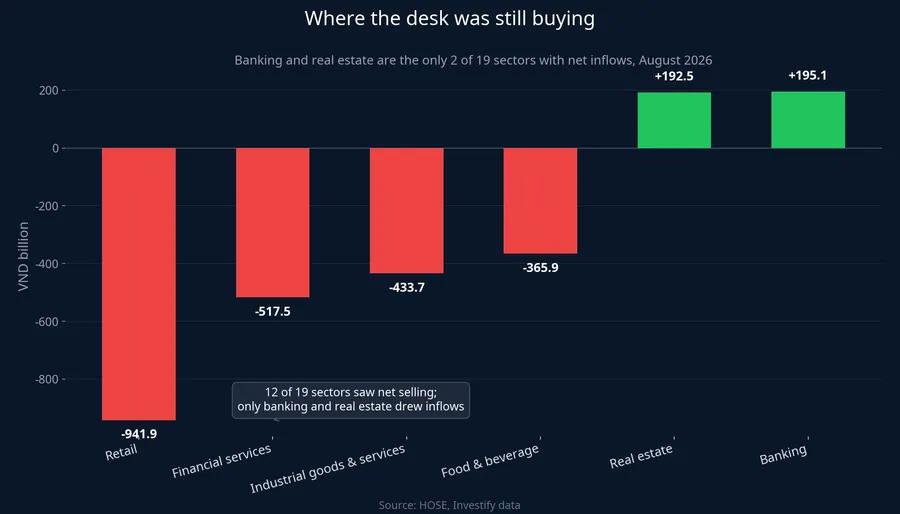
The top net-buy list reflects the same tilt: NVL at VND 259.9 billion, SBT at VND 230 billion, MBB at VND 219 billion, and CTG at VND 137.3 billion. Five of the ten most-bought tickers were bank stocks. A desk genuinely fleeing the market would be unlikely to simultaneously add to the exact two sectors leading the index higher.
Why brokerages trim proprietary books when the market rises
There's a reason rooted in the business model, not in a market call. As the index climbs, individual investors' demand for margin loans rises with it, and margin lending generates steady interest income at a much lower volatility risk than holding a proprietary equity book.
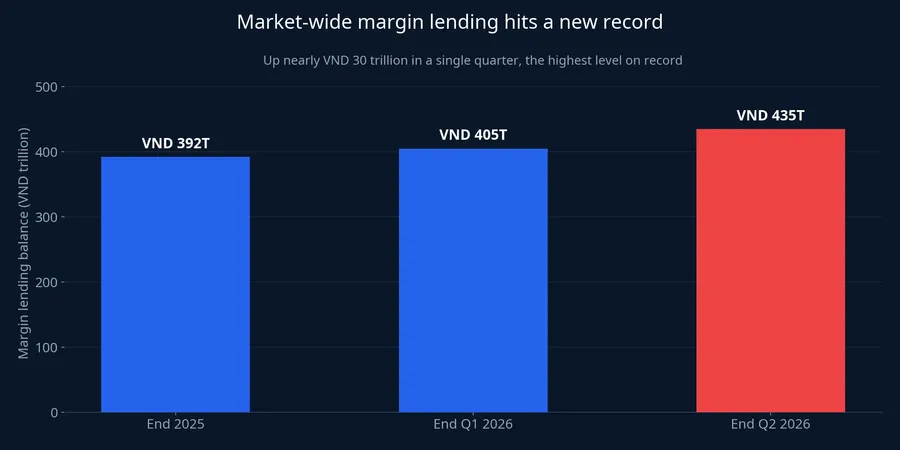
Leverage was already sitting at record levels heading into August. Per Q2/2026 data, market-wide margin lending balance reached roughly VND 435 trillion, up nearly VND 30 trillion in a single quarter from about VND 405 trillion at the end of Q1. That is the highest level since Vietnam's stock market began operating.DNSE
For a brokerage, selling down its own equity book to free up capital for lending is a capital-allocation decision, not a vote on where VN-Index is headed.
The genuine selling was real, and price didn't follow it
To be fair, not all of the VND 1,917.3 billion was portfolio restructuring. MCH was net-sold VND 377.1 billion, LPB VND 157.6 billion, FPT VND 137.6 billion, and VNM VND 116.2 billion. The fact that selling clustered in the three sessions ahead of a five-day holiday also suggests part of it was routine risk-reduction before a long break, standard practice for a proprietary book.
But even in the heavily-sold names, proprietary selling didn't dictate price. GEX was among the most net-sold tickers and still rose from VND 24,550 on August 20 to VND 26,450 on August 28, up 7.7%. GEE, on the other hand, fell from VND 75,300 on August 12 to VND 64,800 on August 28, down 13.9%. Same corporate group, same direction of proprietary trading, opposite price outcomes. Other capital flows in the market were the real determinant of price, not the desk's selling on its own.

The real story of August: who carried the rally
Set proprietary trading aside and look at the full flow of capital, and a more accurate picture emerges. In August, both institutional blocks pulled money out: proprietary desks net-sold VND 1,917.3 billion on HOSE, and foreign investors net-sold more than VND 1,300 billion.Thời báo Tài chính Việt Nam Foreign net selling dropped sharply from the average pace of the prior three months, and foreigners even bought net in the final sessions of the month. Still, the month as a whole closed net-sell.
The force holding the index up, then, was domestic retail capital, deployed on top of a margin base already at record levels before August even began. That's the point worth investors' attention, and it's a very different story from "the sharks are fleeing."
A rally led by retail money isn't inherently bad, since Vietnam's market has always been driven by retail liquidity. What makes it more sensitive is the leverage riding along with it: when most of the buying power is tied to margin loans, an ordinary pullback can be amplified into a chain of forced liquidations.
How to read proprietary flow correctly
For individual investors, a more useful reading framework for the current period would prioritize the following, in order.
First, the structure of the net-selling figure. A session where a proprietary desk net-sells VND 1,000 billion, with VND 700 billion concentrated in a single ticker through the negotiated channel, means something entirely different from VND 1,000 billion spread across two dozen large-cap names via matched orders. Only the second case is a genuine signal of reduced positioning.
Second, the buy side. The sectors a desk keeps accumulating during a net-selling month usually reveal portfolio direction more clearly than what it sold, since buying is an active choice while selling can simply be closing out a position that had run its course.
Finally, margin lending balances. This data is published quarterly alongside brokerages' financial statements, and given August's rally, the balance at the end of Q3 will be the most direct gauge of how much leverage the market is carrying. That's a number worth watching far more than any single session's net-selling headline.