


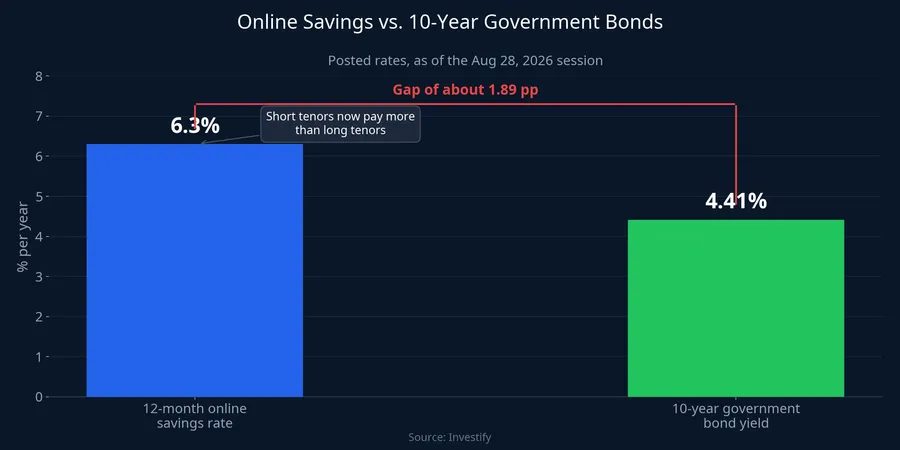
Late August 2026 finds a Vietnamese saver looking at a rate table where the familiar order has flipped. Lock up savings for 12 months and the median online rate across 29 banks is 6.30% a year, topping out at 7.00%. Lend to the government for 10 years through bonds, and the yield in the August 28 session was just 4.414%. Tie up money ten times longer and earn nearly 1.9 percentage points less a year.
The next question is how long that holds. A speech in Wyoming just pushed the answer to the top of the agenda.
What happened at Jackson Hole
On August 28, Fed Chair Kevin Warsh delivered his first speech at the Jackson Hole symposium since taking office, titled In Our Time. He kept to his now-familiar approach of giving markets no forward guidance, and closed with the line most quoted afterward: "I stand here today with a commitment to a discipline, not to a decision."
It was the rest of the speech that moved markets. Warsh stated that the Fed's 2% PCE inflation target is fixed and unchanged.CNBC He cited July PCE inflation at 3.7% and CPI at 3.4%, with 54% of the PCE basket's categories up more than 3% over 12 months.markettimes Summer data, he said, was better than expected but did not yet show meaningfully improved underlying trends, and US financial conditions had not broadly tightened. The implication: the Fed still has room to act further.

Markets read it that way immediately. Per the CME FedWatch tool, the probability of a Fed rate hike at the September 15-16 meeting jumped from about 35% before the speech to nearly 60%.Vietstock By August 31, that probability was still holding around 57%.FireAnt It's worth being precise here: this is a futures-market price, not a Fed commitment. The July meeting itself ended with a 9-3 vote to hold rates at 3.50-3.75%, with three dissents favoring a 25-basis-point hike.Trading Economics
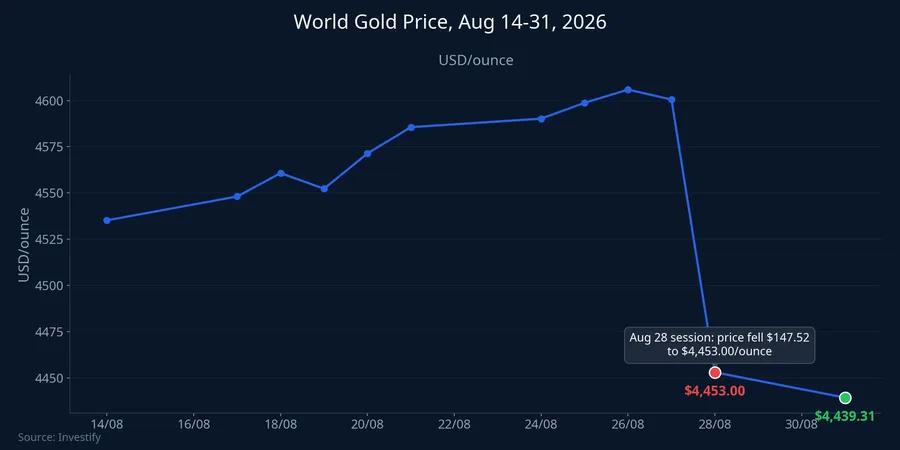
Asset prices reacted almost instantly. The US 2-year Treasury yield rose about 11 basis points to around 4.34%, and the dollar index gained 0.6%.CNBC World gold prices closed the August 28 session at $4,453.00/ounce, down $147.52, a sharp 3.21% single-session drop. The decline carried into August 31, when gold fell to $4,439.31, 4.7% below the $4,658.11 peak set on August 25.
Lining up the channels against one question
For Vietnamese investors, the useful question isn't whether the Fed hikes. That's outside anyone's control. The useful question is: if global rates genuinely turn another notch higher, which channel gets hurt, and which barely moves?
Gold takes the most direct hit, and the August 28 session illustrated exactly that mechanism. Gold pays no yield, so when expected real yields rise, the opportunity cost of holding it rises too. Most of gold's August rally was built on expectations of Fed easing, and that expectation was just pulled away.
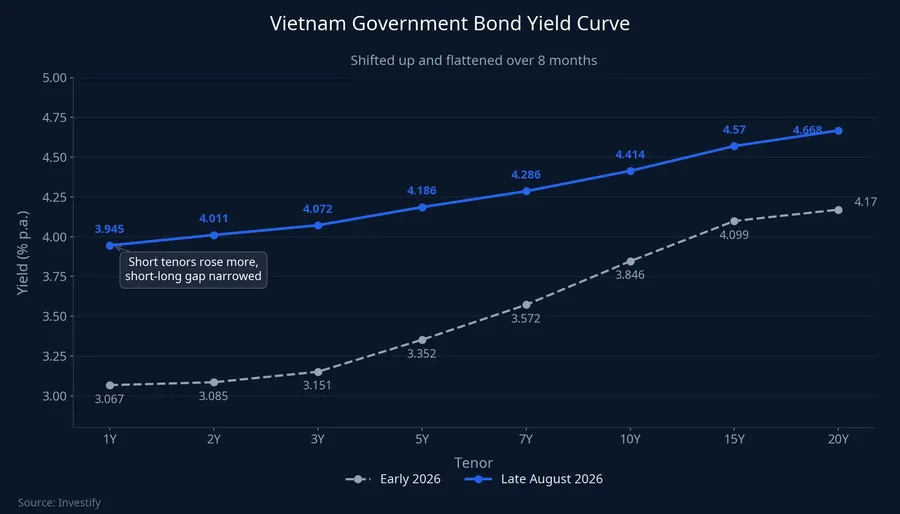
Long-dated bonds carry risk of a different, less visible but more persistent kind: holders lock in today's yield for a full decade, while the reward for accepting that lock-in keeps thinning. The yield spread between Vietnam's 10-year and 1-year government bonds narrowed from about 77.9 basis points at the start of the year to roughly 46.9 basis points by late August. The domestic yield curve has shifted up but flattened, tracing the same shape the US curve just moved through in a matter of sessions, where the 2-year/10-year spread compressed from 45.6 to 37.2 basis points.
Short-tenor deposits and fixed-income products are the least affected group, for a simple reason: domestic rates had already covered most of their climb before Jackson Hole, not because of it. An August 30 survey put 12-month rates in a 3.90-7.00% range, with a 6.30% median online and 5.90% median over the counter; most banks had already raised deposit rates by 0.2 to 2.1 percentage points over the first eight months of the year.
Stocks sit in the middle, and August data shows no rising pressure to exit. Foreign investors net-sold VND 5,559.5 billion market-wide in August, down about 66% from VND 16,509 billion in July. Selling pressure concentrated in Banking (net VND -2,088.7 billion) and Real Estate (net VND -1,811.4 billion), while Retail and Information Technology drew net buying of VND 1,262.6 billion and VND 895.9 billion respectively. The VN-Index closed out the month at 1,832.12 points after five straight up sessions.
Vietnam's difference: the FX buffer still holds
The main channel through which a Fed rate hike transmits into a Vietnamese investor's portfolio is the exchange rate, not the dong deposit rate. On that front, Vietnam is heading into September with a buffer, not an open wound.
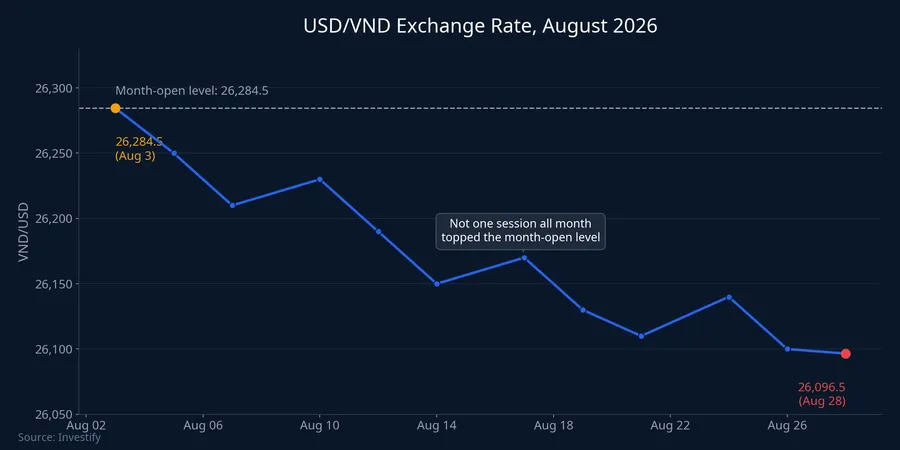
The USD/VND rate in the August 28 session stood at 26,096.5, down 0.72% from the start of August and down 0.77% from the start of 2026. Not once during August did the rate climb back above its month-open level. In other words, the dong strengthened slightly against the dollar during the very stretch when global markets began repricing the odds of Fed tightening.
To be fair, the sharp rise in domestic deposit rates over the past eight months has nothing to do with the Fed. At least three explanations are equally plausible: system liquidity tightening as credit growth outpaces deposit growth, competition to retain deposits as other channels pull in capital, and domestic inflation expectations. Available data isn't enough to rank these three causes, but the fact that they predate Warsh's speech is the clearest evidence that Vietnam's rate story has its own drivers, not one that simply follows the Fed.
The nearly 1.9-percentage-point gap between 12-month deposits and 10-year government bonds isn't a free lunch either. The two instruments differ in who bears the repayment obligation: a deposit is a commercial bank's liability, covered by deposit insurance only up to VND 125 million per person per bank, while a government bond is a sovereign obligation. Part of that gap is simply the price of that difference; only the remainder is the real reward for the saver.
A framework for choosing, and signals to watch
For a time horizon under a year, a fixed-income rate of 6-7% a year is now a reasonable benchmark for money waiting on opportunity, simply because stretching out to a 10-year tenor now pays less, not more. Extending duration is only worth reconsidering once the spread between the long and short ends of the domestic curve widens back out from its current level of around 47 basis points. This isn't a specific buy or sell call. It's a yield-by-tenor comparison framework any investor can apply to their own portfolio.
Three signals will answer this question over the coming weeks. US inflation data is the metric Warsh himself emphasized, and it will decide whether hike odds stay above the 50% mark. The September 15-16 FOMC outcome will settle the scenario. The nearest and easiest signal for domestic investors to watch is how USD/VND trades when Vietnam's market reopens on September 3 after four holiday sessions, since that will be the first time the dong reacts to this hawkish pivot.
Taken together, the current picture tilts toward staying short: the FX buffer is intact, domestic deposit rates got ahead of the Fed, and the reward for locking up capital long-term is thinning rather than growing. The biggest risk to this framework is if the Fed actually hikes on September 16 and the domestic exchange rate reacts more sharply than expected — that would be the first real test of the FX buffer since Jackson Hole.