

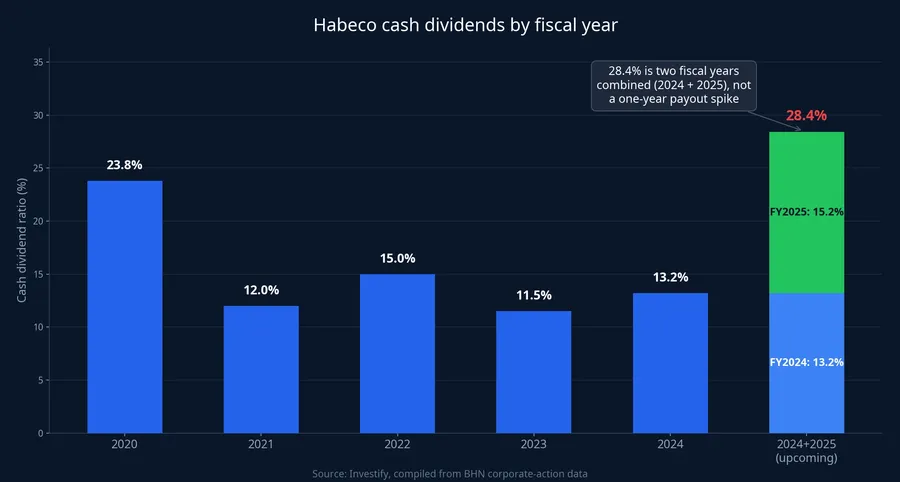
In late August, Habeco announced it will pay VND 658.312 billion in cash dividends to shareholders, a 28.4% ratio equivalent to VND 2,840 per share.Tin nhanh Chứng khoán Divided by the VND 31,100 closing price on August 28, the dividend yield tops 9%, a figure that instantly catches the eye of investors hunting for reliable dividend stocks.
Taken alone, that number looks generous. But placed on the company's actual timeline, its meaning changes completely: this is not one year's dividend. It is two fiscal years, 2024 and 2025, combined into a single record date.

2025: the highest profit in years
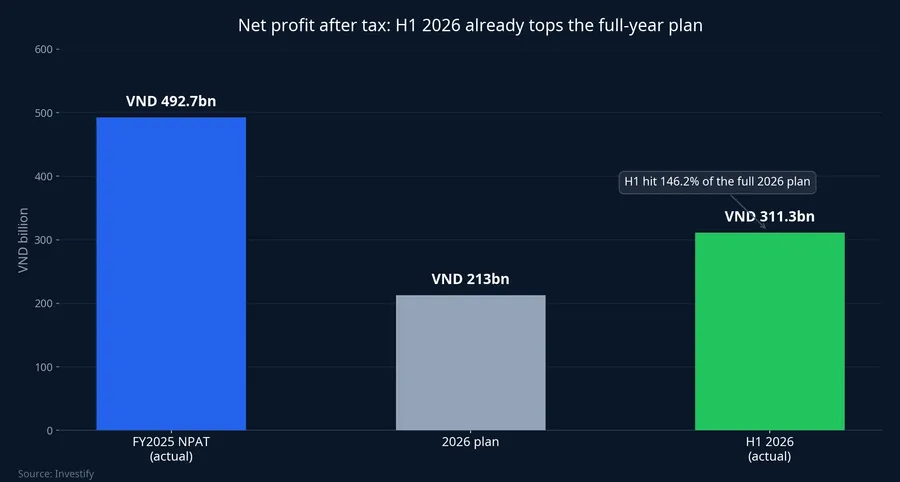
In 2025, Habeco posted net revenue of VND 8,524.6 billion and net profit after tax of VND 492.7 billion, up 25.6% year over year.MekongASEAN That was the company's highest profit in years, well above the target its own shareholder meeting had set at the start of the year.
What matters here is Habeco's payout rhythm: the company always pays dividends one to two years behind the fiscal year they belong to. The most recent payout before this one was for fiscal 2023, at an 11.5% ratio, paid out in July 2025. By mid-2026, shareholders still hadn't received a single dong for 2024 or 2025. The upcoming VND 658 billion payout is the catch-up for those two years, not a sudden burst of generosity this year.
Broken down, the 28.4% ratio is 13.2% for 2024 and 15.2% for 2025. Set against the company's payout history — 15% for fiscal 2022, 12% for fiscal 2021, 23.8% for fiscal 2020 — each of those figures sits well within a familiar range. The headline number is striking because it adds two years together, not because payout levels jumped.
The 2026 plan: a deliberate step back
Right after a record profit year, Habeco's management presented shareholders with a markedly lower 2026 plan: revenue around VND 7,800 billion and net profit after tax of VND 213 billion, down 57% from 2025's actual results.DNSE The projected 2026 dividend fell in step, to just 7.2%, or roughly VND 167 billion.
Three real pressures sit behind that caution. First is the excise tax roadmap: the amended Special Consumption Tax Law, passed by the National Assembly on June 14, 2025, holds the beer tax rate at 65% through 2026, then raises it 5 percentage points a year, to 70% from 2027 and up to 90% by 2031.VnEconomy Habeco's product mix skews toward mass-market beer, the segment most sensitive to price, so it has to adjust operations well before the tax actually rises.
Second is drink-driving enforcement. Decree 168/2024, effective January 1, 2025, sharply raised fines for driving under the influence, squeezing the on-premise channel of restaurants and eateries directly. The decree was revised in May 2026 to cut red tape, but fine levels were not lowered — a sign the legal framework has settled, not loosened.
Third is an increasingly expensive fight for market share. In Vietnam's beer market, Heineken holds around 40%, Sabeco 30%, Carlsberg 9%, and Habeco about 7%.VietTimes In 2025 alone, Habeco spent more than VND 700 billion on advertising and promotions, more than its entire net profit for the year. Management calls 2026 a pivot year for the 2026-2030 cycle, accepting lower profit to defend market share while pushing expansion in the south.
H1 2026: reality running ahead of plan
In the first half of 2026, Habeco posted consolidated net revenue of over VND 4,764 billion and net profit after tax of over VND 311 billion, versus VND 179.7 billion in the same period of 2025.MekongASEAN In Q2 alone, revenue of VND 2,835 billion was the highest in nearly nine years, and net profit after tax of VND 240 billion was the strongest quarter in more than five years.
In other words, after just six months, actual profit had already exceeded the entire full-year target set in the 2026 plan. The drivers were favorable weather, market-development gains, and bank deposit interest. Habeco is sitting on over VND 5,300 billion in idle cash, about two-thirds of total assets, and carries almost no debt.
Two dates shareholders need to remember: September 15 and October 16
The ex-dividend date is September 15, 2026, the record date is September 16, 2026, and cash is expected to hit accounts on October 16, 2026.
There's a mechanic new investors often overlook: right at the open on September 15, the stock's reference price will be adjusted down by exactly VND 2,840. Buying on September 12 to catch the dividend generates no gain, because the cash payout is deducted from the share price the moment the market opens. A dividend is cash flow for shareholders who already held the stock, not a short-term buying opportunity.
Why the 7.2% figure is easy to misread
The 7.2% dividend projected for 2026 tends to get read as a forecast about the company's health. Read against the timeline, it means something else entirely.
First, that number is tied to a VND 213 billion profit plan, and that very plan was already exceeded after six months. The actual 2026 dividend ratio will be decided by shareholders at next spring's annual meeting, once full-year results are in hand. Habeco's payout history shows the ratio always tracks actual results, not the plan set at the start of the year.
Second, the 2026 dividend — if the usual pattern holds — will be paid out in 2027 or 2028. That's cash flow one to two years from now, not something happening today. What the 7.2% figure really signals is a management stance: the company is bracing for a stretch where it must spend more to defend its position, before the tax hikes begin in earnest from 2027.
Three things individual investors should weigh
The dividend yield looks attractive, but it comes with three concrete constraints worth putting on the scale before committing capital.
Thin liquidity is the first constraint. The Ministry of Industry and Trade holds 81.79% of Habeco, the Carlsberg group holds about 17.5%, and less than 1% floats freely on the exchange. Matched volume on many August sessions ran just a few hundred to a few thousand shares. An investor buying even a few hundred million dong worth of stock could push the price meaningfully, and selling runs into the same problem in reverse.
A normal year's dividend yield sits well below the 9% figure grabbing attention. Taking the fiscal 2025 dividend alone, VND 1,520 divided by the VND 31,100 share price works out to about 4.9%. At the planned 7.2% for fiscal 2026, or VND 720, the yield drops to roughly 2.3%. Against prevailing 12-month bank deposit rates, Habeco's dividend isn't a standout income channel, while the share price can still move.
The long-term story isn't settled either. Habeco's financial footing is solid, backed by more than VND 5,300 billion in idle cash and almost no debt. But holding 7% of a market where the leader controls 40% means every additional point of share has to be bought with selling expense. That expense eats straight into profit, which is exactly what funds future dividends.

What to watch next
Under the current setup, a stock like BHN suits investors who prioritize steady cash flow and accept slow growth, more than those chasing high short-term yields. The liquidity constraint alone limits how large a position is practical to build, whatever view an investor takes on the company.
Two milestones ahead will fill in the rest of the picture. Q3 and Q4 results will show whether H1's momentum is durable or simply a strong consumption season. The spring 2027 annual shareholder meeting will lock in the real dividend ratio for fiscal 2026, and that number, not today's 7.2% plan, is the one worth comparing against.