


On July 31, 2026, Vingroup (VIC) released consolidated first-half financial statements with a headline number every investor wants to see: net profit after tax of VND 20,375 billion, 4.5 times the same period in 2025, hitting 58% of the full-year plan in just six months.Thanh Nien Net revenue reached VND 222,288 billion, up 72.5% year-on-year.MekongASEAN
The obvious read is broad-based growth, and a multi-fold jump like this looks like proof of a new cycle. That read is not unreasonable; real numbers back it up. But open the footnotes of the same report and the components behind the record figure tell a different story.
What Q2's math actually adds up to
Q2 2026 carried nearly the entire increase for the half. Quarterly net revenue hit VND 117,936 billion, up 162%, while net profit after tax reached VND 14,764 billion, more than six times the VND 2,297 billion booked in Q2 2025.Dien Tu Ung Dung
What matters here sits in the footnotes, not the summary line. Total pre-tax accounting profit for Q2 was VND 22,169 billion. Note 25.2 recorded a gain on disposal of financial investments and transfer of a subsidiary worth VND 15,882 billion, against just VND 394 billion a year earlier. Note 28 recorded other income of VND 7,862 billion, of which VND 7,523 billion was sponsorship funding received.
Add the two non-sales items together and Vingroup collected VND 23,405 billion, more than its entire pre-tax profit of VND 22,169 billion for the quarter. Strip those two items out, and the remaining core profit for Q2 was actually negative, at roughly VND 1,236 billion.
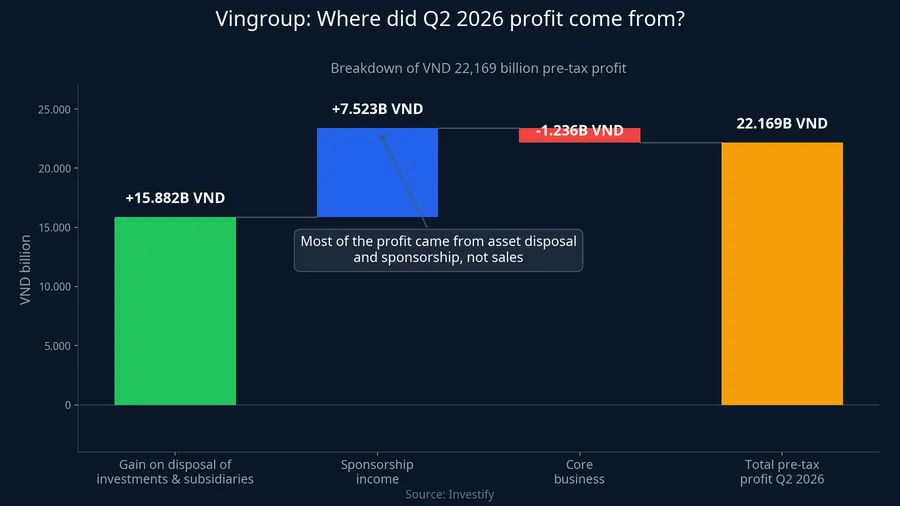
The source of the largest gain is no mystery: the company disclosed it directly. In Q2, VinFast completed the transfer of its manufacturing operations in Vietnam, and Vingroup booked a gain of more than VND 12,500 billion from the deal.VnExpress Across the full first half, gains from subsidiary transfers and investment liquidations totaled VND 17,409 billion, versus VND 2,172 billion a year earlier.Dien Tu Ung Dung
The second item is not customer revenue either. Per the report, Chairman Pham Nhat Vuong of Vingroup provided VND 12,500 billion in funding to the group's subsidiaries during the first half, bringing his cumulative personal contributions to roughly VND 43,800 billion.CafeF
Where the real cash is coming from
Note 31, the segment information section, paints a clearer picture than any consolidated line.

Real estate transfer is where the actual cash gets made. In the first half, the segment posted revenue of VND 127,197 billion and pre-tax profit of VND 71,121 billion, driven largely by large-lot handovers at Vinhomes Green Paradise, Vinhomes Global Gate Ha Long, and Vinhomes Saigon Park.Dien Tu Ung Dung

Manufacturing runs the other way. With revenue of VND 61,415 billion, the auto, e-scooter, and industrial products segment posted a pre-tax loss of VND 49,417 billion over six months, averaging more than VND 273 billion a day. In Q2 alone, manufacturing revenue was VND 33,427 billion while corresponding cost of goods sold reached VND 50,652 billion, or 151.5% of revenue. In other words, the segment loses money at the point of sale, before accounting for any selling or administrative costs.
The remaining segments contributed thin margins: hospitality and tourism earned VND 1,020 billion, education VND 107 billion, and healthcare lost VND 700 billion.
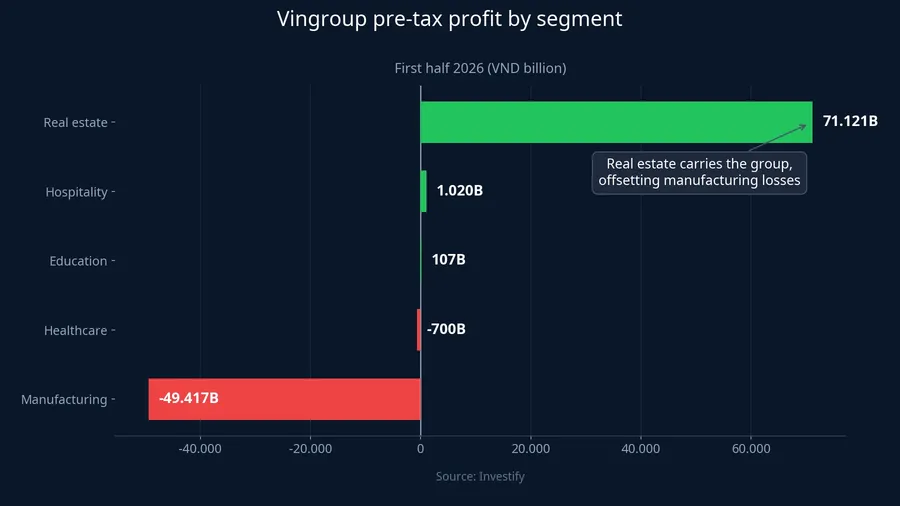
None of this means demand is weak. VinFast delivered 128,662 electric cars worldwide in the first half, up 78% year-on-year, plus 429,175 electric scooters, 3.7 times the prior-year figure.VietnamFinance Cars are selling, and selling more of them. The issue is that each vehicle sold still doesn't cover the cost of making it.
Interest expense: the counterweight often left out
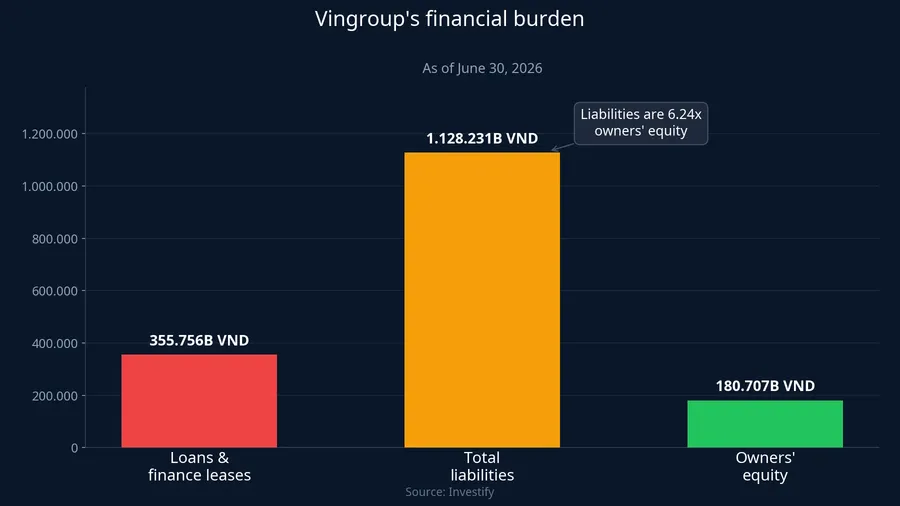
Vingroup's cumulative interest expense for the first half reached VND 16,632 billion, equivalent to more than VND 91 billion a day. Total loans and finance lease balances hit VND 355,756 billion, up roughly 5.1% from the end of 2025.MekongASEAN
The balance sheet shows leverage has thickened further. Total assets as of June 30, 2026 reached VND 1,308,938 billion, but total liabilities stood at VND 1,128,231 billion, or 86.2% of total capital and 6.24 times owners' equity of VND 180,707 billion.Dien Tu Ung Dung Short-term debt rose from VND 602,600 billion to VND 788,421 billion in just six months, while cash and cash equivalents stood at VND 76,395 billion, only 9.7% of that short-term debt. The current ratio slipped to 1.05x.
Borrowing costs aren't cheap either. VND-denominated loans carry floating rates from 6.1% to 14.5% a year, while unsecured loans carry fixed rates from 11% to 12% a year.
A fair reading of the company's position
There are several plausible ways to read this same set of numbers, and the most dramatic one shouldn't be the only one that survives.
First, the gain from transferring VinFast Manufacturing is not an accounting trick. It was a deliberate restructuring step, shifting VinFast toward an asset-light model focused on R&D, technology, and sales. The value recognized is real value accumulated over years — it just crystallized into a single quarter.
Second, the VND 71,121 billion real estate profit is genuine operating profit, not a one-off. Even stripping out every divestment and sponsorship item, this segment alone can carry most of the group. What's worth watching is that this profit comes from large-lot handovers, which cluster by project and delivery schedule rather than spreading evenly across quarters like retail revenue.
Third, the manufacturing segment's loss widened partly because volume widened with it. Segment revenue grew 86%, and before a business reaches breakeven, selling more units means a larger absolute loss.
All three readings hold up. But none of them turns a VND 12,500 billion-plus gain from selling a subsidiary into a source of income that can repeat next quarter, and none of them turns the Chairman's funding into revenue from customers.
What to watch in the coming quarters
Given this result, the sensible way to read the next two quarters is to split the headline figures into three layers before comparing them against the plan.
The first layer is segment-level profit in the footnotes, not the consolidated line on the summary page. This is the only place that shows how much real estate earned and how much manufacturing lost. The second layer is the gap between that operating profit and interest expense: with interest running above VND 91 billion a day, operating profit has to clear that bar before it counts as real growth. The third layer is manufacturing's gross margin: cost of goods sold at 151.5% of revenue in Q2 is the starting point, and however far that number falls in Q3 will say more than any press release about delivery volumes.
Vingroup's full-year 2026 plan targets revenue of VND 485,000 billion and net profit after tax of VND 35,000 billion.MekongASEAN The first half already completed 58.2% of the profit target, but a large share of that came from two non-recurring items. If Q3 brings no new disposal deal, the rest of the plan will have to be carried by the pace of real estate handovers and how quickly the manufacturing loss narrows. That is a scenario to monitor, not a risk already confirmed.
The market is still paying a premium for this story. VIC shares closed the August 28 session at VND 236,000, up roughly 10.2% from VND 214,100 on July 31, the session right after the semi-annual report was published. The Q3 earnings release will be the first time this profit figure is read without a large divestment gain standing in front of it — that's when the real test for the group's core margin begins.