

Retail investors in Vietnam are pitched corporate bonds through three channels: bank counters, brokerage advisors, and open-end bond funds. On every pitch sheet, the number that jumps out first is the yield. In the same month of August 2026, within the same three-week window, that number ranged from 7.87% to 13% a year. But the more useful question isn't "which rate is higher." It's who is paying for that five-plus percentage point gap, and with what.
Same month, two different price tags for capital
From early August through August 25, the market recorded 28 bond tranches worth roughly VND 28.7 trillion, with banks alone accounting for 23 tranches worth about VND 23.9 trillion.Tien Phong In other words, more than 8 out of every 10 dong of new corporate bonds issued that month came from banks borrowing.
What's notable is that the group dominating volume also carries the lowest rates in the market. Vietcombank and BIDV tranches in August mostly sat at 7.87-8.2% a year, while private joint-stock banks paid more: Sacombank up to 10%, PVcomBank 9.6-9.8%, TPBank around 9.1%. Báo Đầu tư noted that bank bond rates had cooled from July, when private banks were paying 9.8-10%.Báo Đầu tư

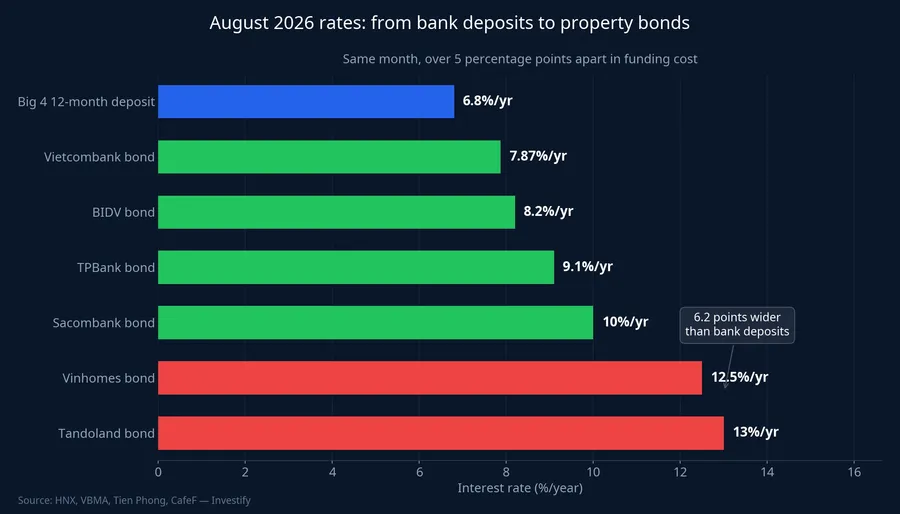
On the property side, far fewer tranches came to market, but at a much steeper cost of capital. Vinhomes raised VND 2 trillion with a 3-year tenor at 12.5% for the first two coupon periods. Tandoland Joint Stock Company raised VND 258 billion over 5 years at 13% for its first two coupons, the highest rate disclosed that month.Tien Phong
For an anchor point: at the same time, a 12-month deposit at the Big 4 state banks paid 6.8% a year, and the highest rate in the market at that tenor was ACB's 7.8%.CafeF Big 4 bank bonds pay roughly one percentage point above Big 4 deposits, while the highest-paying property bond beats deposits by over six percentage points. That gap isn't a reward for moving fast. It's the price the market is putting on risk.
Question one: who's borrowing, and where does repayment come from
Banks issue bonds mainly to top up Tier 2 capital and lock in medium- to long-term funding. Repayment comes from interest income across an entire loan book, under State Bank of Vietnam oversight of capital adequacy and liquidity ratios. The risk isn't zero, but it's the risk of an institution with a continuously running cash flow under regular supervision.
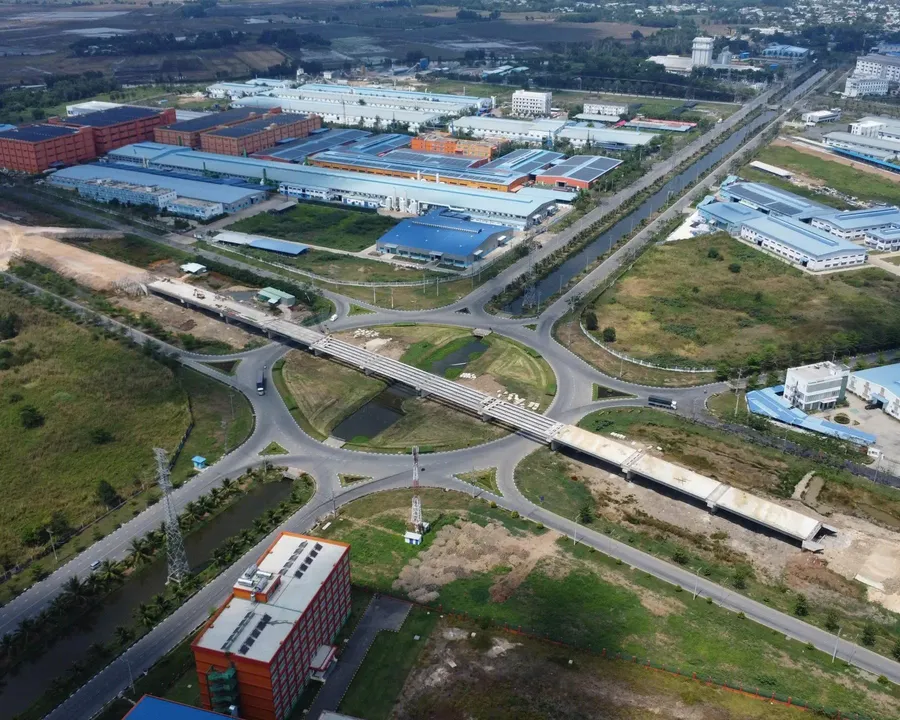
The profile behind a 13% coupon looks very different. Tandoland is the developer behind the Mai Ba Huong residential project (147 hectares) and the Tandoland industrial park (250 hectares) in Tay Ninh, part of the Tan Do Investment and Construction group. A Saigon Ratings assessment from April 2026 found the company had generated no core operating revenue throughout 2023-2025, since the projects remain in their investment phase.Fili What that rating doesn't spell out for bondholders: by the end of 2025, the company's total liabilities stood at VND 6,135 billion, and accumulated losses of VND 190 billion had pulled equity down to VND 1,160 billion. In May 2026, the company had to raise its charter capital to VND 2,850 billion.
The issuer's own cost of capital tells a clearer story than any prospectus: three older tranches totaling VND 93 billion still outstanding carry 9.5% coupons, a June 2026 tranche jumped to 12%, and the August tranche went to 13%. Same issuer, same project, and the cost of capital climbed nearly four percentage points in just a couple of years. The trajectory of the rate is the market's own running record of how it grades the risk.
Question two: where do bondholders rank in the collateral pool
This is the part of any offering document that gets read least carefully, and the part that matters most when things go wrong.
The TDRL12603 tranche, issued on August 13, 2026, does carry collateral. But to create that collateral, Tandoland had to amend the terms of an older tranche, TDR12602 (VND 345 billion, issued in June), to share the claim. The collateral pool is valued at VND 1,766 billion, with total secured value held flat at VND 1,194 billion, a maximum coverage ratio of 68%. That pool is now split on equal payment priority across three parties: OCB bank's share fell from 71% to 49%, holders of the older TDR12602 tranche hold 29%, and holders of the new TDRL12603 tranche hold just 22%.Fili
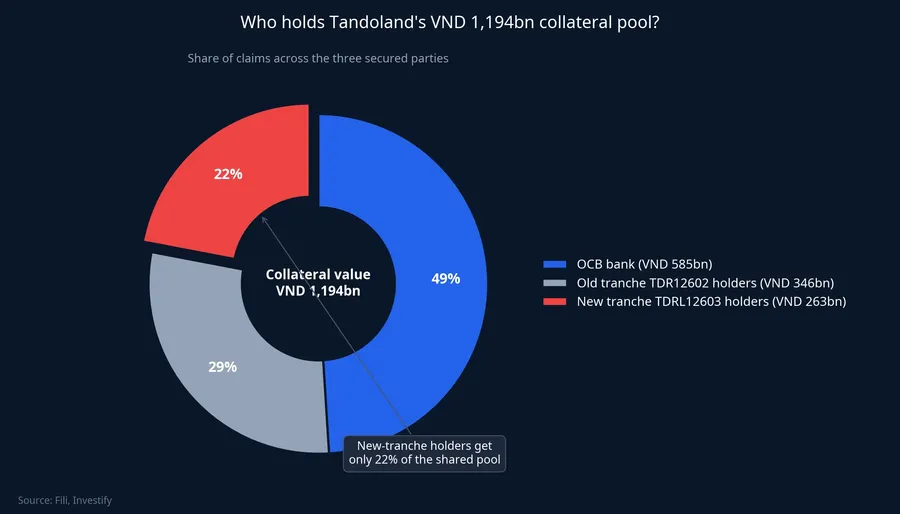
Put plainly: a buyer of the new tranche isn't getting a dedicated pool of assets. They're getting a 22% claim on a pool that also has to cover the bank and an earlier group of bondholders. In a downside scenario, recovery gets diluted exactly in that proportion, no more. This is precisely the line Decree 200/2026 was written to draw: the difference between collateral with real substance and collateral that exists mostly on paper.
To be fair to the issuer, this tranche does carry an early-redemption commitment of a cumulative 5%, 20%, and 50% of face value after 24, 36, and 48 months, a bondholder-friendly term on paper. But that redemption commitment only gets honored if the company has the cash, and that circles straight back to question one: core revenue still hasn't materialized.
Question three: what's the sector paying when this tranche comes due
The risk on any single bond tranche isn't confined to its own paperwork. It also depends on whether the whole sector can access fresh capital exactly when that tranche matures.
FiinGroup data shows that from August through the end of December 2026, non-bank issuers face nearly VND 89 trillion of bonds coming due, up 31.2% from the same period in 2025.Tien Phong Property alone accounts for nearly VND 59 trillion of that, roughly 66% of all non-bank maturities in the last five months of the year, with December 2026 forecast as the heaviest point. In August alone, property issuers had about VND 6.4 trillion coming due, up 144% from July, led by Thai Son Construction and Investment (about VND 1.9 trillion), Hung Thinh Land (about VND 1.8 trillion), and Kinh Bac Urban Development Corporation (about VND 1 trillion).
The real risk sits in a detail that floating-rate bondholders often overlook: according to VCBS, about 52.44% of outstanding corporate bonds carry a floating or hybrid rate mechanism, and VIS Rating believes some floating tranches could reset to 14-16% a year.Báo Đầu tư For a buyer, a higher rate sounds like good news. For the issuer footing the bill, it's a cost-of-capital spike arriving exactly when cash flow is tightest. That's why a number of issuers are now negotiating to cap floating rates at 11.5% through mid-2027, rather than letting the formula run up to 12.5-12.9%.

The law built a filter, but reading the fine print is still on you
Effective June 5, 2026, Decree 200/2026 replaced decrees 153/2020, 65/2022, and 08/2023. Under the new rules, an individual qualifying as a professional securities investor can only buy privately placed corporate bonds if the tranche carries both a credit rating and either collateral or a payment guarantee from a credit institution.VietnamBiz The decree also bars issuers from using their own shares or capital contributions as collateral.
That filter screens out the weakest structures, but it doesn't answer, on a buyer's behalf, where they rank on the collateral or where repayment cash is supposed to come from. For most retail investors who don't qualify as professional securities investors, the practical route into corporate bonds is an open-end bond fund or a publicly offered bond, where due diligence is partly done for you and risk is spread thin across many issuers instead of concentrated in a single tranche.
A framework for answering these questions before you commit
Given market conditions in the last quarter of 2026, money that needs to stay safe belongs in term deposits or state-owned bank bonds, where the spread over savings is only about one percentage point and, in exchange, carries the lowest risk in the group. Capital willing to take on moderate risk makes more sense through a bond fund, since risk there is spread across dozens of issuers rather than concentrated in one tranche.
Single-issuer corporate bonds paying 12-13% should only be on the table once all three questions above have answers in a disclosed document, not in a verbal pitch. If even one question goes unanswered, a five-point spread isn't enough compensation for what you don't know. The date to watch is already clear: December 2026, when the property sector's maturity wall peaks, will show which issuers can repay from real cash flow and which ones have to go back to the negotiating table with their own bondholders.