

Three trading sessions, two foreign fund groups, nearly 7 million shares. What matters here isn't that PNJ's stock has recovered. It's who just sat down in the seats other shareholders had just vacated, and exactly when they did it.
Over three sessions on August 13, 14 and 19, 2026, two foreign institutional investor groups separately crossed the 5% ownership threshold in Phu Nhuan Jewelry Joint Stock Company (HOSE: PNJ). All three trades happened before investigators released their initial findings on a diamond-smuggling case, and all fell within the record-date window for PNJ's upcoming extraordinary shareholder meeting.
Three sessions, two fund groups, nearly 7 million shares
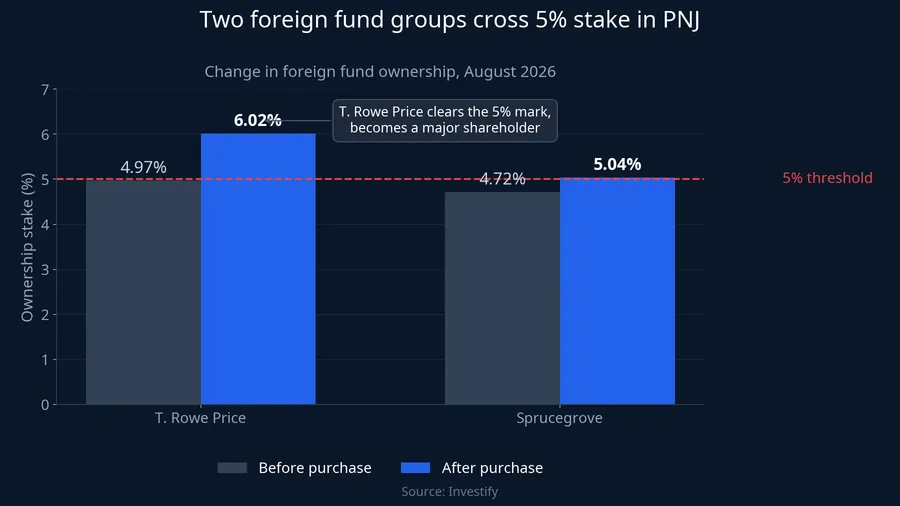
On August 13, the foreign investor group linked to T. Rowe Price Associates bought an additional 525,300 PNJ shares, lifting its stake from 25,441,296 shares (4.97%) to 25,966,596 shares (5.07%) and reclaiming major-shareholder status.Tuổi Trẻ A day later, the fund group represented by Sprucegrove Investment Management Ltd. added roughly 1.62 million shares, raising its stake from 24.18 million shares (4.72%) to 25.8 million shares (5.04%).Mekong ASEAN Within that group, Vanguard International Value Fund was the biggest buyer, adding over 1.51 million shares to bring its own holding to 21.86 million units. Worth clarifying: Vanguard participated as a member fund within the Sprucegrove group, not as an independent major shareholder.
The largest single purchase came on August 19, when the T. Rowe Price group added nearly 4.9 million more shares, lifting its stake from 5.07% to 6.02%, equivalent to more than 30.8 million shares.Mekong ASEAN That number is worth pausing on: total matched volume for the entire August 19 session was only 3,352,700 shares, meaning the fund's purchase far exceeded what showed up on the order book. Most of it had to go through negotiated block trades.
Combined, the two fund groups bought nearly 7 million shares across the three sessions. Closing prices on those days were VND 35,300, VND 36,500 and VND 35,700 per share, putting the total value of that stock at roughly VND 250 billion. After the trades, T. Rowe Price and Sprucegrove together held about 56.6 million shares, equivalent to 11.06% of PNJ's charter capital.
Neither institution is a newcomer here. T. Rowe Price was founded in 1937 in Baltimore and manages roughly $1.86 trillion in assets as of July 31, 2026, and had previously held a stake in PNJ.Tin nhanh Chứng khoán Sprucegrove is an independent, 100% employee-owned Canadian investment manager that was a major PNJ shareholder from 2023 before dropping below 5% in April 2025.VietNamNet

The seats they filled were left empty by someone else
To understand how two funds could buy up to 7 million shares in three sessions without hitting the foreign ownership cap, you need to look at PNJ's foreign room beforehand. This is one of the few Vietnamese stocks that has stayed close to the 49% foreign ownership cap for years, so any large purchase needs real space to move into.
As of the close on July 3, 2026, foreign ownership in PNJ stood at 48.24%, leaving just 0.76 percentage points of room, equivalent to fewer than 4 million shares.VietnamBiz At that level, T. Rowe Price's 4.9-million-share purchase on August 19 alone would have been impossible. The room only opened up after a bout of panic selling: after the former director of PNJ Assessment Co., Ltd. was indicted in early July in connection with the diamond-smuggling ring, PNJ shares fell from VND 63,000 at the end of June to VND 31,000 at the end of July, losing more than half their value in a single month.Tuổi Trẻ By July 27, foreign ownership had fallen back to 45.13%, with room widening to about 3.87 percentage points.VietnamBiz

Behind that room figure was a mass exodus. At the end of June, 50 domestic and foreign funds held 64.45 million PNJ shares, equivalent to 12.6% of shares outstanding. A month later, only 26 funds remained, holding 28 million shares, or 5.47%. Twenty-four funds closed their positions entirely, and total fund holdings dropped by 36.45 million shares. The counterparty to that exodus was domestic retail investors: in July alone, foreign investors sold a net roughly 28.4 million shares (VND 1,057 billion) through matched orders, while domestic retail investors bought a net roughly 27.1 million shares (VND 1,129 billion). In the first 20 days of August, the flow reversed: foreign investors bought a net roughly VND 301 billion, while domestic retail investors sold a net roughly VND 227 billion.
In other words, the same block of shares moved from foreign funds to domestic retail investors in July, then partly moved back in August. The difference was in the purchase price and the timing.
Buying before the legal risk was lifted
On August 20, police in Thanh Hoa province released information determining that none of the smuggled diamonds had entered PNJ's retail system, while confirming the company held complete diamond import documentation.Mekong ASEAN Earlier, Cao Thi Ngoc Dung, Chairwoman of PNJ's Board of Directors, had stated that the 28,000 smuggled diamonds in the case never entered PNJ's distribution system.Tuổi Trẻ
All three fund purchases happened before August 20. The stock then hit the daily ceiling on two consecutive sessions, August 21 and 24, gaining nearly 7% each time, before touching VND 45,550 on August 25 and closing that session at VND 42,650 on a spike in matched volume of more than 22 million shares. By the close on August 28, PNJ stood at VND 42,100, about 18% above the price range where the T. Rowe Price group bought on August 19.
There's one more date that's gotten less attention. PNJ's record date for its extraordinary shareholder meeting fell on August 25, with the meeting itself expected in October 2026.Thời báo Tài chính Việt Nam Both fund groups finished buying before that deadline, so the 11.06% stake mentioned above is also 11.06% of the voting rights at the upcoming meeting. On the insider side, CEO Phan Quoc Cong also completed a purchase of 1 million PNJ shares during this period, and the board approved a plan for a share buyback, plus hiring an international firm to conduct an independent business review alongside a tax auditor.FiLi
What the extraordinary meeting has to answer
The October meeting has one central agenda item: adjusting the 2026 business plan.CafeF The plan approved at April's annual meeting called for revenue above VND 48,660 billion and after-tax profit of nearly VND 3,409 billion for the year. After the first half, actual results have drifted far from that target.
In Q1 2026, PNJ posted net revenue of VND 17,245.2 billion and after-tax profit of VND 1,467.4 billion, up 79% and 116.5% year-on-year respectively. But Q2 reversed course entirely: revenue still rose 11.9% to VND 8,483.7 billion, while after-tax profit swung to a loss of VND 283 billion, driven by an VND 865.5 billion provision related to buying back products from customers after the diamond incident.VietNamNet For the first six months combined, after-tax profit came to roughly VND 1,184 billion, or about 35% of the full-year plan.
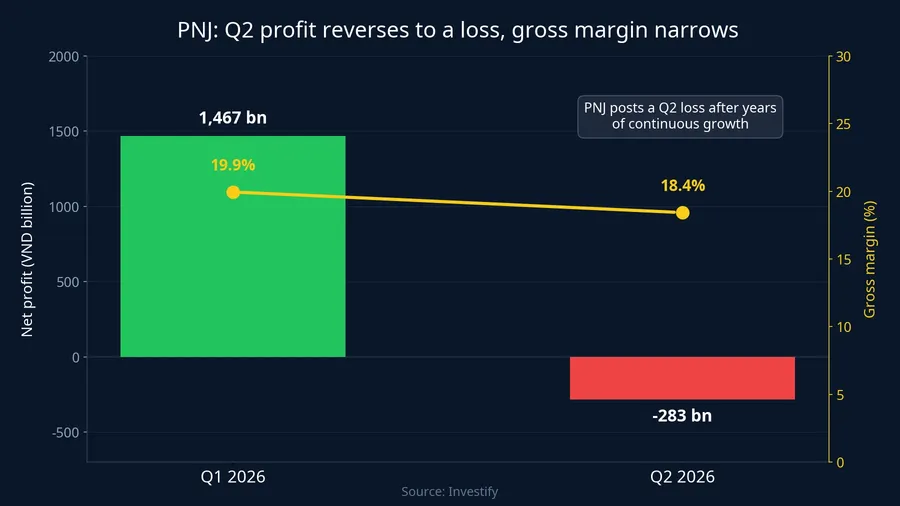
Three other indicators deserve more attention than the headline profit figure. Gross margin in Q2 fell to just 18.43%, down from 21.48% a year earlier, reflecting a growing share of low-margin 24K gold in the revenue mix, a structural pressure that exists independently of the diamond case. Inventory at the end of Q2 stood at VND 15,149.4 billion, higher than in Q1. And operating cash flow in Q2 was negative VND 1,568.2 billion, a reversal from a positive VND 3,557.8 billion in Q1, as the company had to pay cash to buy back products from customers. PNJ itself has said the product buyback activity could continue to affect Q3 results.
How to read this signal
Two long-running asset managers crossing the 5% threshold is a real, notable data point. As of August 20, PNJ's P/E ratio stood at approximately 6.58x, below even the 9.38x level that represents one standard deviation under its 10-year average.Tuổi Trẻ At that valuation, the two funds had grounds to treat the diamond shock as a one-time risk rather than a fundamental change in the business's value.
But the gap between institutional funds and retail investors isn't about who read the situation correctly. It's about cost of capital and time horizon. T. Rowe Price manages roughly $1.86 trillion, so its PNJ position is a tiny sliver of a global portfolio that can sit for years. Sprucegrove has held PNJ before, trimmed its stake, and come back; for a fund like that, a three-year cycle is routine. For a leveraged retail investor, three months already feels long. On top of that, when the funds bought on August 13, 14 and 19, prices sat in the VND 35,000–36,500 range. Anyone buying after August 21 is paying 15% to 20% more for the same story, and the most easily quantifiable piece of legal risk has already been resolved.
A cheap entry point and a strong institutional signal don't cancel out the structural pressure already visible in the numbers: a narrowing gross margin, rising inventory and negative operating cash flow are three issues independent of the diamond case, and none of them has been resolved yet in Q3. A reasonable watchlist for the period ahead has three specific markers. First, the October extraordinary shareholder meeting, where management must disclose the revised business plan and the remaining provision balance. Second, the Q3 financial report, particularly operating cash flow and gross margin, not just the net profit line. Third, further ownership disclosures from these same two fund groups, since whether they hold steady or keep adding after the meeting is what will actually confirm the long-term thesis they just bet on.
A strong institutional signal doesn't substitute for an answer to how far core profitability recovers. The October meeting and the Q3 report are where that answer shows up.