


Look at the headlines and the week of August 24-28, 2026 was a good one across all three channels Vietnamese retail investors use most: the VN-Index had its strongest week of the month, SJC gold bars closed higher than they opened, and 12-month savings rates stayed above 6% a year at several banks. All three statements are true. The problem is that all three overstate the money that actually landed in the account of whoever put capital in.
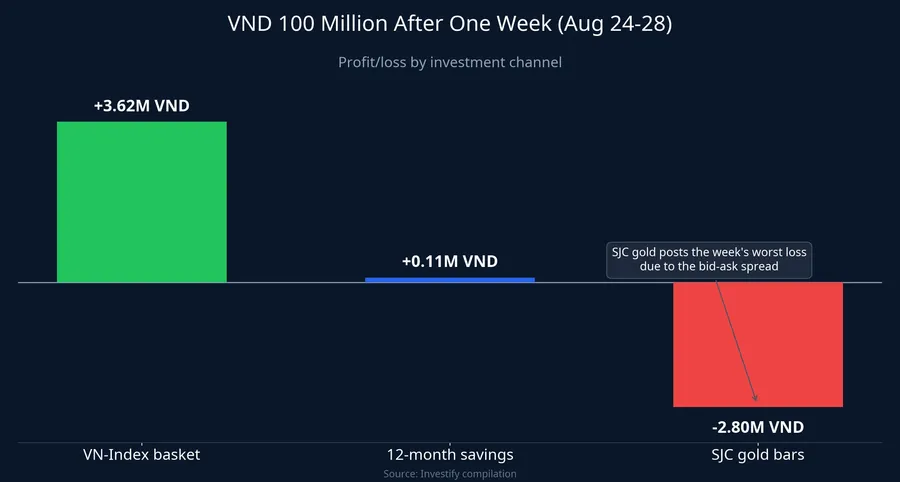
For a fair comparison, put exactly VND 100 million into each channel over those same five sessions. Buy the VN-Index basket and the account gains roughly VND 3.62 million. Deposit into a 12-month savings account at a state-owned bank paying 5.90% a year and the balance ticks up by about VND 113,000. Buy SJC gold bars on the morning of August 24 and sell them back on the afternoon of August 28, and the account loses VND 2.8 million. The gap between the best and worst outcome is VND 6.42 million on the same capital, over the same five trading days.
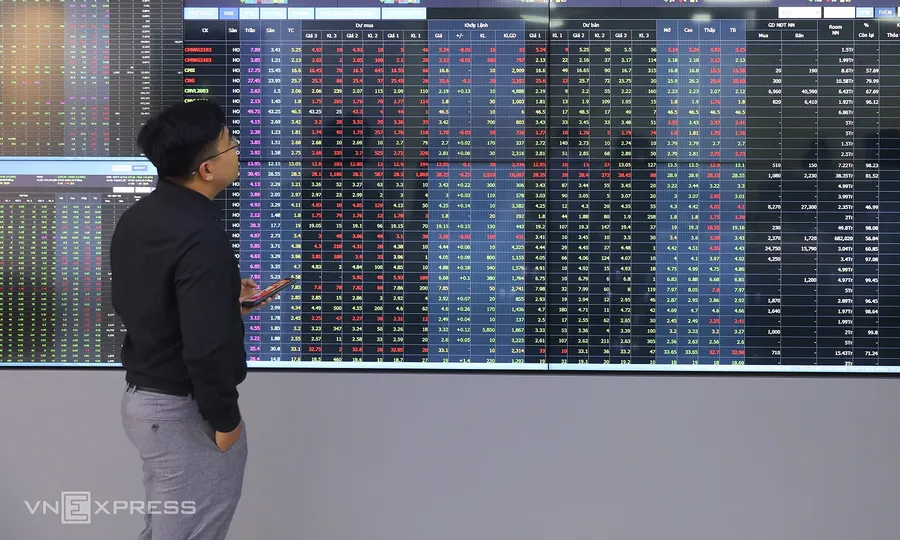
Stocks: the index is not a portfolio
The VN-Index closed the week at 1,832.12 points, up 64.00 points from 1,768.12 on August 21, equivalent to +3.62%: its strongest week in August. But that number only holds for whoever owned the right basket of index stocks.
Look under the hood and the picture changes. Of 1,568 tickers with a full week of data, only 465 gained (29.7%), while 555 fell (35.4%). The median return across all those tickers was 0.00% and the average was -0.37%. An investor who randomly pulled a handful of names from last week's board most likely broke even or took a small loss, even as the index added 64 points.
The dispersion runs even wider: the weakest 10% of stocks fell 6.26%, the strongest 10% gained 4.55%, a 10.81 percentage-point spread in just five sessions. The index was pulled up by a narrow group of heavyweights, led by banks, which traded VND 30,327 billion and gained 1.60% for the week. Anyone not holding that group didn't get a 3.62% week in their own account, no matter what the headlines said.
Gold bars: the loss is baked into the spread
SJC gold bars show the widest gap between headline and actual outcome, because the loss is built into the price structure itself, not caused by the market moving down.
SJC's sell price on August 28 was VND 150.2 million per tael, against a buy-back price of VND 147.2 million on the same day. The VND 3 million spread per tael, close to 2% of the transaction value, is what the jeweler keeps. Buyers absorb that cost the moment they hand over money, before the price moves in either direction. Buy a tael at the VND 150.0 million sell price on the morning of August 24, sell it back at the VND 147.2 million buy price on the afternoon of August 28, and the result is a loss of VND 2.8 million (1.87%), even as every headline that week reported SJC gold rising. On the morning of August 29, SJC cut both prices by another VND 1.5 million per tael, to VND 145.7 million buy and VND 148.7 million sell, pushing the loss for anyone holding through Saturday morning to VND 4.3 million per tael.
The world price story is more complicated than a single explanation. Global gold prices moved sideways for the week, from USD 4,607.35 to USD 4,596.29 per troy ounce (-0.24%), but most of the decline was packed into the final session. On August 28 at Jackson Hole, Fed Chair Kevin Warsh (US Federal Reserve) said inflation remained above the 2% target and the central bank "still has work to do" if it isn't confident about the disinflation path, implying a possible rate hike.CNBC Markets immediately repriced: the odds of a Fed rate hike in September jumped from roughly 35% to nearly 60%.Fili But gold had already turned lower before the speech, falling 1.38% on August 26 after peaking the week at USD 4,658.11 per troy ounce on August 25, and part of the late-week decline was also attributed to weaker US consumer confidence data. The available evidence isn't enough to split exactly how much of the drop came from Warsh's remarks versus the confidence data, but both work through the same channel: rising yields and a stronger dollar make gold, a non-yielding asset, less attractive.

Domestic gold also lags world prices by a beat. While the converted world price sat nearly flat for the week, SJC's price kept climbing, widening the premium of SJC over the converted world price from roughly 1.4% on August 21 to roughly 3.9% on August 28. That premium is risk that falls on whoever buys last, since it tends to narrow once the domestic market catches up with the world price. The VND 1.5 million cut on the morning of August 29 was the first sign of that narrowing.
Savings: the most certain number, also the slowest
Savings deposits are the one channel where the advertised rate equals the rate you actually receive, as long as you hold to maturity.
Per the rate sheet published August 28, Vietcombank, BIDV and VietinBank all listed 5.90% a year for 12-month over-the-counter deposits.Thương hiệu và Công luận Online deposits at Agribank and BIDV earned 6.80%. The highest rate available to individual depositors under VND 1 billion was around 7.00%, and it always came with conditions: a specific product, a specific channel, or a promotional rate for only the first six months of the term.

The price of that certainty is time. Over exactly one week, VND 100 million deposited at 5.90% a year earns roughly VND 113,000; to make up the VND 2.8 million a gold buyer lost that same week, a savings account would need to run for nearly six months at the same rate. And if withdrawn early, accrued interest gets recalculated at the demand-deposit rate, effectively close to zero.
Open-end funds: they solve stock-picking, not market risk
For investors without the time to track the board every week, open-end fund certificates are the most commonly cited alternative, since they remove the need to pick stocks or time entries. Eight months of 2026 data show that path solves one problem, not every problem.
From the start of the year through August 28, the VN-Index rose 2.67%, from 1,784.49 to 1,832.12 points. Among the 34 equity open-end funds with full year-to-date data, the average return was -4.79%, with only 6 funds posting a gain; the top performer, VNDAF, returned +1.50%, while the worst, DCDE, fell 18.19%. The group of 9 balanced and multi-asset funds averaged -6.39%, led by VCBF-TBF at +0.32%.
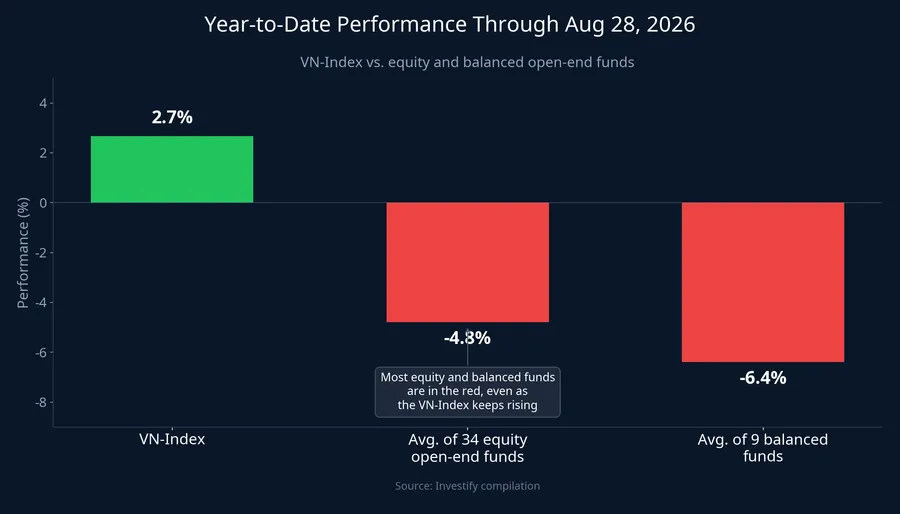
Two takeaways stand out here, and both cut against common expectations. First, not a single fund in either group beat the VN-Index over the first eight months of the year, so the assumption that "handing money to a fund manager guarantees beating the index" has no basis in the current period. Second, the gap between the best and worst equity fund runs to nearly 20 percentage points, meaning picking the right fund matters almost as much as picking the right fund category. Open-end funds shift the stock-picking work to a professional portfolio manager, along with management fees and transaction costs. They do not erase the volatility of the underlying market.
The decision is the time horizon, not last week
The week of August 24-28 doesn't prove one channel is better than another. It shows that each channel carries its own gap between the headline number and the number that lands in an account: stocks lose it in market breadth, gold bars lose it in the bid-ask spread, savings lose it in the time capital stays locked up, and funds lose it in fees and in picking the right fund.
An allocation framework should therefore track when the money is actually needed, not which channel rose the most last week. Money that must be spent within 12 months fits savings deposits best, since that's the only channel that tells you the ending number in advance. Money that can stay invested for several years has more room in stocks or fund certificates, since only that time horizon is long enough for growth to outweigh entry and exit costs, and weeks as volatile as this one. Gold bars, with a VND 3 million spread per tael, all but rule out weekly trading; if gold has a place in a portfolio, it belongs there as a long-term store of value, not a short-term trade.
Vietnam's stock market is closed from August 31 to September 2 and reopens on the morning of September 3. US jobs data due in early September will be the next test for the nearly 60% odds markets are now pricing for a September Fed rate hike: weak data could push those odds back down, while strong data would reinforce them further. That's the variable most worth watching, since it drives both the gold price and foreign capital flows into stocks over the coming weeks.