

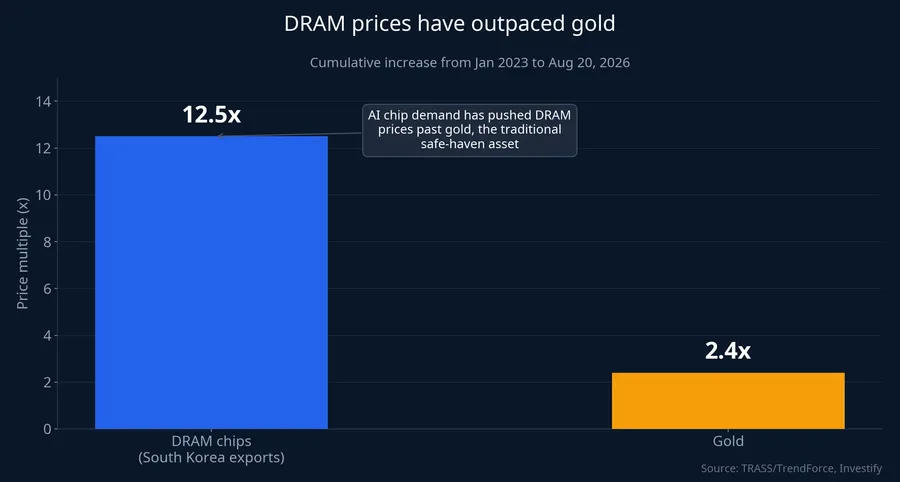
Since January 2023, when ChatGPT went mainstream, South Korea's DRAM export prices have risen 12.5-fold.TrendForce In the first half of August 2026, South Korea's average DRAM export price, excluding finished memory modules, reached $92,183 per kilogram, up 401% year-on-year, according to Korea's Trade Association Statistics Service (TRASS).Thanh Nien A kilogram of exported memory chips is now worth roughly as much as 620 grams of 24K gold, while gold itself gained only 2.4x over the same stretch. That comparison doesn't mean memory chips are literally worth more than gold by weight; it just shows how fast the gap between the two assets has closed.Wccftech
For Vietnamese investors, the more useful question splits in two: who is paying for this surge right now, and who gets paid back, but only later.
The shortage isn't coming from lower sales
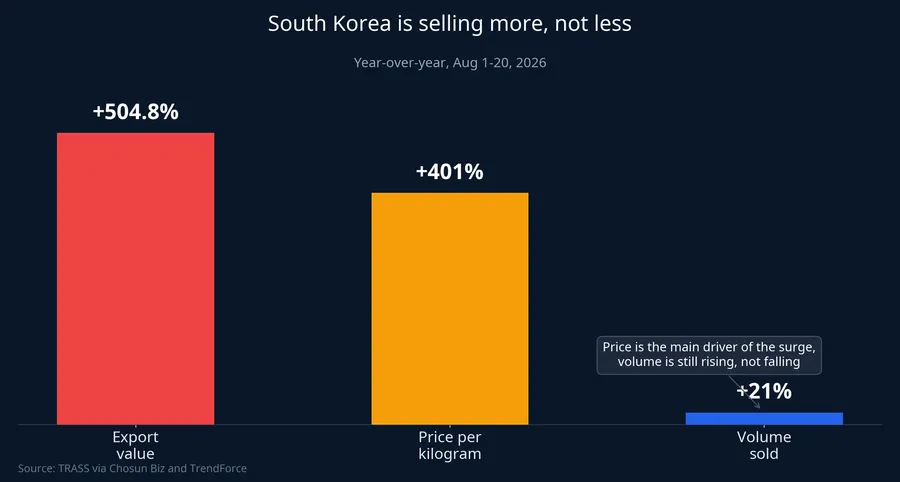
The instinctive read on any commodity that jumps by multiples is a supply shock: a plant shuts down, a shipping route gets blocked. South Korea's trade data tells a different story. Over the same window, August 1-20, 2026, South Korea's DRAM export value hit $9.8 billion, up 504.8% year-on-year.TrendForce Because value grew faster than unit price, the gap between the two figures implies volume sold, measured in kilograms, actually rose by roughly a fifth, not fell.
South Korea is exporting more memory chips than it did last year, and the consumer market is still starved for supply. The space between those two true statements is the real substance of this price surge.
AI is first in line, consumers are last
The mechanism comes down to who stands at the front of the queue. An AI server needs 8-10 times more DRAM than a conventional server, and AI infrastructure demand alone already consumes more than half of global DRAM output. Even before high-bandwidth memory (HBM) enters the picture, data center demand is enough to eat into the supply meant for phones and PCs.

HBM tightens the squeeze further in a way that gets less attention than it should. It's memory built by stacking 12 to 16 layers of DRAM chips, a more complex process with a lower yield of chips that pass quality control, so every wafer diverted to HBM production yields far less usable capacity than the same wafer making standard DRAM.
The dominant force here is economics, not engineering. Every wafer used for AI-grade HBM earns 3 to 5 times more than the same wafer making consumer DRAM, and that revenue is already locked in through multi-year contracts with AI chipmakers and major data center operators. Samsung, SK Hynix and Micron have shifted more than 70% of capacity to AI chips; Micron has gone as far as exiting the consumer market entirely and retiring its Crucial brand. Coffee and oil prices rise when output falls short of demand. Memory chip prices are rising because manufacturers are actively choosing their customers, and ordinary consumers aren't the customers being chosen.
Reading the 401% figure correctly
Part of that 401% comes from how the number is measured, not from pure price appreciation. A standard DRAM chip's capacity has doubled, from 8Gb to 16Gb, as manufacturing has advanced, so the same kilogram of silicon today carries more capacity than it did before. Export mix has also shifted heavily toward HBM and server-grade DRAM, which carry a higher value per unit of weight than consumer-grade DRAM, so the average price per kilogram also reflects that mix shift, not price appreciation alone.
The independent evidence for real price appreciation sits in contract pricing: the same product, measured quarter to quarter, with no mix effect involved. Per TrendForce, server DRAM contract prices rose a cumulative 64% in the second half of 2025 and are forecast to rise a further 270% in 2026; in Q2 2026 alone, server DDR5 prices rose 53-58% quarter-on-quarter.TrendForce That confirms the increase is real, even if the 401% headline figure is amplified somewhat by the way it's measured, by weight.
The industry hasn't reached consensus on when supply and demand will rebalance. SK Hynix CEO Kwak Noh-jung forecasts 2027 will be the worst year in the industry's history from a supply standpoint, with demand potentially outstripping supply even beyond 2030.Tom's Hardware Micron Technology CEO Sanjay Mehrotra calls the current shortage structural rather than cyclical.Yahoo Finance More cautiously, JPMorgan Global Research warns that a slowdown in AI capital spending is the biggest risk to the memory chip industry, since the entire cycle rests on capex from a narrow group of customers.JPMorgan The three views aren't contradictory; they simply differ in how much confidence to place in a growth cycle that depends this heavily on one narrow customer base.
Vietnam pays first, gets rewarded later
For domestic distributors and retailers, the payoff from this price surge already shows up in Q2 2026 financial results. Digiworld posted first-half net revenue of over VND 15,773 billion, up 40% year-on-year, while after-tax profit came in above VND 509.6 billion, up 130%, meaning profit grew far faster than revenue.Tin nhanh chung khoan In the laptop and tablet segment specifically, average selling prices rose about 20% as RAM and component costs stayed elevated, while a portion of inventory was still sourced under older, cheaper contracts. DGW shares closed the August 28 session at VND 42,200 (DB: DGW).
Mobile World Investment (MWG) also posted a group-wide gross margin of a record 22.2% in Q2 2026, up 2.1 percentage points year-on-year, which lifted net margin from 4.4% to 6.8%.Elibook MWG shares closed the August 28 session at VND 75,000 (DB: MWG).
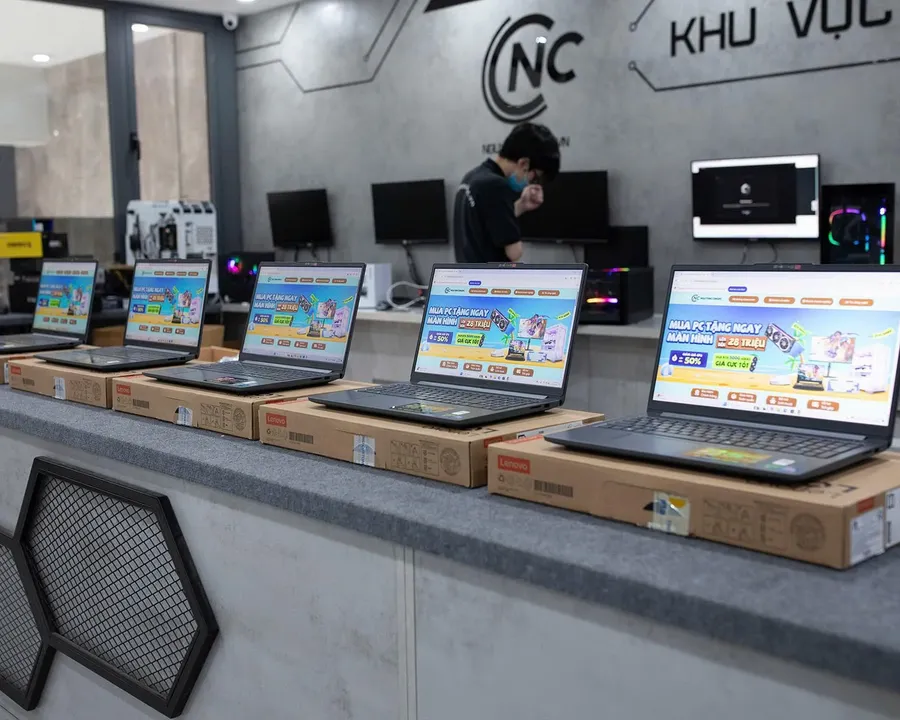
The point investors should take away: both companies' current gains come from the gap between new selling prices and older, cheaper inventory. That's a temporary edge. Once chip prices cool, or once high-priced inventory gradually replaces the cheaper stock, that same edge flips into margin pressure.
Vietnam packages by the ton, not by chip value
Vietnam doesn't manufacture memory chips. Vietnam packages and tests them: it receives finished chips from fabrication plants, encases them, attaches the contact pins, runs quality checks, and ships them back to the customer.
The largest facility is Amkor's plant in the Yen Phong II-C Industrial Park in Bac Ninh, with total investment of $1.6 billion. The company is seeking approval to triple maximum capacity, from 1.2 billion to 3.6 billion units a year, equivalent to raising output from 420 to 1,600 tons annually, with the line installation timeline running through Q3 2027.VnExpress In Bac Giang, Hana Micron Vina runs northern Vietnam's first semiconductor plant, packaging and testing chips for Samsung and SK Hynix directly.Bao Dau Tu
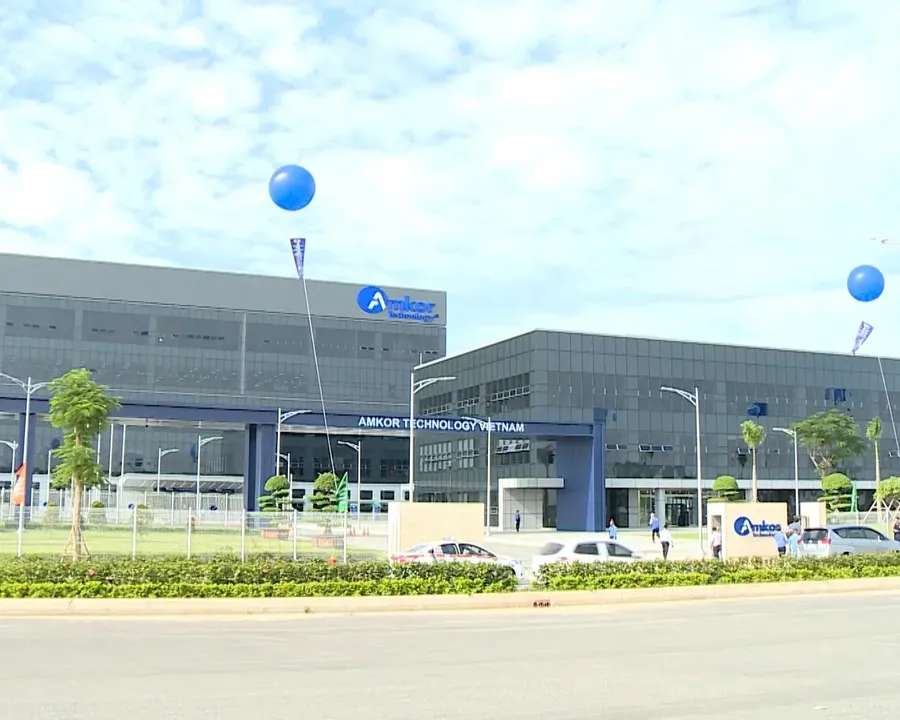
This is where a reasoning trap opens up. Vietnamese plants measure output in tons and units, while South Korea's DRAM prices are measured in kilograms. The two units line up neatly enough that it's tempting to multiply them together, and the result would be completely wrong. Packaging and testing plants are paid a processing fee per unit handled, not a percentage of the value of the chip inside; the chip itself remains the customer's property throughout. So a 401% jump in DRAM prices doesn't translate into a proportional revenue jump for packaging operations in Vietnam. What actually drives revenue up is the number of chips moving through the line, and that number only rises once new capacity comes online. In other words, Vietnam pays for this price surge in real time, and collects its reward on a construction timeline.
The payoff is arriving, just slowly
Capital flows are a more reliable signal of Vietnam's upside here than chip prices themselves. In the first seven months of 2026, total registered FDI into Vietnam reached over $38 billion, up 58% year-on-year, with processing and manufacturing continuing to account for the bulk of it.VTV Every new semiconductor project announced this year falls into the packaging and testing category.
Samsung is weighing an investment of roughly $4 billion in a chip packaging plant in Thai Nguyen, alongside a separate plan worth roughly $1.5 billion for Vietnam's first chip testing facility.MarketTimes LG Innotek is investing $1 billion to build a semiconductor substrate plant in Hai Phong, expected to be operational from 2027.Fili Both commitments were made during precisely the stretch when memory chipmakers have been at their most profitable.
It's worth acknowledging that this capital isn't flowing in solely because of the memory chip boom. Supply chains shifting out of China, labor costs, and incentive policies from northern provinces are all contributing factors, and some of these projects were in the pipeline before DRAM prices took off. The current price surge is likely accelerating disbursement more than it's creating investment decisions from scratch, though there's no clean way to separate out exactly how much each factor contributes.
Three signals worth watching
For individual investors, this cycle is in its middle innings, not its early stage. Most of the price gains have already fed through into the earnings and valuations of the companies benefiting from them. Three signals are worth tracking in the months ahead.
Spot prices for DDR4 and DDR5 are the earliest signal. In April 2026, spot prices for 16GB DDR4 modules fell about 5%, the first monthly decline since February 2025, even though prices remained many multiples higher than a year earlier. If that decline extends into a second and third month, it's a more reliable signal than any long-range forecast.
The pace of line installation at Amkor's Bac Ninh plant, targeted for completion in Q3 2027, determines when Vietnam actually starts capturing a larger share of this value chain.
The pace of capital spending among cloud service providers is the most dangerous variable of all. If that pace slows just as Samsung and SK Hynix's new capacity comes online starting in 2027, an oversupply scenario could arrive very quickly, and distributor stocks still holding high-priced inventory would be the first to feel the impact.
Within a sub-one-year horizon, monthly spot prices remain the most reliable signal. They move before contract prices, before earnings reports, and before any long-range forecast gets published.