


In mid-August, a portfolio disclosure from the Bill & Melinda Gates Foundation Trust got read by most US financial outlets exactly one way: the fund had cut $818.9 million worth of Berkshire Hathaway stock.Yahoo Finance But that same filing also showed Berkshire remains the single largest position in the trust's portfolio, which means the two details never contradicted each other, they're just two halves of the same document.The Motley Fool Most headlines online only grabbed the first half for the click.
Why "big money sold, so I should worry" is a reasonable instinct
Plenty of individual investors read the moves of large institutions as a buy-sell signal, and that instinct isn't unreasonable. Big funds run dedicated research teams, get access to company leadership, and operate on a longer time horizon than retail investors. When a fund that has stood by Warren Buffett, Chairman of Berkshire Hathaway (BRK.B), for two decades suddenly trims his signature stock, the natural reflex is to assume they saw something.
The catch is that a quarterly portfolio disclosure (a 13F) only tells you how the portfolio changed. It never tells you why.
What the filing actually shows
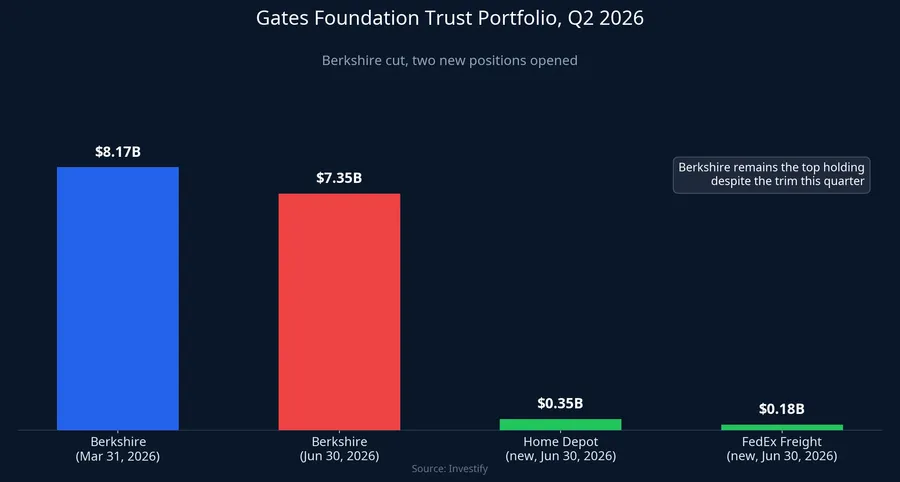
In Q2 2026, the trust run by Bill Gates, Chairman of the Gates Foundation and co-founder of Microsoft (MSFT), sold 2.4 million shares of Berkshire Hathaway, a 14% cut that left it holding 14.7 million shares. The position's value fell from $8.17 billion at the end of Q1 to $7.35 billion as of June 30.Yahoo Finance
The same quarter, the trust opened two new positions: one million shares of Home Depot worth $352.68 million, about 1% of the portfolio, and nearly 1.2 million shares of FedEx Freight Holding worth roughly $180 million, bought right after the company spun off as an independent listing on June 1, 2026.Yahoo Finance The total portfolio grew from $31.67 billion across 22 holdings to $34.42 billion across 24.
Put side by side: $818.9 million came out of Berkshire, and only about $533 million went into the two new positions. The gap didn't chase another stock.
The fund sells because it has to
In Q1 2026, the same trust sold off its last 7.7 million shares of Microsoft, worth roughly $3.2 billion.The Motley Fool That's stock in the company Bill Gates himself co-founded, wound down gradually over two years from nearly 28.5 million shares. Yet no serious analyst read it as a bearish call on Microsoft, because the reason for selling sits in the trust's charter, not in the company's outlook.
In May 2025, the Gates Foundation announced it will spend $200 billion over 20 years and shut down by December 31, 2045, with annual giving rising to $9 billion starting in 2026.Gates Foundation An organization committed to spending down its entire endowment in two decades treats selling stock as routine cash-raising, not an investment call.
There's a change on the inflow side too. On July 14, 2026, Warren Buffett excluded the Gates Foundation from his annual gift of Berkshire shares for the first time in roughly twenty years.CNBC Nearly $6 billion in Berkshire stock was redirected to four funds bearing the Buffett family name instead, while law firm WilmerHale reviews the foundation's past ties to Jeffrey Epstein, a convicted sex offender who died in 2019. That gift happened after Q2 had already closed, so it isn't the cause of this quarter's sale, but it confirms the inflow of Berkshire stock into the trust has stopped: what it still holds now only has one direction to go, sold down gradually to fund grants.
Meanwhile, Berkshire itself is buying at its strongest pace in years
If the Gates trust selling is a negative signal about Berkshire, Berkshire itself sent the opposite signal in the very same quarter.
Greg Abel, CEO of Berkshire Hathaway (BRK.B), took the helm on January 1, 2026. In Q2, the conglomerate spent $4.5 billion on share buybacks, up from just $235 million in Q1, and bought nearly $20 billion in stock net after 14 straight quarters of net selling.CNBC Cash and Treasury bills fell from a record $397.4 billion on March 31 to $365.5 billion on June 30.The Motley Fool That capital flowed into the $9.7 billion OxyChem deal, the $8.5 billion Taylor Morrison deal, and a standalone $10 billion stake in Alphabet.
In other words, a longtime shareholder trimmed its position to fund its own spending needs, while the company's own management bought in at its strongest pace in years. Both are true, and reading only one half produces two entirely opposite conclusions.
None of this means Berkshire is cheap. BRK.B shares are up only about 3% year-to-date through mid-August 2026, well behind the S&P 500's 13%-plus gain, largely due to the leadership transition and a tech-heavy rally pulling the index up. That's a separate valuation debate, entirely independent of how many shares the Gates trust sold this quarter.
Forty-five days after it's already over
13F filings are due within 45 days of quarter-end. The portfolio snapshot is dated June 30, the filing deadline is August 14, and the news cycle clusters around mid-August. An investor reading the story on August 17 is looking at a portfolio that's already seven weeks stale, with no way to know what the institution has bought or sold since.
The Home Depot position illustrates the lag well. The trust bought its one million shares sometime between April and June. It wasn't until mid-August that Home Depot reported quarterly results that beat forecasts, though the company kept its full-year guidance unchanged rather than raising it. Some headlines strung these two events into a backwards cause-and-effect story, as if the trust bought because it foresaw strong results. In reality the trust bought first, the earnings came later, and anyone copying the trade off the news bought after both.
The same problem shows up in Vietnam's market
Vietnamese retail investors don't read 13F filings, but they do check the foreign net-flow tally every session, and the interpretation tends to be identical: if they're selling, I should worry.
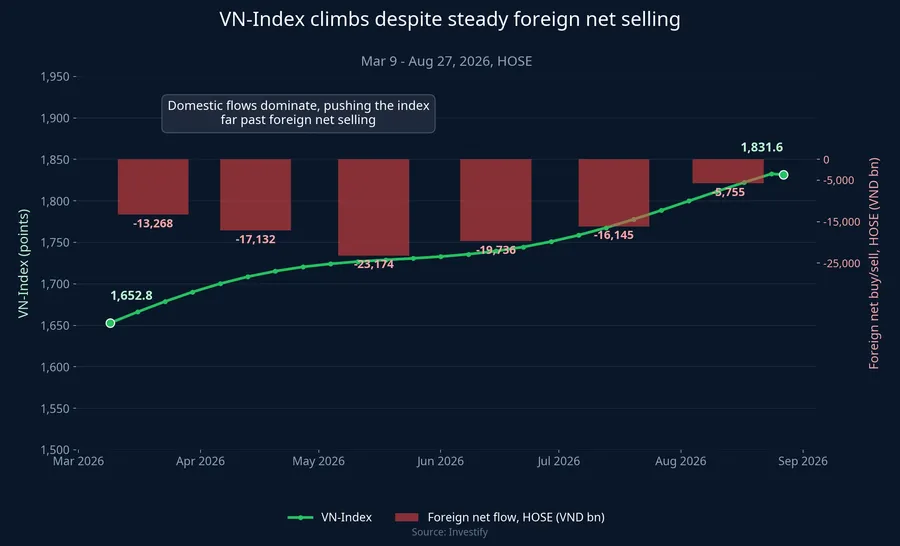
From March 9 to August 27, 2026, foreign investors net sold VND 95,209 billion on HOSE, with 103 of 121 sessions logging net selling. Over that same window, the VN-Index climbed from 1,652.79 points to 1,831.56 points, a gain of 10.8%. Anyone who treated the prolonged selling streak as a reason to stay out missed the entire rally.
That signal is also carrying less weight over time. Foreign investors' share of total market trading value fell from about 33% back in March to 28.11% in the August 27 session. In August alone, net selling shrank to just VND 5,755 billion, roughly a quarter of May's peak. By the end of July 2026, the market counted nearly 13.66 million trading accounts, about 99.5% of them domestic retail.Vietstock Liquidity support has changed hands.
How to read a portfolio disclosure correctly
The more accurate takeaway isn't "ignore big institutions." It's that a portfolio disclosure tells you what changed, and never tells you why.
Before treating any institutional move as an investment signal, three things are worth checking, in this order. First, the seller's constraint: is the fund selling to fund payouts, to meet redemptions, or to rebalance against an index. Second, the lag: how stale is the data you're reading, and how much has the price already moved since. Third, the remaining weight: trimming 14% while still holding the top spot is a completely different story from exiting entirely.

For individual investors, the sensible standard is rebalancing on your own schedule and against valuation thresholds you set in advance, not on someone else's disclosure calendar. The Gates trust is selling Berkshire on its own spending schedule through 2045, and that schedule isn't yours. The same logic applies to foreign net-selling on HOSE: it reflects the specific constraints of that pool of capital, not a single vote for the whole market.
Worth watching in the coming weeks: whether foreign net selling keeps shrinking the way it has since May, and whether that group's share of trading value stabilizes around 28% or falls further.