


On August 26, 2026, Trương Công Thắng, CEO and Board Member of Masan Consumer Corporation (HOSE: MCH), completed the purchase of 2.7 million MCH shares, exactly matching the volume he had registered.MekongASEAN The deal lifted his stake from more than 4.1 million to over 6.8 million shares, taking his ownership from 0.315% to 0.522% of charter capital.MekongASEAN The registration window ran from July 28 to August 26, opening just days after HOSE announced the new VN30 basket on July 15 (effective August 3), with MCH included for the first time.Vietstock
For many retail investors, a headline like this reads as a shortcut conclusion: insiders are putting real money in, so the stock must be worth buying. That belief has a real basis, and it deserves a fair hearing before being checked against what actually happened to MCH.

Where that belief comes from
August has genuinely been a month of insider buying. Per Dân trí's August 26 tally, executives across listed companies bought over 100 million shares worth more than VND 1,800 billion, spanning PNJ, VCI, KBC, HPX, KDH, VBB, and ANV.Dân trí Tô Hải, Board Member at Vietcap Securities, alone spent roughly VND 674 billion accumulating more than 31 million VCI shares.Dân trí
The bullish case is straightforward. Nguyễn Thế Minh, Head of Investment Banking and Deputy Head of Business at An Binh Securities, argues executives buy when a stock is cheap, buy to cushion prices when foreign and retail investors are both selling, and that the move itself builds market confidence. He points to PNJ, whose share price has risen roughly 40% from the VND 31,000 level on the day its CEO began buying.Dân trí Trương Hiền Phương, Senior Director at KIS Vietnam Securities, adds that management knows the business best, so buying implies the price sits below intrinsic value.Dân trí
Nothing about that logic is wrong, but it holds on average over the long run, while retail investors tend to apply it to decisions made in a matter of weeks. MCH shows that gap most clearly.
What the data at MCH actually shows
Thắng's buying window overlapped almost exactly with MCH's entry into VN30, precisely when the stock should have benefited most from index-tracking flows. The actual result ran the other way.
On July 28, the day the registration period opened, MCH closed at VND 138,900. By August 26, the last day of the window, the price was VND 141,900, up 2.16%. Over the same stretch, the VN30 index climbed from 1,824.35 to 1,970.01 points, up 7.98%. In other words, in the exact month the executive bought his full registered lot, the stock trailed the index it had just joined by nearly 6 percentage points.
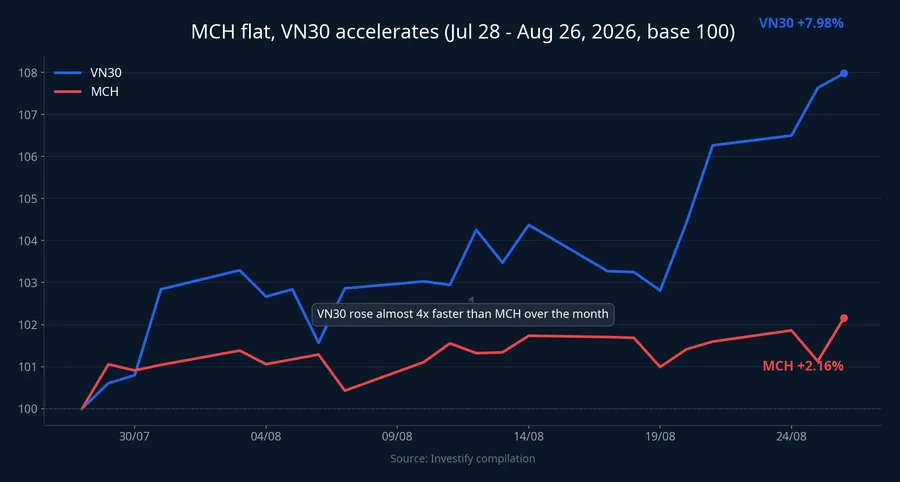
August 3, the day the new VN30 basket took effect, delivered an even sharper contradiction. MCH fell 2.34% to VND 137,700, its steepest drop of the whole period, while VN30 rose 2.44%. Foreign inflows into MCH also arrived early rather than on the effective date: foreigners bought a net VND 77.1 billion on July 28 and VND 75.5 billion on July 30, then sold a net VND 18.9 billion on August 3 itself.
MCH did recover late in the window, rising from VND 136,600 on August 19 to VND 141,900 on August 26, a gain of 3.88%. But crediting that entire move to the CEO's buying ignores several other explanations unfolding at the same time. Masan Consumer paid out more than VND 2,614 billion in a 20% cash dividend advance settled on August 19.MekongASEAN On August 21, FTSE Russell added both MCH and MSN to the small-cap segment of the FTSE GEIS index series.MekongASEAN And on August 26, the broader market rallied, with the VN-Index adding 29.91 points. The available data isn't enough to isolate how much of that late rally came from the insider trade itself.
Why a registration isn't a commitment
What retail investors tend to overlook is the gap between registering to buy and actually buying. Across insider trading data for 2025 and 2026, the market recorded 1,581 buy registrations with disclosed volumes. Of those, 674 ended in a partial buy or no buy at all, roughly 43%.
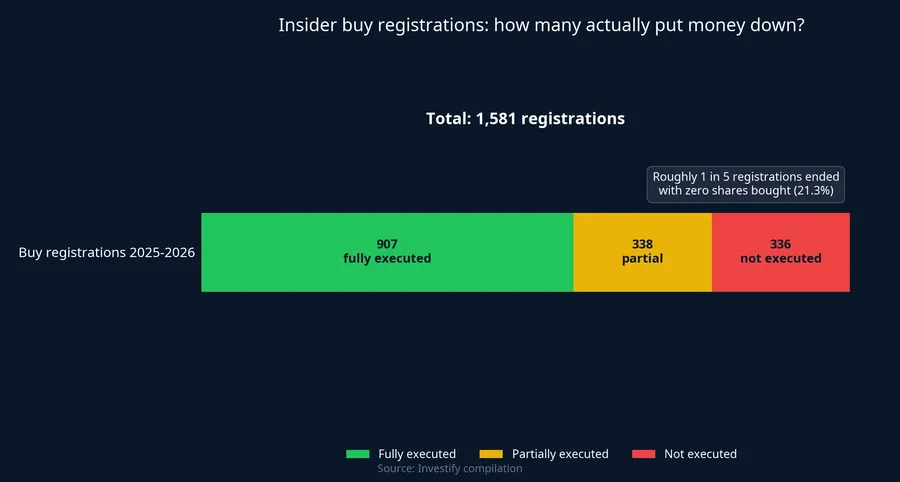
Break it down further and the picture sharpens. 336 registrations resulted in zero shares purchased. 338 were only partially filled. By volume, these shortfalls registered about 1.89 billion shares but executed only 0.59 billion, meaning nearly 69% of registered volume was never bought. The "not executed" group has also been thickening over time, from 31 cases in Q1 2025 to 68 cases in Q3 2026.
Legally, none of this is a violation. Insiders must register at least 3 trading days before a planned transaction and report results no later than 10 days after it ends, under the 2019 Securities Law, Decree 155/2020, and Circular 96/2020. If they fall short, the only obligation is to disclose a reason. Regulatory penalties target undisclosed trading, not the act of registering and then not buying, even after Decree 306/2025 (effective January 9, 2026) raised fines and extended trading suspension periods.Fili
The reasons cited for a shortfall tend to be mundane: the price didn't meet expectations, market conditions weren't favorable, or personal financial plans changed. Đoàn Hoàng Anh, daughter of Đoàn Nguyên Đức (Chairman of Hoàng Anh Gia Lai Corporation), once registered to buy 4 million HAG shares and ended up buying none, citing personal financial difficulty.Tuổi Trẻ
The reverse also has precedent. An Binh Securities' expert points back to 2022, when many executives bought in while the market was under pressure and still lost money as their stocks fell with the broader trend. Those who borrowed to fund the purchase faced forced liquidation, as seen at Novaland, Phat Dat, and more recently DIC Corp.

How to actually read an insider trading headline
The risk isn't that Thắng bought MCH shares. He bought his full registered volume, an outcome most registrations on the market fail to reach. The risk is how some retail investors turn this kind of headline into an instant buy signal, skipping three layers of data that should be checked first.
The first layer is which signal to trust. The result report, filed no later than 10 days after the trading window closes, is the reliable data point, not the initial registration, which only states intent at a single moment in time.
The second layer is the right yardstick. Compare the purchase to the person's existing stake, not to charter capital. For Thắng, 2.7 million shares raised his holding to roughly 1.66x what he owned before the trade, even though his stake relative to charter capital stays under 0.6%. Measured against charter capital, the number looks tiny; measured against his personal position, it's a meaningful increase. Add the context that HOSE applies a 20% free-float ratio to MCH for index weighting, per an August 12 announcement, and this block of shares represents only about 1% of the stock's actual free-floating capital.CafeF
The third layer is separating the insider trade from other events happening at the same time. MCH had multiple forces converging in a single month: the CEO's buying window, the VN30 effective date, a cash dividend payout, and FTSE Russell's index decision. Attributing the entire price move to any one of them is a reading that invites mistakes.
What the data doesn't confirm is that the stock will rise because Thắng bought in. At Thursday morning's close on August 27, MCH sat at VND 141,700, down 0.14%, while the VN-Index was essentially flat at 1,822.66 points. The next signals worth watching are Q3 earnings and how MCH's free-float ratio evolves, two factors far more likely to drive institutional flows than any single insider trade. For other stocks riding a similar wave of executive buying, like PNJ, VCI, or KBC, the same reading framework applies.