


In the early hours of August 27 Vietnam time, Nvidia released its latest quarterly results. Revenue, profit, gross margin, and even next quarter's guidance all beat analyst expectations. The market's first reaction was to sell.
About thirty minutes after the report hit the wires, Nvidia shares fell 1.3% in after-hours trading.Kiplinger Then the analyst call began. CFO Colette Kress gave a single number for fiscal year 2028 — a year that hasn't even started — and the stock reversed, climbing 4.4% in that same after-hours session. Two opposite reactions, less than an hour apart, on the same company during the same earnings call. For investors heading into Vietnam's own earnings season, this is about as clean an illustration as you'll get of a principle that's easy to forget: stock prices don't react to the numbers a company just reported. They react to whichever part of those numbers the market hadn't already paid for.
A report that beat expectations on every line
For the quarter ended July 26, 2026, Nvidia posted revenue of $96.2 billion, up 18% from the prior quarter and up 106% year-over-year. That beat the $92.1 billion analysts had forecast.Nvidia GAAP net income came in at $59.7 billion, up 126%. The data center segment, Nvidia's largest revenue source, brought in $89.0 billion, up 117% year-over-year.Nvidia Large cloud customers contributed $48.7 billion, while the remaining group — AI cloud, industrial, and enterprise customers — brought in $40.3 billion, up 138%.CNBC Next quarter's guidance beat expectations too: Nvidia guided to $108.0 billion, versus the $104.2 billion analysts surveyed by LSEG had expected.Nvidia If it hits that mark, it would be the first time any chipmaker has topped $100 billion in quarterly revenue.
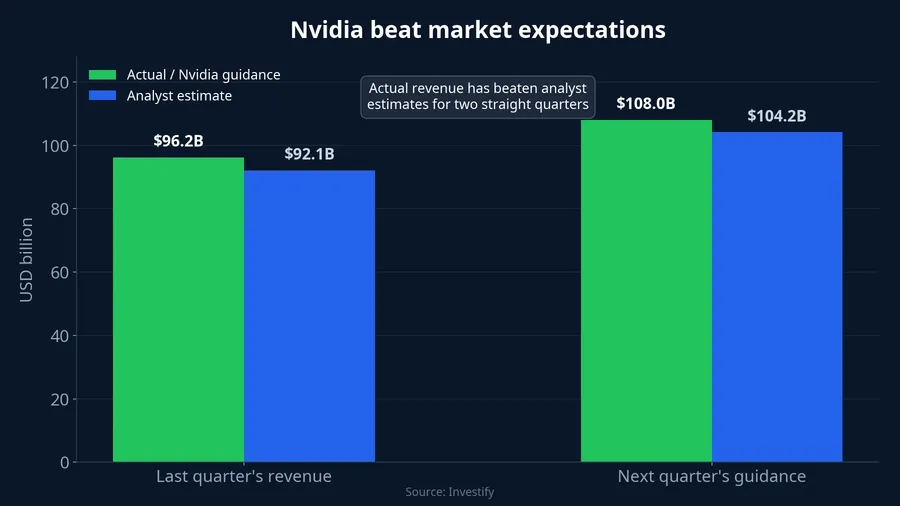
Looking at that scorecard, it's hard to find a reason to sell. Yet the market sold anyway. That's exactly the part worth slowing down to unpack.
Why a beautiful report still couldn't hold the price
The short answer: the beat had already been paid for. For months, Nvidia stock had been bought on the assumption that the company would keep beating forecasts. When that assumption came true, it merely confirmed the current price. It didn't create a new reason to pay more.
This isn't speculation. According to Bespoke Data, cited by CNBC, Nvidia shares have fallen the day after each of its last four earnings reports, even though every one of those reports met or beat estimates on EPS, revenue, and forward guidance.CNBC Four straight beats, four straight declines. The setup heading into this report told the same story: on August 26, Nvidia shares fell about 1% in the final hour of trading — the eighth decline in nine sessions — closing at $209.66, well below the $236.54 high set on May 14, 2026.CNBC

The worry wasn't about Nvidia itself. It was about Nvidia's customers. Google, Amazon, Microsoft, and Meta are together expected to spend roughly $725 billion on capital expenditure in 2026, up 77% from $410 billion the year before.Value Add VC The cost of spending that aggressively is already showing up: both Amazon and Alphabet reported negative free cash flow in the second quarter.CNBC
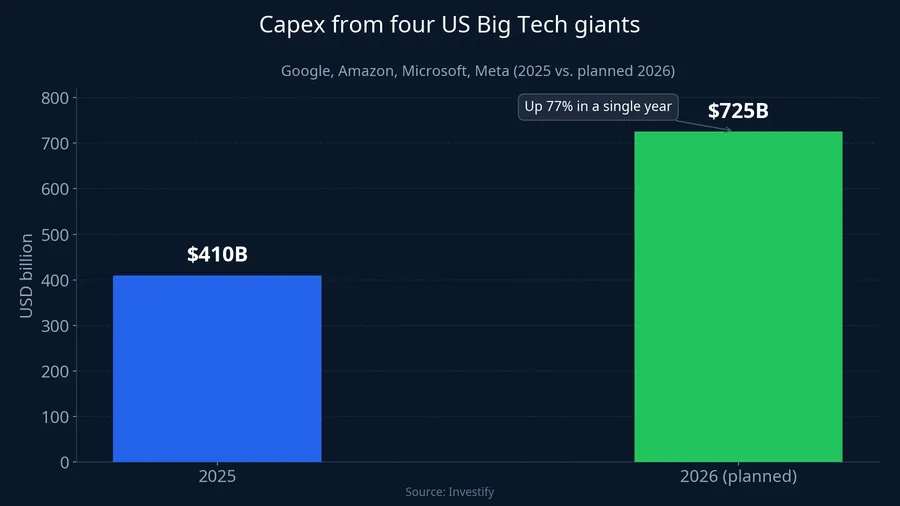
The question hanging over the market, then, wasn't "how much did Nvidia sell last quarter." It was "who still has money to keep buying, and for how long." A quarterly earnings report can't answer that question, because it only describes what already happened.
The sentence that flipped the price
On the analyst call, CFO Colette Kress, Executive Vice President and Chief Financial Officer of NVIDIA Corporation, said the company expects fiscal 2028 revenue to grow roughly 70%, well above the 45% growth analysts had previously modeled for that year. More important than the number itself, she described it as a supply-constrained estimate, not a demand-constrained one. Founder, Chairman and CEO Jensen Huang made the point explicit: the company has enough supply to hit 70% growth, and actual customer demand is running higher than that.CNBC
That's the answer to the question the market had been asking. If 70% is capped by manufacturing capacity rather than customer budgets, the "AI infrastructure spending is about to run out of steam" scenario gets pushed back by at least another year. Kress added that capex from Nvidia's five largest cloud customers is projected to rise to $1.3 trillion next year, up from $800 billion in 2026.CNBC
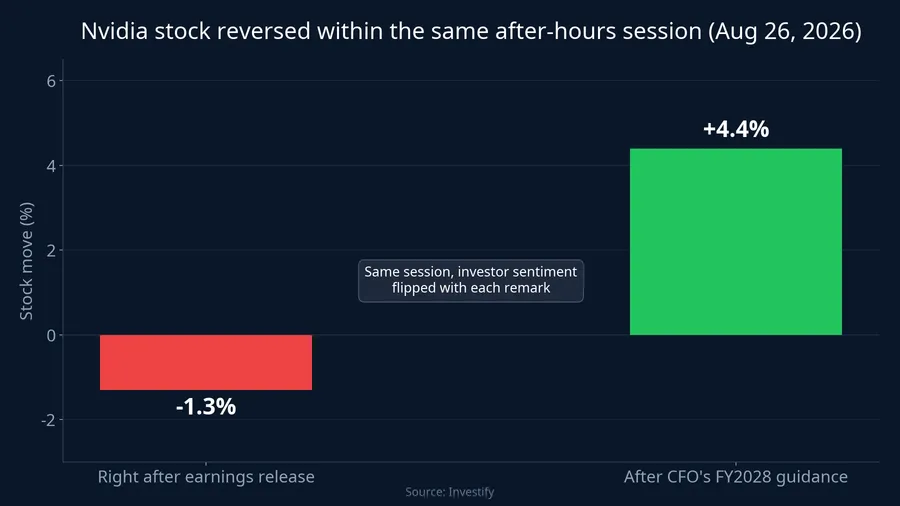
The same call included other news capable of moving the stock on its own, including a $26 billion buyback authorization.CNBC But the timeline points squarely at the revenue guidance: the stock was still down 1.3% right before the call started, and only turned around after the 70% figure was spoken aloud.
What the report doesn't say about demand
The picture isn't entirely rosy, and the risks Nvidia itself flagged deserve more attention than one night's price swing. Gross margin currently sits at 75% and the company expects it to keep sliding, bottoming out in the fourth fiscal quarter in the 71-72% range, partly because memory chip prices are rising.CNBC Kress described the current memory chip shortage as largely caused by the AI infrastructure buildout itself: this wave of investment is driving up its own input costs.
This quarter's report also broke out debt as a standalone risk factor for the first time, disclosing $33.5 billion in outstanding senior notes and a $25 billion commercial paper program, of which $15 billion matures within one to five years, up from just $2.75 billion in the prior reporting period.CNBC China is nearly absent from the revenue picture: the older-generation chips Nvidia is permitted to sell there account for less than 1% of data center revenue.CNBC
What Vietnamese investors should take from that night
Vietnam's own semi-annual and Q3 earnings season is approaching. The lesson here isn't about Nvidia specifically. It's about how to read any earnings report.
First, past numbers only move a price when they diverge from what the market has already paid for. A company that reports 40% profit growth after its stock already ran up 60% year-to-date has merely met the bar the market set, not cleared a new one. Conversely, a stock priced for a bad scenario only needs results that are less bad than feared to bounce.
Second, forward guidance usually carries more new information than the results themselves. For a Vietnamese company, that means the rest of the year's plan, project progress, prices already locked in for the next period, contracts already signed. That's where the market's open question gets answered, and where the price usually reacts hardest.
Third, separate a company's own risk from the risk sitting with its customers. Nvidia is selling extremely well, yet it still got sold off because the market doubts its buyers' spending power. The same lens applies to steel stocks facing the health of the construction sector, industrial-park stocks facing FDI inflows, or brokerage stocks facing overall market liquidity.
As for the direct read-through to Vietnam's own market, be careful with chain reasoning. On August 26, the VN-Index closed at 1,821.32 points, up 1.67%, while FPT rose 2.69% to VND 72,600 per share; the Nasdaq closed nearly flat that same session, down 0.1%. Over the month of August, foreign investors were net sellers of VND 5,773.8 billion on the HOSE, yet the VN-Index still gained 4.93% on the back of domestic flows. A strong night for US chip stocks can lift sentiment generally, but this month's rally in Vietnam has been carried by local money, not global risk appetite.
The signal worth watching over the coming months isn't Nvidia's next quarterly revenue number, which will most likely keep growing strongly. What's worth watching is capital spending plans at its largest customers, and their own free cash flow. That's where the AI supply chain will either stall or keep accelerating, and where stock prices across the sector will react first.